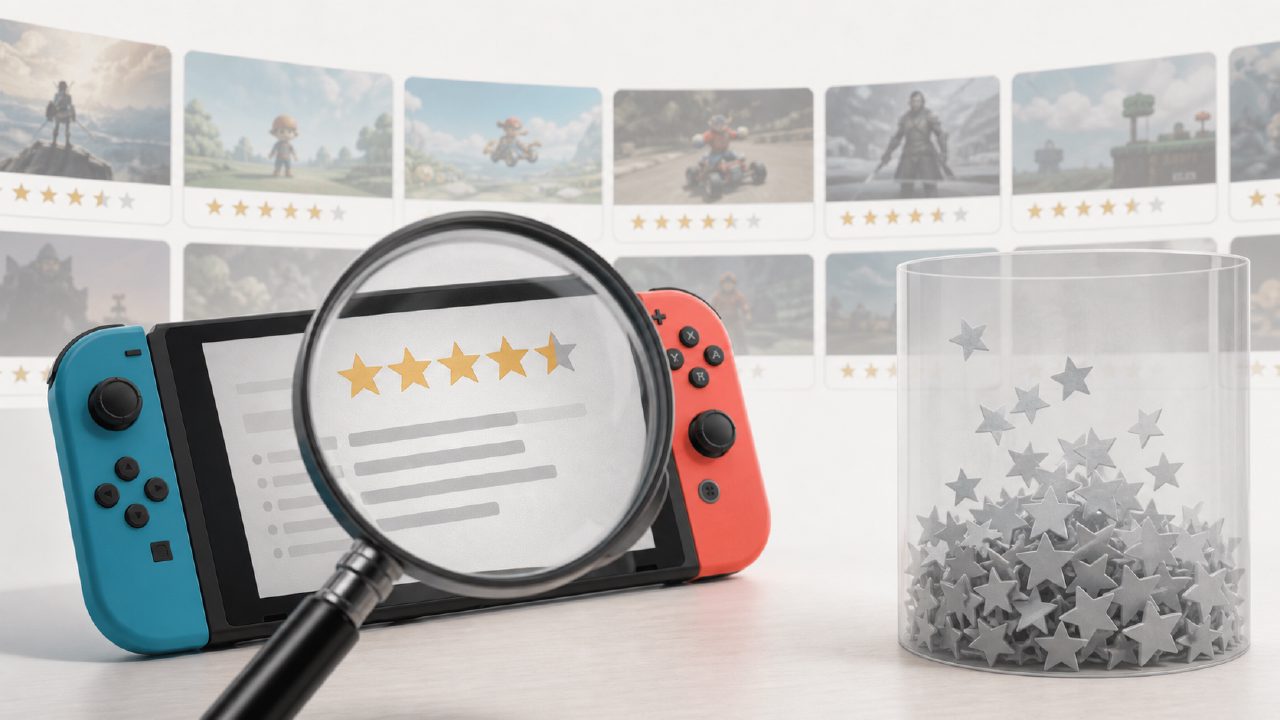
Every time you open the eShop and see games with 4.8 stars, 4.9 stars, don't you have doubts? An indie game that hasn't even been released yet can have thousands of perfect ratings—how much of that score is real and how much is fake? The term 'High Score' has been twisted on the Switch to the point where some treat it like a bible, while others see nothing but empty numbers. Today, let's cut through the fluff and lay out a few hard-hitting angles to help you see through the smoke.
1. Understand What Tricks the eShop Rating System is Playing
The eShop's rating logic is actually quite sloppy. Users finish a game, casually tap five stars, and that's it—no weighting, no time decay, no purchase verification. What does this mean? When a game first launches, a fan community floods it with five-star ratings, and the score skyrockets. Three weeks later, real players start showing up and the rating begins to drop, but that initial High Score has already been screenshotted and used as promotional material.
I fell for this myself with a certain pixel-art side-scrolling action game. It had an eShop rating of 4.7, but the actual gameplay felt floaty and the level design was ridiculously repetitive. After checking overseas reviews, I found that the core player community gave it a real score around 7 out of 10. So when you see a High Score, don't rush to buy—scroll down to the latest reviews, especially those from the last two weeks.
2. High Scores Also Depend on the Genre: Don't Compare Hollow Knight to Overcooked
The top spots on the Switch game charts are rarely wrong with those major titles, but if you measure a two-player Switch game by the 95-point standard of Zelda, almost none will pass. Different types of games naturally have different scoring standards—comparing them directly is meaningless.
For example, two popular co-op games on the Switch game recommendation list both score 4.6. One is a 60-hour RPG with a deep story and complex combat system; the other is a party game perfect for laughing with your partner on the couch over a weekend, only 8 hours long. Can the weight of these two 4.6 ratings possibly be the same? A 4.6 for the former means it's above average in its genre, while a 4.6 for the latter means it's almost the ceiling of its kind. Before looking at scores, first understand what experience you're after.
3. Indie Game Recommendations Hide the Most Score Traps
The indie game recommendation section is where High Score inflation is worst. Small teams have no marketing budget, so it's common for them to rely on friends, family, and core fans to boost ratings at launch. Additionally, indie game players tend to have a 'support the developer' mindset, so they're generous with ratings. A walking simulator with charming art but mediocre gameplay scores 4.8—higher than many well-crafted mid-sized titles. That's not normal.
I once found a puzzle game in the indie recommendations with a 4.9 rating. The visuals were stunning, but the puzzle logic was contradictory, forcing me to look up guides. The comments section was full of five-star 'supporting domestic games' posts. That's fine in itself, but the problem is that this High Score can seriously mislead you about the game's content. When dealing with indie games, reading the negative reviews is more useful than looking at the score. Negative reviews with specific details are often far more valuable than five-star ratings.
4. Real Scenarios: How Three Types of Players Should Use Ratings
Scenario 1: You only play games on weekends
There's no problem focusing on High Scores in Nintendo's game recommendations. The ratings for first-party and second-party titles are relatively solid and less inflated. Just glance at anything above 4.5, combined with screenshots and video clips from the game gallery, and you can generally judge whether it suits your taste.
Scenario 2: You're a hardcore action player
Don't just look at the total score. The same action game might have a 4.3 on the eShop but only a 7.2 user score on Metacritic. The difference comes from casual players—they think 'it's a bit hard but looks nice.' What you need is the High Score from the core gaming community. Use the game gallery to check detailed user reviews. Someone might write '60 hours for 100% achievements, top-notch feel but endgame balance is broken'—that kind of information is worth more than stars.
Scenario 3: You're looking for two-player Switch games
The High Scores in the two-player Switch game category are more reliable than those for single-player games. The reason is simple: the rating group for co-op games is mostly real families and couples, who have much less incentive to inflate scores. A 4.5-rated co-op game usually means 'both people genuinely had a good time'—less fluff, more trustworthy.
5. Treat High Score as a Gatekeeper, Not a Guide
Using ratings directly as a filter is still useful. For example, in the game rankings, set a cutoff at 4.2 and ignore anything below—that reduces the chance of stumbles. But once you're in the candidate pool above 4.2, the score won't help you much with selection. That's when you go back to old methods: look at actual screenshots in the game gallery, read a few specific neutral and negative reviews, and figure out what genre it belongs to.
My current buying habit is a three-step process: first check the eShop rating to see if it passes the threshold, then go to the game gallery to browse screenshots and video clips, and finally ask the community 'how's the late-game experience?' If it passes all three, it's usually solid. Chasing High Scores blindly might leave you with a pile of 4.8-rated games, with only your wallet feeling happy.
Comments
Leave a Comment