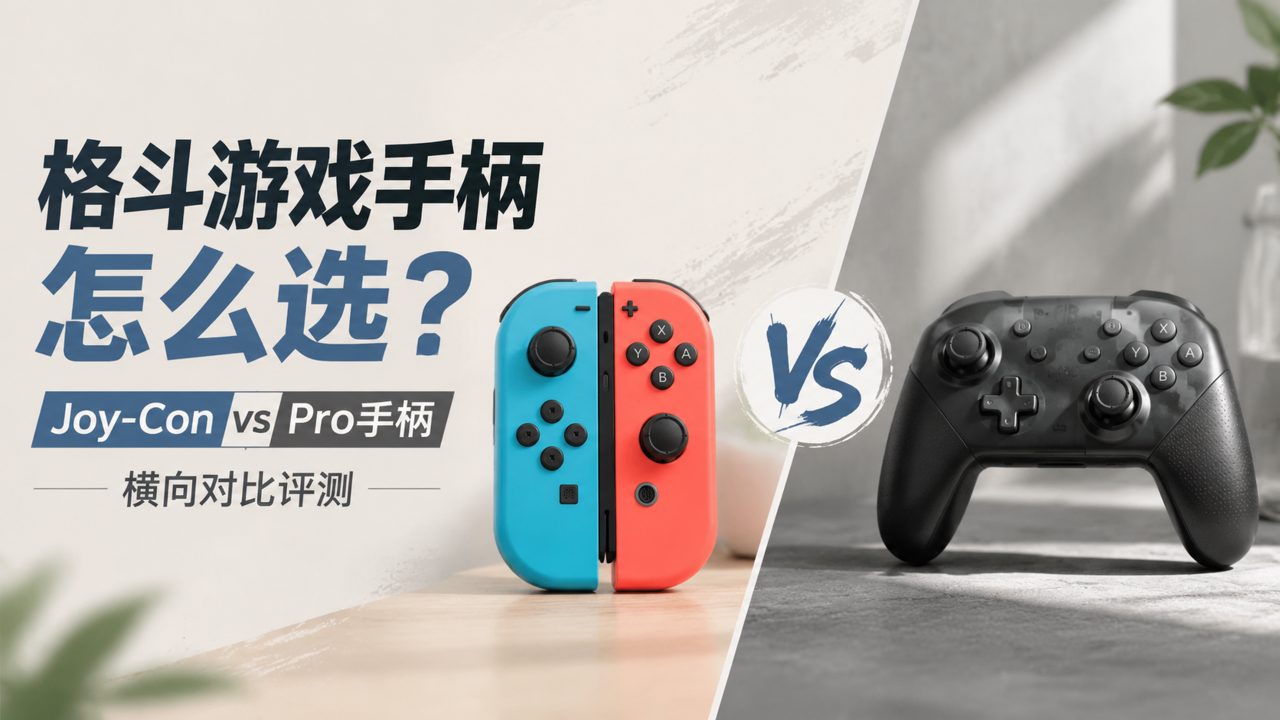
What's most infuriating about fighting games isn't getting taken out by a combo from your opponent, but when you're trying to execute a special move and your Joy-Con acts like it just woke up — misinputs, disconnects, even outright drift. Especially on the hardcore fighting games on Switch, which demand extremely precise controls, if the controller is even slightly uncooperative, the experience plummets from peak to rock bottom.
Many people initially just make do with a pair of Joy-Cons for convenience. But once you actually start playing, you realize the sticks are too short to smoothly execute diagonal inputs, the shoulder buttons are soft and mushy, completely messing up combo timing. Not to mention when playing local multiplayer, handing a horizontal Joy-Con to a friend — the feel is downright anti-ergonomic. Not to say it's unplayable, but this setup is only good for killing time. If you're seriously ranking up or practicing combos, Joy-Cons are definitely not a long-term solution.
Controller Options Comparison: Original Pro, Third-Party Fighting Controllers, or Stick with Joy-Con?
First, let's talk about the Joy-Con. Its biggest issue is the short physical travel distance of the stick module, plus a slight latency from Bluetooth connection. In frame-sensitive games like Super Smash Bros., a few frames slower can mean the difference between life and death. Also, the button areas on the Joy-Con are very close together; when you mash the R button, you can easily accidentally hit ZR, making gameplay frustrating. The advantage is its split design — you can detach it and use it as two controllers, great for casual sessions where you want to quickly pair controllers for multiplayer games on Switch. Many players on Xingba use it for party games for convenience.
Now look at the original Pro Controller. It's expensive, but its feel and response are top-tier. Its stick has moderate resistance and clear centering, and while some feel the D-pad is prone to misinputs, in actual fighting games it's much more accurate for diagonal commands than the Joy-Con. The weight and grip shape can handle long sessions of stick motions without your fingers getting sore after half an hour. The only problem is the price — the cost of a single Pro Controller can buy several discounted games on one platform. If your budget allows and you're the type who plays ranked at least three or four times a week, the Pro Controller is a "one-and-done" choice.
Third-party controllers are more complicated. Brands like 8BitDo and IINE — some imitate the Pro Controller's button layout, others have six-button layouts for fighting games. I tried a third-party controller for around 100 RMB, the feel was okay, but in wireless mode it occasionally glitched — sudden lag, or auto-fire triggering unintentionally, which is fatal for the rhythm of fighting games. Another pitfall is compatibility: some third-party controllers won't be recognized when plugged into the Switch dock, or stop working after firmware updates. Always check reviews before buying; don't cheap out on "universal models" from small manufacturers.
Hidden Pitfalls in Dock and TV Mode
Many players overlook the impact of the dock on the fighting game experience. When playing in TV mode, the controller signal doesn't go directly to the console but goes through Bluetooth to the dock, then back. If the dock is too far from your seating position, or if there are tables and chairs obstructing it, the return latency increases noticeably. A friend of mine hides his Switch inside a TV cabinet and sits on a sofa three meters away — his Pro Controller occasionally "disconnects for a moment." This is especially apparent when playing the fighting games on the recommended Nintendo game list.
Another detail: the dock has poor heat dissipation. Playing fighting games with the dock plugged in for long periods causes the console to heat up, and Bluetooth module performance drops slightly. While not serious, if you're used to playing with the machine stuffed in a closed storage case, it's advisable to take a break every hour or add a small fan blowing on it. Otherwise, by the end, your combo success rate will visibly decline.
If you're a pure controller player, you can use a third-party dock or an extension cable to place the console closer, reducing interference. Many players on Xingba's Game Guide have discussed the subtle effects of different docks on controls, and those with DIY skills even added active cooling to their docks.
How to Choose? The Key is Knowing Your Fighting Game Scenario
First, decide what game you mainly play. If it's Smash Bros., Dragon Ball FighterZ, or similar games that rely on rhythm and footsies, the Pro Controller or an equivalent is the minimum requirement; Joy-Cons are basically only for practice. If it's Street Fighter 2 or King of Fighters, traditional 2D fighters that demand more from the D-pad and combos, some third-party six-button controllers might even be better for executing moves than the Pro Controller.
Next, consider whether you play online ranked more or local multiplayer with friends. If you're online daily, prioritize wireless stability, don't skimp on cheap controllers. If you mainly party and play a few rounds of two-player Switch games, then Joy-Cons and a few cheap third-party spares won't hurt. Many old-timers on Xingba have two setups: one Pro Controller for themselves, and a set of cheap controllers for friends.
Don't fall for the "80 bucks solves all fighting games" hype. Cheap controllers lock your skill ceiling. Fighting games are all about that instant satisfaction of pulling off a move — if your gear is so bad you can't even execute combos, you might as well not play. It's best to find time to try different controllers at a physical store or at a friend's place. Feel is something words can't describe; you'll know immediately once you hold one.
Finally, if you're new to Switch fighting games, don't rush to upgrade gear. Open up Xingba's Switch Game Recommendations and Game Rankings, find a few indie games suitable for beginners to practice on. Once you're sure you've fallen in love with this hardcore competitive genre, then your wallet is worth opening for a better controller.
Comments
Leave a Comment