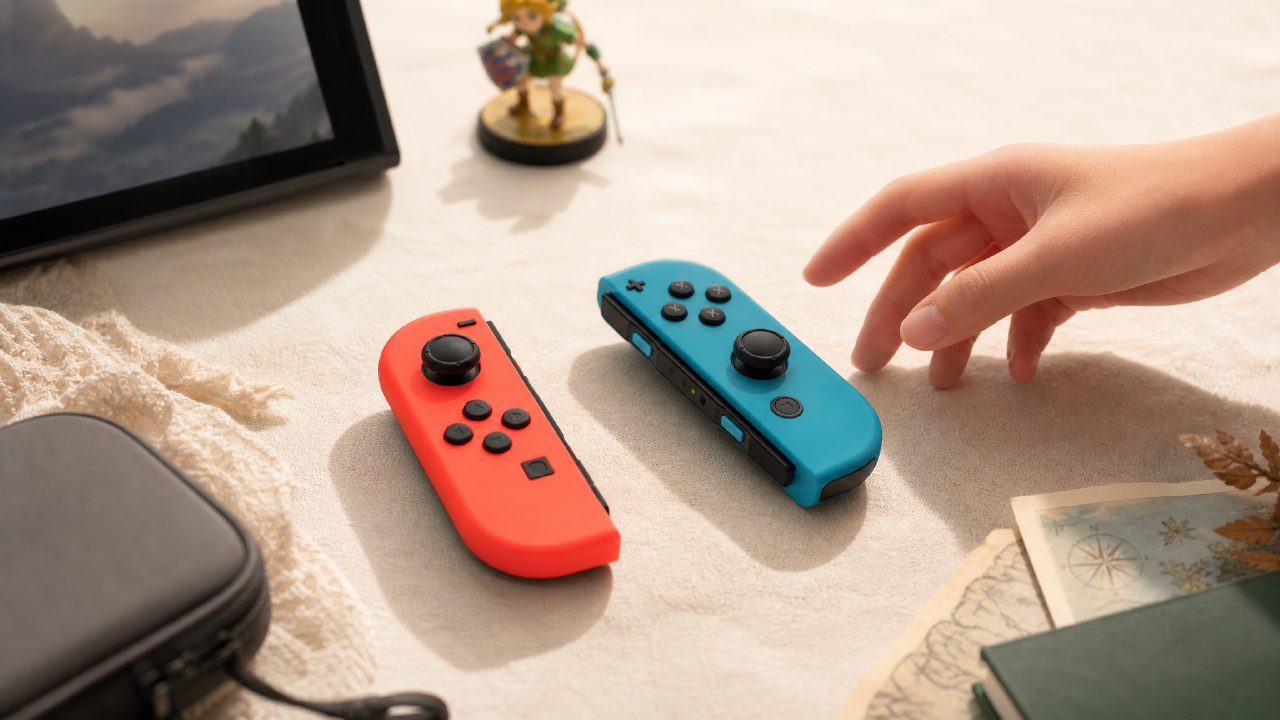
The first time I slid the Joy-Cons off the sides of the Switch console, I actually froze for a moment. Such a small thing, almost weightless in the hand, with tiny buttons—my first thought was: can this really play games well? After a few months of playing, the conclusion is: it's clever, but not perfect. Some trade-offs you have to weigh for yourself.
Let's talk about tabletop mode first. On weekends, I take my Switch to a friend's place. Before leaving, I pull the console out of the dock and casually stuff the two Joy-Cons into my pockets. When I get there, I stand the console on the table, each person grabs one controller, and we start playing Overcooked right away. This scenario is actually the most successful moment of Joy-Con design—no need to bring any extra accessories, two people can sit down and play. The entry barrier for two-player Switch games is indeed lowered to the minimum, especially in outdoor settings; it's much more convenient to set up a quick session than to bring a Pro Controller.
But the problem lies in the grip feel. A single Joy-Con is too small—my hands are a bit larger, and after holding it for a while, my pinky finger hangs in the air, and when playing combos in Street Fighter, I tend to slip by the third button press. When split into two for two-player use, the feel is barely acceptable, but if you really want to play shooting or fighting games seriously for a long time, you'll most likely want to attach it back to the grip or switch to a Pro Controller. This thing is designed for convenience, not for competitive feel.
Drift Issue: Not Everyone Encounters It, But You Can't Pretend It Doesn't Exist
Discussions about Joy-Con drift have appeared in the comment sections of almost every game ranking online over the past few years. In my own use, the two analog sticks only started showing slight centering deviation after about half a year—nothing serious; in Zelda, when running across the map, it would occasionally drift left a bit, but when playing a collection of indie game recommendations with frequent menu operations, the impact was minor.
One fact needs to be made clear: not every pair of Joy-Cons will drift, but the probability is indeed not low. Some people around me have used theirs for nearly two years without issues, while others have replaced them twice. If you care about long-term cost and stability, this is something to seriously consider. Of course, DIY stick replacement or repair services are now mature, but it's still one more thing to worry about.
On the other hand, the Joy-Con's motion control features are actually underrated in real games. When playing Nintendo game recommendations like Ring Fit Adventure or Just Dance, the gyroscope inside the controller is quite accurate, and the feedback for many motion operations is more responsive than third-party controllers. This is why, despite the drift risk, many gamers still recommend the original—some experiences can only be provided by the original hardware.
Back to everyday usage scenarios. If you mostly play connected to a TV, attaching the Joy-Cons to the grip solves the issue of holding them separately, but the grip itself has no charging function, which is a bit awkward. If the controller runs out of battery mid-game, you either plug in a charging cable or swap to another pair and charge them alternately. Compared to the experience of Xbox or PS controllers that can be charged with a single cable for a whole day, the Switch's solution feels less straightforward.
If you're the kind of person who likes to whip it out for a quick session while waiting for a bus or during a lunch break, then the portability of the Joy-Cons integrated with the console is indeed the optimal solution. No need to bring an extra controller; just take it out of the bag and start playing. Combined with the game library in the game encyclopedia, the utilization of fragmented time can be greatly improved.
A Few Practical Trade-offs to Help You Decide If It's Right for You
If you primarily play alone and prefer to play titles from Switch game recommendations in handheld or tabletop mode, then the original Joy-Cons are sufficient. But if you have a fixed TV gaming setup, or often play action games that require frequent button presses, then having an extra Pro Controller would be more comfortable.
If you're the type who often gathers with friends, then having one or two extra pairs of Joy-Cons is necessary. Tabletop mode supports up to four-player battles, but only the two original controllers have motion control—additional third-party controllers often have some features cut or reduced compatibility. The advantage of original controllers is that they are stable in both video game encyclopedia and community reviews, but if you buy at full price, you need to prepare your budget.
Finally, a personal note: I don't recommend buying cheap no-name third-party alternatives to save money. Poor feel, unresponsive motion controls, and loose seams are common issues, and in the end, you'll just waste money. Instead, it's better to use the original accessories first, and then supplement when you confirm what you truly lack.
The Joy-Con is a design that involves many trade-offs. It's not perfect, but its value lies in whether you're willing to compromise for these portable, multiplayer scenarios. Drift is a real annoyance, but the convenience of being able to pull out a pair and get a group game going at any time is something other controllers can't replace.
Comments
Leave a Comment