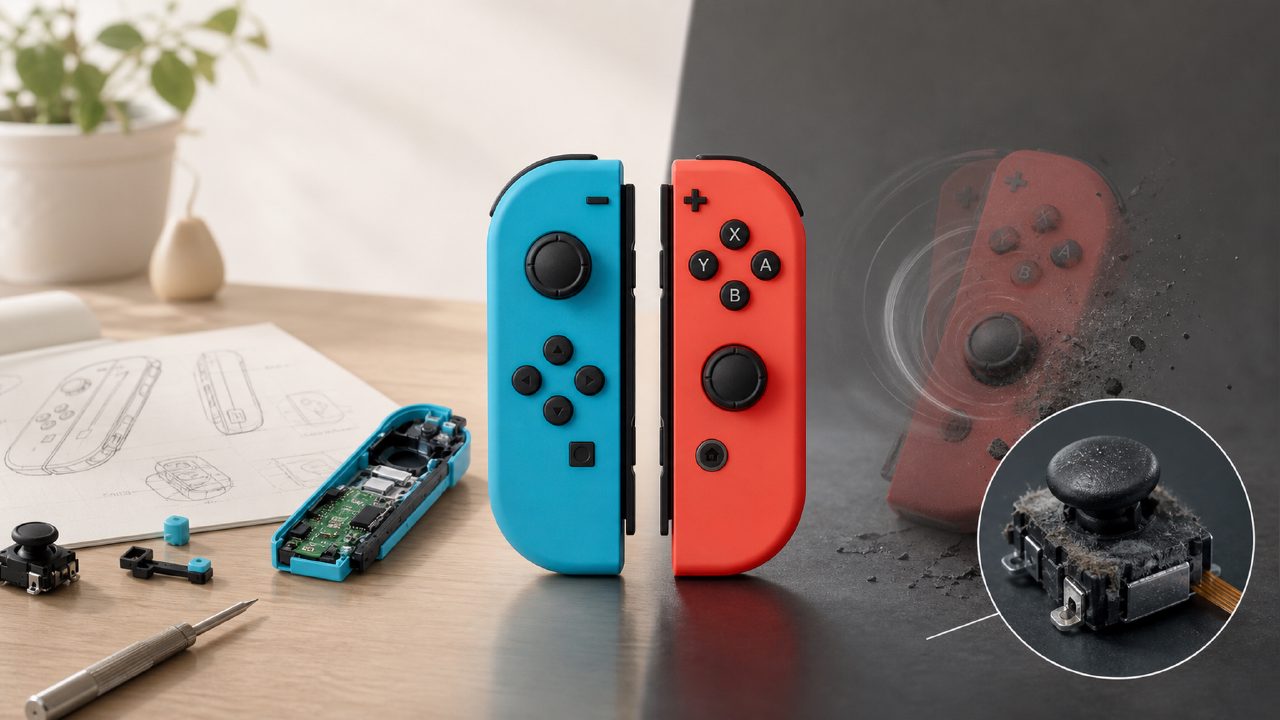
Let me start with a real scenario: When I first got my Switch, I detached the Joy-Con from the sides of the console and held them in my hands. My first reaction wasn't “so light” but “is this thing really durable?”
After using them for a while, my feelings became much more complicated. They are indeed the core experience of the Switch, but also the most love-hate controller I've ever bought.
Design Ingenuity and Its Trade-offs
The first time I played on the TV, I inserted both Joy-Con into the official grip. The feel was indeed better than holding them separately, but the grip itself is hollow and absurdly light. During intense battles in Zelda, I always felt it wobbling in my hands, lacking a solid, filled feeling.
Holding a single Joy-Con to play two-player Switch games is quite convenient – small enough, and the button layout when turned sideways is reasonable. But if you have large hands, playing for more than half an hour will make your right thumb feel like it's doing gymnastics trying to reach the right stick and ABXY buttons. This is a necessary compromise for the split design.
Another point that few people mention: the Joy-Con's ZR/ZL trigger buttons are microswitches with no linear travel. When playing racing games, you can't control the throttle depth like you can with a Pro controller – it's only “pressed” or “not pressed”. If you mainly play racing or shooting games, this could be a notable drawback.
Drift: Not If, But When
I originally bought a launch Switch. After about 200 hours of Splatoon 2, the left stick started drifting left automatically. It felt strange – the plastic shell of the controller was still like new, but the internals had already failed.
Later I switched to the newer model (the Console bundled controller with the battery life upgrade). The drift came later, but it still wasn't completely avoided. I used some unofficial methods – like spraying electronic contact cleaner at the base of the stick – which bought some time, but didn't fix it permanently.
Actually, the Joy-Con's stick module is plug-and-play. If you're a bit handy, you can buy a replacement for about $3 and swap it out yourself – it's not difficult. But for most players, this is still something they shouldn't have to worry about.
Multiplayer Scenarios and Irreplaceability
I remember one time at a gathering, four of us wanted to play Mario Party. I only had one Pro controller. That's when the value of the Joy-Con became apparent – each friend took half a controller, with motion controls, buttons, and analog sticks all available. Setting up a game with four units was indeed quick.
Moreover, some games rely heavily on motion controls. For example, when playing Ring Fit Adventure or 1-2-Switch, the Joy-Con's IR camera and accelerometer are irreplaceable by any other controller. This means that even with the drift issue, you still need to have at least one pair at home.
Personally, if you often browse content like Switch game recommendations or Nintendo game recommendations, you'll find that many games emphasizing motion controls and multiplayer cooperation make the Joy-Con an unavoidable accessory. If you mainly play solo indie game recommendations or grind through Hollow Knight or Hades on game rankings, the Pro controller offers a much smoother experience.
Charging and Connection Issues
Another practical experience: when using Joy-Con separately, each is independently powered. If you play Just Dance with a single controller, it's easy to drain one of them. Charging them back on the console is fine, but if you happen to go out and forget to charge them, bringing dead Joy-Con with you is essentially pointless.
Also, signal obstruction. If you place the Switch under the living room TV cabinet and sit at the other end of the sofa, with your body between the two Joy-Con, occasional brief disconnections can occur. Though not frequent, that one second of drift during Splatoon could decide the match.
Honest Advice for Those Still Hesitating
The quality of the Joy-Con depends entirely on what games you play and how you play them.
- If you're a hardcore single-player gamer who mainly uses docked mode (Dock) and plays action or RPG titles, I recommend getting a Pro controller and leaving the Joy-Con attached to the console for handheld mode.
- If you often have friends over, or enjoy motion control, party games, or dancing, you don't need a “better controller” – you need a backup set of Joy-Con. After all, if one pair breaks, the other can still take over.
- If you're looking for a game encyclopedia or figuring out which games are good for two players, the Joy-Con's split design is the cheapest solution – no need to buy extra controllers to play together.
Overall, the Joy-Con is an accessory that “isn't necessary but changes the experience.” It has many annoyances, especially regarding durability. But when you open up two Switches, hand a pair of Joy-Con to a friend, and start laughing while playing a certain two-player Switch game, those little flaws seem temporarily forgiven.
Comments
Leave a Comment