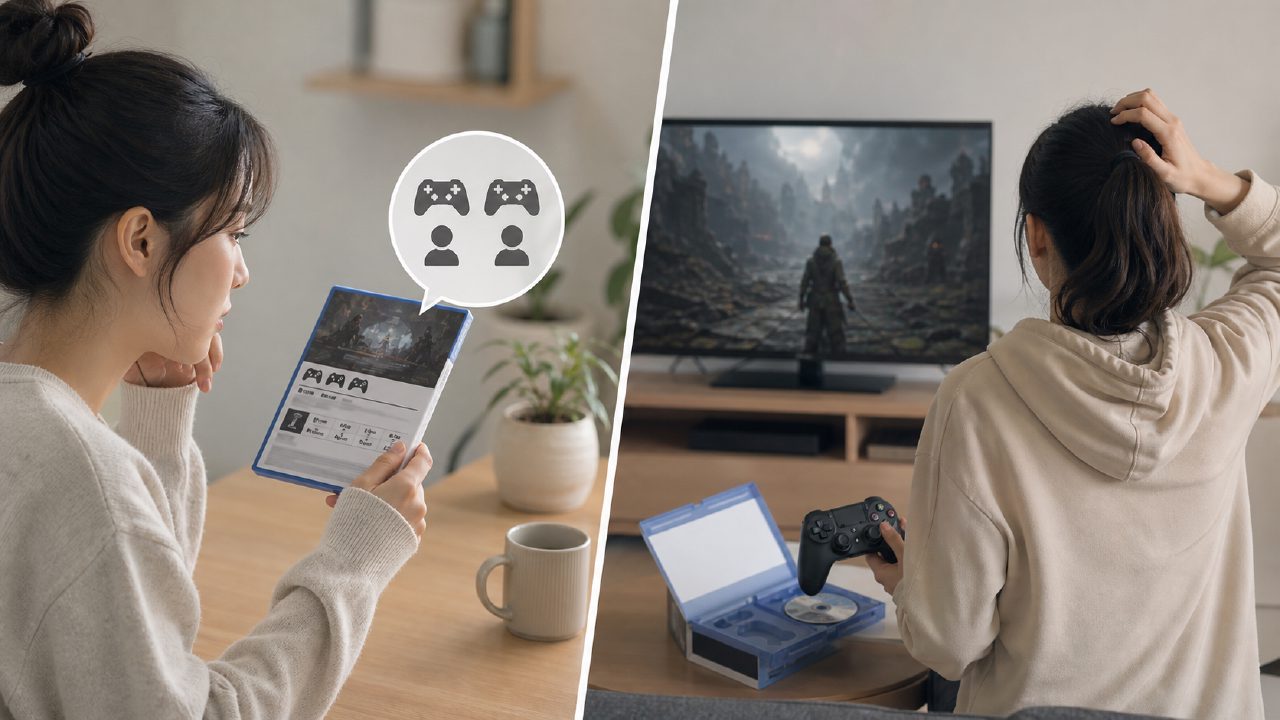
Before buying a Co-op game, I urge you to first think clearly about one question: how many usable controllers do you have at home?
This is not nonsense. I've seen too many people excitedly buy a two-player Switch game, only to open the package and realize that to play with two people, you need to spend another few hundred bucks on a pair of Joy-Cons. Even worse, some games don't support single Joy-Con operation at all; you need a full controller per person — meaning at least two Pro controllers or two pairs of Joy-Cons. Not checking this before buying, only to find out after downloading that you can't play together, is truly frustrating.
Don't be fooled by "up to 4 players" — only two might actually be able to play
Many co-op game boxes say "1-4 players", but you need to carefully check whether it refers to local multiplayer, online play, or hot-seat. Games like "Just Dance" support multiple players, but in practice, you can use a phone to scan a QR code as a controller — but the input lag will make you question life. To truly enjoy the game, you still need physical controllers.
Another easily overlooked point: some co-op games don't require buying two copies at all. For example, "Overcooked 2" or "Snipperclips", one copy, one console, one pair of Joy-Cons, and two people can play together. But for "Animal Crossing", want to build two islands on the same Switch? No way. At this point, you need to consider whether both can play simultaneously online or if you'll take turns. For such details, it's best to browse through game databases before buying, or watch some gameplay videos — don't just look at the cover art.
Co-op isn't just "fighting monsters together" — it could also be "arguing together"
The term "co-op" sounds wonderful, but in practice, some games are actually a "cooperative quarrel" mode. The most typical example is the "Overcooked" series — it's supposed to be about cooking together, but anyone who's played it knows it ends up being about who stole whose plate and who set the kitchen on fire. If you and your partner have short tempers, it's better to start with a forgiving game like "Kirby and the Forgotten Land" — at least you won't fall out over a gameplay mistake.
Another real issue: the skill gap between two players. If one is a hardcore action gamer and the other is a casual player, choosing a game becomes an art. Buying a hardcore co-op game like "Cuphead"? In all likelihood, one person will be lying on the ground watching the other perform. Better to go to the Switch game recommendations section to find games where a strong player can carry a weak one and still have fun, or simply pick turn-based cooperative games so neither feels too anxious.
If you're going for first-party blockbusters in Nintendo game recommendations, you're most likely fine — Nintendo has always been solid in local multiplayer experiences. But if it's third-party indie game recommendations, you really need to be careful. Many indie games add co-op mode as a patch later, without thorough testing, so issues like disconnections, unrecognized controllers, and save file conflicts often occur. I suggest prioritizing classic titles that have long dominated game rankings; the chance of stepping into a pitfall is much lower.
Think before you boot up: play locally or online?
This is a pitfall I've fallen into myself. Before buying "Monster Hunter Rise", I thought two people sitting together could play locally, only to find out that both need a Nintendo Switch Online membership to play together. Local wireless multiplayer and online play have different membership requirements. Some games support local play without a membership, but others don't. Before buying, check the discussion forums for two-player Switch games, or directly ask friends who have played it — don't just assume.
Also, if you're playing remotely, network is an unavoidable issue. The Switch's Wi-Fi module isn't particularly strong, and most co-op games have one player as the host and the other joining. If your home broadband upload speed isn't enough, the other player will experience constant teleportation. In such cases, either use a wired connection or a gaming accelerator; otherwise, the experience gap will be huge and you'll easily end up resenting each other.
Pitfall avoidance summary
Ultimately, the core method to avoid pitfalls when buying co-op games is just one thing: confirm how many people your existing devices and network environment can actually support for playing together. Don't get carried away by the words "multiplayer fun" on the cover. Check the support modes in game databases, read real player feedback in the Switch game recommendations community, and finally compare your and your teammate's actual free time — no matter how well designed a co-op game is, if you two can never find time to play together, it's just a decoration.
Comments
Leave a Comment