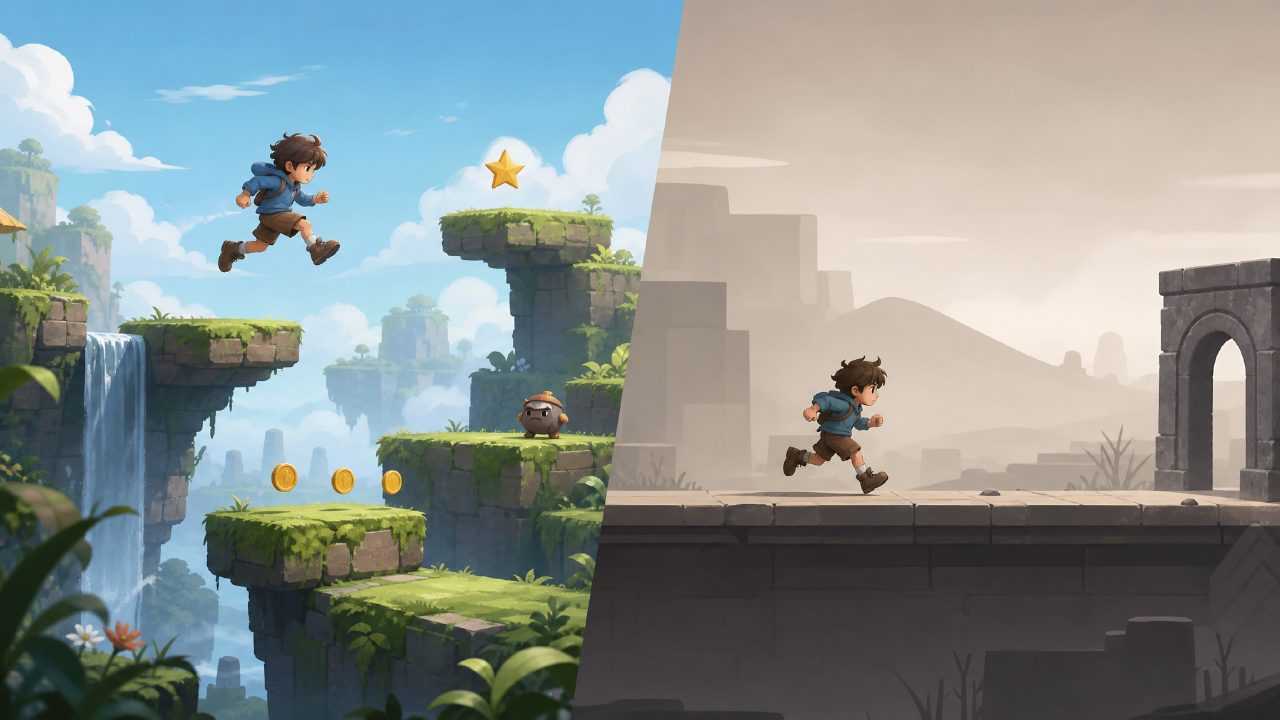
What is a Platformer Game? How is it Different from Regular Level Progression?
Simply put, the core of a Platformer is "jumping." You control a character jumping between platforms, climbing, dodging obstacles, and going from start to finish. Compared to regular level progression, Platformers emphasize precision and timing—it's not just knowing how to clear a stage, it's whether you can make the jump.
This genre has a long history, starting with Donkey Kong and Super Mario. But now on the Switch, Platformers have evolved into many branches: some focus on puzzles (like Celeste), some on combat (like Hollow Knight), and some on pure parkour (like N++). The common thread is that your character is almost always running and jumping, rarely stopping.
If you're new to the genre, try New Super Mario Bros. U Deluxe. Its difficulty curve is gentle, and death penalties are light, making it one of the top Switch game recommendations for beginners.
I'm terrible at platformers—are these games beginner-friendly?
It depends on the game. For example, Celeste has a reputation for being hard, but it includes an assist mode—you can toggle invincibility, infinite jumps, or even flight. The real design intent is to let everyone reach the ending, just with different experiences for experts and casual players.
Meanwhile, Super Mario Odyssey has almost no death penalty—falling off just costs a few coins, and you respawn immediately. It's one of the most accessible Platformers in Nintendo game recommendations. You don't even have to worry too much about the jump button details; you can have fun just pressing buttons randomly.
But if you jump straight into hardcore titles like Celeste or Hollow Knight, you'll likely get discouraged. I suggest browsing game rankings for titles tagged "low difficulty" or "casual" to ease into the genre.
Do I need a separate controller to play Platformers on Switch?
Mostly no. The Joy-Con button layout is sufficient, especially for games like Super Mario Bros. Wonder or Kirby and the Forgotten Land—the triggers and D-pad feel fine.
However, if you're playing pixel-art hardcore Platformers from indie game recommendations, like The End Is Nigh or Spelunky 2, you might want to reconsider. These games require frame-perfect inputs, and the Joy-Con's analog stick doesn't recenter cleanly, while the D-pad is too soft and prone to misinputs. In my experience, using a Pro Controller reduces death counts by about 30%. The Pro Controller's D-pad has clearer divisions—press left and it's left, rarely accidentally registering up.
Also, if you often play on TV, there's no need to worry about input lag in docked mode—the Bluetooth connection is stable. But if you use a third-party controller, make sure it supports native vibration and gyro on Switch. Some cheaper controllers won't let you jump across rotating platforms in Platformers.
What are the must-play Platformer titles on Switch?
If you're asking for "must-play," the list is actually short:
- Super Mario Odyssey—The pinnacle of 3D platformers. Every moon feels like its own unique level.
- Super Mario Bros. Wonder—The best form of 2D Mario. Wonder Flower power-ups make every stage a surprise.
- Celeste—Pixel art, hardcore, but with the best assist system. Also has a touching story.
- Hollow Knight—Strictly a Metroidvania, but platforming is a huge part—if you can't jump, you can't get abilities.
- Donkey Kong Country: Tropical Freeze—Extremely difficult but with top-tier controls. The hidden levels after completion are a true test of skill.
For a more complete list, check out Xingba's game guide, which filters by genre and difficulty, and includes player comments with data on how many deaths it takes to clear each game—more useful than just reading reviews.
Are Platformer games good for two-player or online multiplayer?
Yes, but you need to choose wisely. Half of the best two-player Switch games are Platformers:
- Super Mario Bros. Wonder—Supports up to four players on the same screen. When you die, you become a ghost that a teammate can touch to revive. Great for playing with friends or a partner.
- Kirby and the Forgotten Land—In co-op mode, Kirby and Bandana Waddle Dee have clear roles: one focuses on combat, the other on puzzles, so there's no conflict.
- Cuphead—Co-op is a mix of yelling at each other and laughing. You restart on death, but the sense of teamwork is rewarding.
- Moving Out—Not a traditional Platformer, but its action logic is similar. In co-op, poor coordination often leads to throwing TVs out the window—it's hilarious.
Avoid trying to play single-player hardcore games like Celeste in co-op—they don't support split-screen or hot-seat modes. After two people take turns for ten minutes, someone will be reaching for their phone.
Summary for the busy reader
Platformers are one of the most rewarding genres to explore on the Switch. Whether you're a complete beginner or a hardcore completionist, there's something for you. Before buying, check the difficulty tags and try demos—don't be fooled by "looks easy" graphics. Also, make good use of community reviews in Switch game recommendations; real player feedback is more useful than ads.
Comments
Leave a Comment