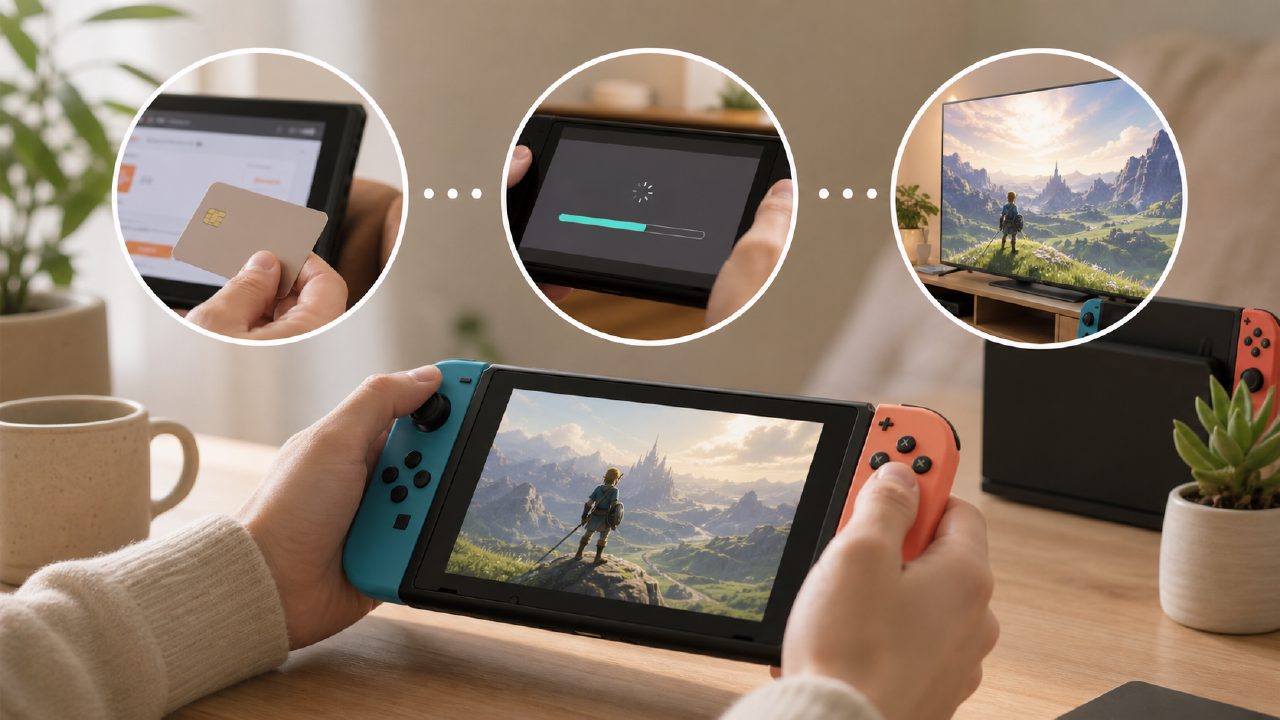
After buying a Switch digital game, from clicking pay to actually playing, how smooth is the journey in between? That's what I've been seriously thinking about recently. I used to think "Shipping" was just downloading—just need a fast internet connection. But after going through several rounds on the eShop, I realized there's a lot more hidden beneath the surface than I imagined.
Let's start with the download itself. I tried a few games of different sizes, and the most obvious feeling is that Nintendo's servers are indeed a bit unstable. For a 2GB indie game, downloading it in the early morning versus during dinner rush hour can take nearly twice as long. Sometimes the progress bar gets stuck at the very end and doesn't move, and you have no idea if the connection dropped or if it's still running in the background. There's no clear prompt for pause and resume (at least not intuitively), so you just stare at the percentage in a daze. If you're always rushing to play for half an hour after work, this completely throws off your rhythm.
But Shipping isn't just about download speed. I also tried two scenarios: family membership sharing and carpool-style shared accounts, and found that the "delivery" logic is different in each case.
With family sharing, the primary account buys the game, and member accounts receive it on their own consoles. Sounds simple, but in practice there's a hiccup: the primary account must verify online, and if you have two consoles at home switching back and forth between users, saves and games often get mixed up. For example, my wife and I wanted to find a two-player Switch game to play together. The primary account is on my console, so she had to log into my account to download it. After downloading, when she opens it with her own account, sometimes she has to re-download the update file. Is it a big problem? Not really, but having to spend an extra three to five minutes every time checking "who's on which console" really kills the mood to play.
Carpool-style shared accounts are another story. One primary account is shared among three or four people, and everyone can play that popular digital title from the Nintendo game recommendations list—costs are indeed very low. But from my experience, there's a specific limitation: when multiple people are online at the same time, the primary account often gets kicked offline. If you're not the account holder and suddenly get a prompt saying "verification required" mid-game, you have to stop and wait for the account owner to respond. That's when you realize that Shipping isn't just about downloading—it also includes the "delivery" efficiency of usage permissions. When permissions are tied to one person, the experience for others naturally comes with lag.
I specifically compared several games: the big titles on the Switch game recommendations list generally took longer to download, while the smaller indie titles from the indie game recommendations were much faster—not necessarily a bad thing, since you buy lightweight games for instant play. But the storage sizes marked in the game library often don't match the actual download time, depending on whether there's a system update or patch pushed that day. Once, I was installing a game under 1GB and had to wait a full twenty minutes because the Wi-Fi signal in docked mode was slightly weaker than in handheld mode. No one ever tells you that detail.
At the end of the day, the experience of the Shipping step depends on your tolerance for waiting. If you're willing to leave it downloading before bed, then everything is fine; but if you're the type who wants to start playing immediately after buying, the asynchronous delivery rhythm of digital versions might frustrate you. Physical cartridges let you play right away, but swapping carts is a hassle—there's no absolute right or wrong here, it's all about trade-offs.
For me, what truly reflects whether Shipping is good or not isn't the speed of a single instance, but the sense of continuity across different scenarios. Platforms like Xingba offer carpool and sharing services that help you split costs, but the price is turning a permission game into a trust game. How much connection delay you can accept determines which plan you choose. The high-scoring titles on the game rankings run smoothly, but whether you can actually get them into your hands and play "smoothly" depends more on how stable the Shipping step is.
Comments
Leave a Comment