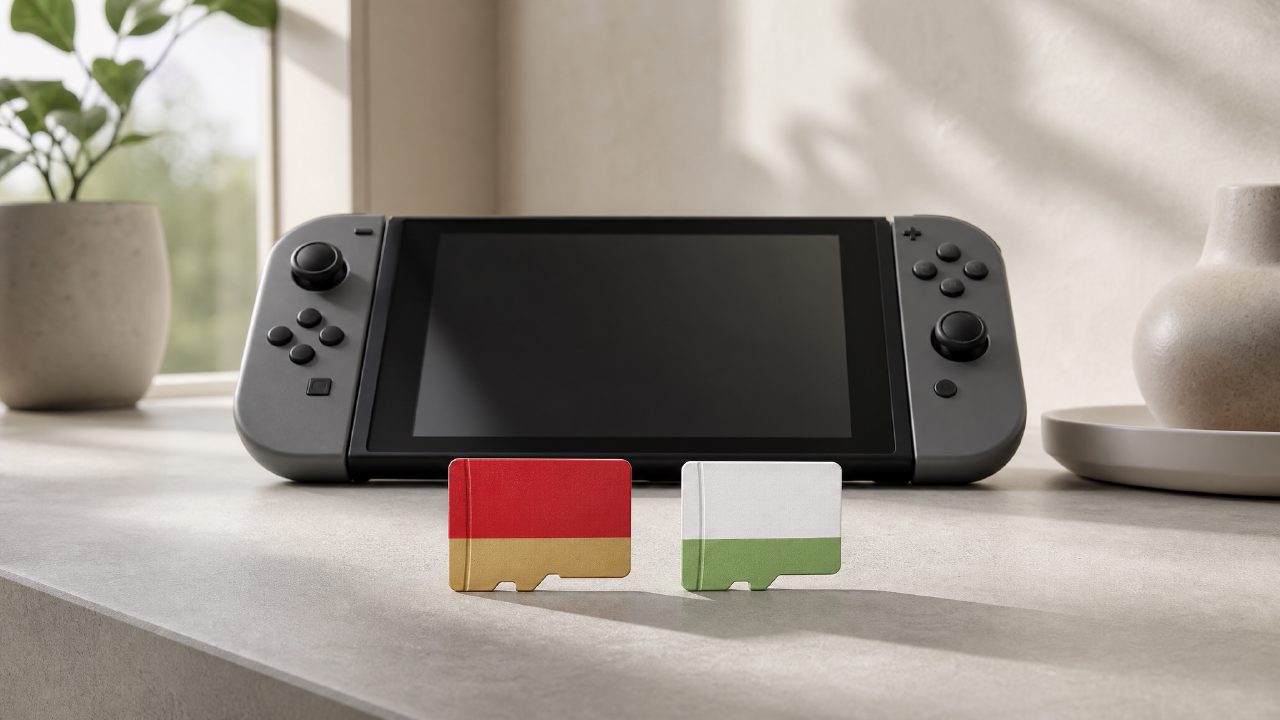
Anyone who plays Switch will eventually hit a wall — storage space full.
Especially if you're a gamer who frequently swaps games, buying too many digital copies you'll find that the built-in 32GB (or 64GB for OLED) is simply not enough. The console's internal storage starts warning after installing just one or two big titles — you can't bear to delete them, but you also can't download new games. That's when you need a good memory card.
But the market has many brands, models, and price ranges for memory cards — which one should you buy to avoid wasting money and not hinder game loading speeds? Today, I'll use several real-world scenarios to directly compare three common options and help you sort it out.
Option 1: SanDisk Special Custom Edition — Most worry-free but most expensive
SanDisk has a microSD card specifically made for the Switch, with the Nintendo logo printed directly on the packaging. The advantage of this card is obvious: plug and play, no need to worry about specifications. The rated read/write speed is around 100MB/s, and in actual tests, loading The Legend of Zelda and Xenoblade Chronicles 3 was stable, with no noticeable stuttering during continuous map reading.
But the price is what it is — for the same 512GB, it's nearly 50 yuan more expensive than the regular version. If you only occasionally play a few top titles from recommended Switch games, spending that extra money isn't necessary. But if you're the type who buys a high-capacity card as soon as you get the console, it's indeed hassle-free — at least you won't buy a counterfeit.
Option 2: Samsung EVO Select — A hardcore cost-effective choice
Samsung's EVO Select series is the one I've recommended most to friends over the past two years. Actual write speeds can reach over 90MB/s, with read speeds stable at 130MB/s. For a console like the Switch that only supports UHS-I at best, this is more than enough.
I've been using my own 512GB card for nearly two years, loaded with several dozen digital games — including many small gems from recommended indie games like Hollow Knight and Dead Cells — and the loading speed is almost indistinguishable from internal storage. Moreover, the price is very friendly, with promotional prices often under 300 yuan. In comparison, the only downside of this Samsung card is its plain packaging, with no brand collaboration flair.
It's worth noting that if you mainly play two-player Switch games (like Mario Party and Luigi's Mansion 3, which require frequent scene switching), the memory card's read speed doesn't have a significant impact on loading — the bottleneck is more in the game's own optimization. But if you frequently download the big titles at the top of the game rankings, the difference between a fast and slow card is noticeable.
Option 3: Lexar Play Series — An underrated budget alternative
Lexar's Play series is actually designed specifically for the handheld console market, with an official read speed of 150MB/s. In actual tests, it can reach around 140MB/s, which is even higher than the Switch's interface limit. This means that no matter which console you upgrade to in the future (if you switch to the next generation), this card won't become a bottleneck.
Its price is almost the same as the Samsung EVO Select, but it excels in one detail: it comes with an SD card adapter. If you use both PC and Switch (e.g., often exporting screenshots for game compendium material), this adapter is very practical. Samsung's EVO Select also includes an adapter, but the Lexar's card holder is noticeably more solid in build.
However, Lexar has one small issue: there have been counterfeit cards on the market. If you buy from unofficial channels, it's best to run a write speed test using a dedicated tool after receiving it — if the write speed is below 30MB/s, it's basically a fake.
How should you choose? Two decision dimensions
First, look at your gaming habits. If you mainly play exclusive big titles from recommended Nintendo games (like Pokémon and Animal Crossing), which are not large in size, 128GB is enough — pick any brand, and go for the cheapest. But if you're a digital edition heavy user, with dozens of games installed on the console, starting at 512GB is the right call.
Second, look at your device ecosystem. If you also use a PC or Steam Deck, the Samsung EVO Select offers the best versatility, with the most balanced speed and price. If you're purely pairing a card for the Switch, the SanDisk custom edition, though a bit more expensive, saves you the effort of judging and comparing.
At the end of the day, a memory card isn't expensive, nor does it need to be cutting-edge. Choose a card that fits your storage habits, plug it in, and forget about it — that's its true purpose.
Comments
Leave a Comment