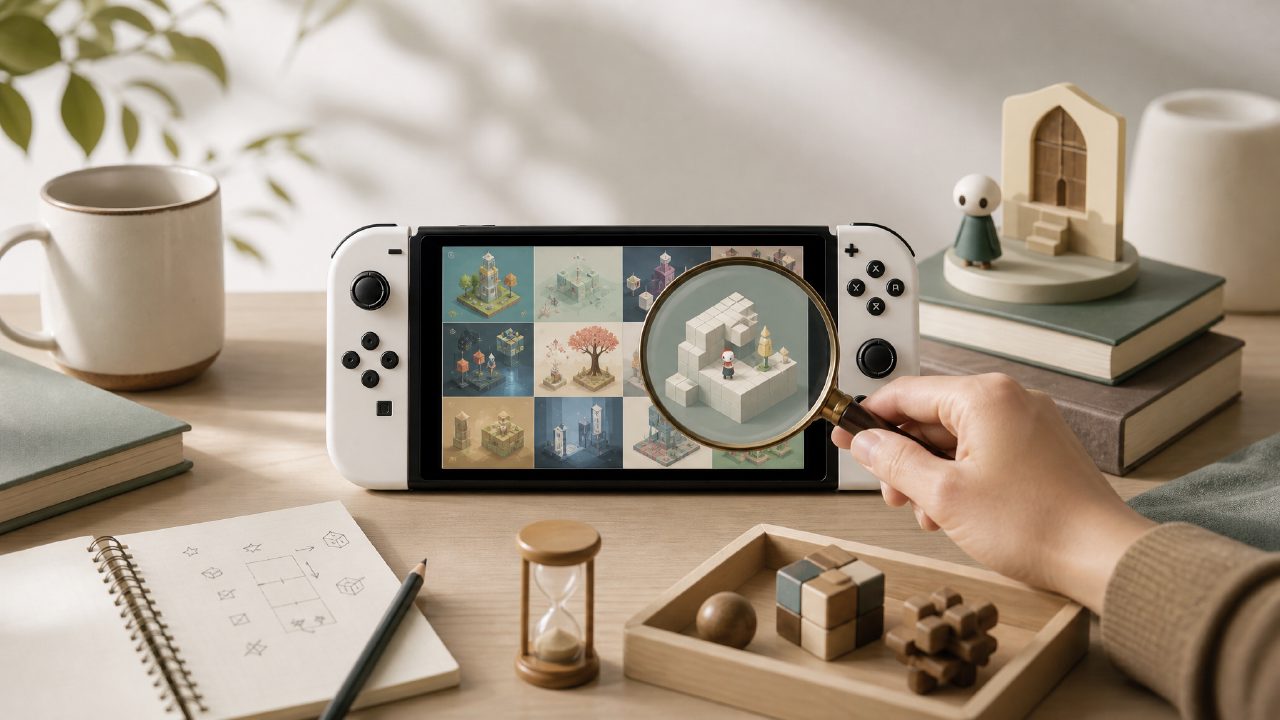
Here's the thing: you open your Nintendo Switch, looking for a Puzzle game that doesn't require much brainpower and can be picked up and put down anytime. This need sounds simple, but once you enter the eShop, you immediately fall into a selection hell — a screen full of blocks, numbers, pipes, puzzles, with prices ranging from a few bucks to hundreds, and you have no idea which one is worth your time.
I was stuck in this spot last week. That night I only had forty minutes of free time, didn't want to play Zelda or Xenoblade, just wanted to exercise my brain a bit without diving into a story. So I did a simple but effective little experiment — using forty minutes to simulate the entire process of a regular player looking for a Puzzle game.
Step 1: How to actually search for Puzzle in the eShop
Searching directly for 'puzzle' yields over 400 results, most of which are junk. I tried three filtering angles in the eShop: first, set the price cap to 50 yuan, which basically eliminates big studio titles but finds creative indie games; second, look at user ratings from the last 30 days, skip anything below 4 stars; third, prioritize those with Chinese language support.
After three minutes of filtering, no more than 10 games actually catch your eye. Among them, two or three you might have seen in various Switch game recommendation lists, but their actual experience can be completely different — for example, some reviews say 'too short' or 'controls are awkward'.
This is crucial. What Puzzle games fear most is not difficulty, but 'feel' being off. Some games have excellent logic, but the Joy-Con stick control just doesn't respond well, or the touch screen support is half-baked.
Step 2: Quickly judge whether a Puzzle game is worth buying
I chose a specific case: Toodee and Topdee. This is a Puzzle game that combines platform action and block pushing. Simply put, you control two characters — one runs in a 2D platform, the other pushes blocks in a top-down view, and the two worlds influence each other.
Before deciding to pay, I did three things:
- Watched a 5-minute no-commentary gameplay video on YouTube, not a review, just a regular person playing. The goal was to confirm 'it looks fun, but will it be annoying to play?'
- Read two negative reviews — one said 'the puzzle design gets a bit lazy in the latter half', another said 'co-op mode has lag'. This let me know its upper and lower limits.
- Opened the eShop's game encyclopedia feature to see which category it belongs to. Actually, most players don't look at the encyclopedia, but I found it quickly helps you filter out 'puzzle but story-heavy' and 'puzzle but action-heavy' categories.
Result? I bought it. 28 yuan, played it for three full evenings.
Step 3: Actually playing it, I discovered some things reviews don't tell you
The biggest feature of this game is that its puzzles are not rigid. Many Puzzles are 'try all combinations, one will work'. But Toodee and Topdee's solutions are often non-linear; you have to first look at the problem from the platform character's perspective, then switch to the top-down view, and the information from both worlds must be processed simultaneously.
The co-op mode is also interesting. One person handles platform jumping, the other handles block pushing. This is actually a typical underestimated two-player Switch game — it doesn't require you both to have great coordination; instead, you laugh a lot at cooperation mistakes.
But there are also downsides. In the later stages, some puzzles are designed too deliberately; you know the answer, but your control precision can't keep up. You have to try repeatedly several times, which is a bit frustrating.
Also, it's not a 'pause and walk away anytime' game. Some puzzles, if you get stuck and leave them for two days, you can't pick up the train of thought when you come back. You have to clear an entire area in one go. This conflicts with many people's fragmented time needs.
Step 4: Horizontal comparison: With the same money, choose Puzzle or something else?
Another candidate I tried was Picross S7. This is a typical 'ten minutes per round, play for a year' fill-in puzzle game. In comparison:
- Picross is more relaxing, more stable, but also more mechanical. You won't be surprised, nor angry.
- Toodee and Topdee has ups and downs, creativity, but it's mood-dependent. You don't want to touch it when tired.
If you just want a quick round on the subway or during lunch break, Picross is a safer choice. But if you want a game where you can laugh with friends and say 'wow' when using your brain, the latter is worth the risk.
This kind of comparison is often overlooked in Nintendo game recommendations and indie game recommendations, because reviewers often only introduce one game without providing horizontal references. In reality, among the names you see when browsing game rankings each week, only two or three might actually suit you.
Conclusion: Not all Puzzle games are suitable for 'casual play'
Back to the original question. You open your Switch, looking for a Puzzle game — the key is to first figure out what you want tonight. Do you want to give your brain a comfortable workout, or do you want the satisfaction of being stumped and then solving it? The games that correspond to these two needs are completely different.
My personal lesson: don't just look at ratings and screenshots. Watch a real gameplay video, read two negative reviews, and ask yourself 'Would I get annoyed stuck here?' If the answer is 'yes', don't buy it.
One last note: if you're browsing the eShop and can't decide what to pick, try flipping through well-organized lists or encyclopedias. Some Switch game recommendations may not have flashy titles, but they can really save you money on trial and error — especially for genres like Puzzle, where once you get into it, it's worth it, but if you buy the wrong one, you really can't keep playing.
Comments
Leave a Comment