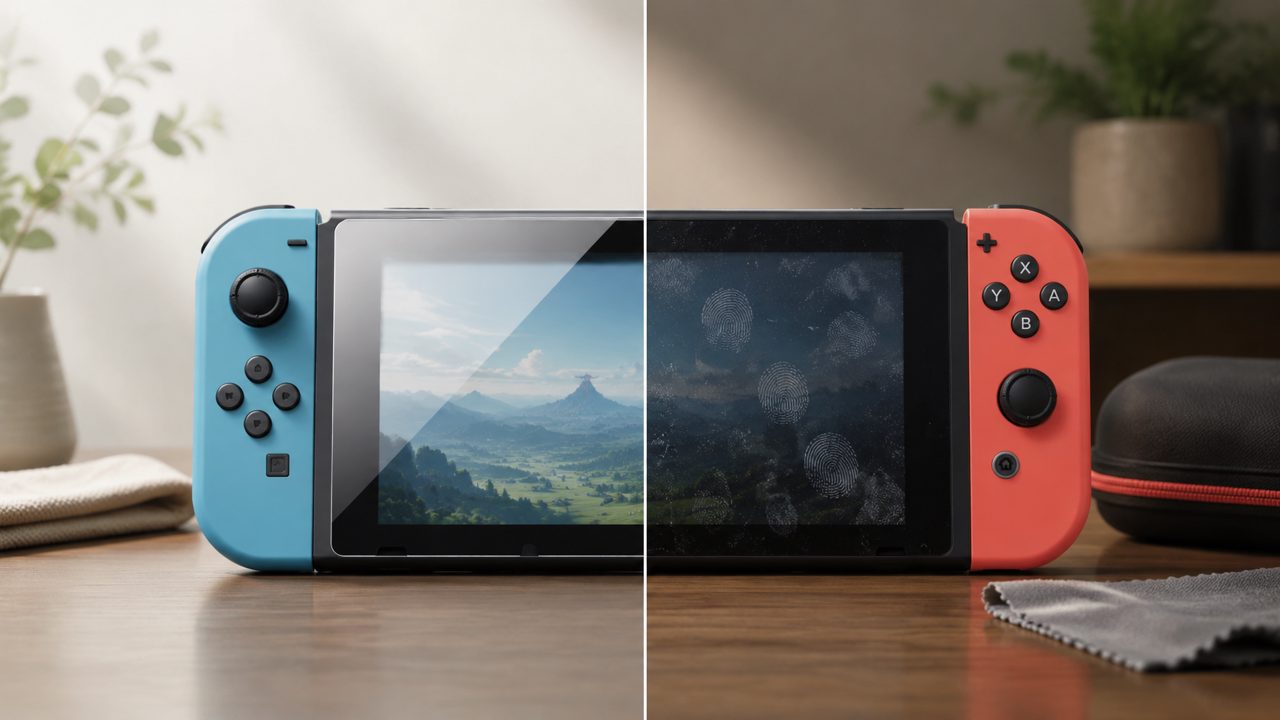
My new Switch wasn't even warm in my hands before the screen already had a fine scratch. I know that feeling all too well—just putting it normally into a bag, and when you take it out, a shallow mark appears at the bottom left corner. It doesn't feel deep to the touch, but when the screen is on, that mark is especially glaring against dark backgrounds. That's the direct reason I decided to apply a screen protector: not to prevent drops, but to prevent this kind of "mysteriously scratched" heartbreak.
I chose an ordinary tempered glass protector, not one of those expensive ones boasting "9H hardness" or "blue light filtering"—just the most common type on the market, priced somewhere between a cup of milk tea and a bowl of noodles. Before applying it, I cleaned the screen first—the Switch's original screen doesn't actually attract dust easily, but if you have a cat like I do, you'll need to be extra careful with the dust removal step before applying the film. If a protector is applied crookedly or dust gets trapped, every time you play Two-Player Switch Games, that line of dust will distract you.
Screen Feel After Applying the Protector
The first thing after applying: swiping the screen. Before the protector, the Switch screen had a rather plasticky feel with more friction. After putting on the tempered glass, the smoothness noticeably improved, especially when switching between games on the menu screen—this change is quite direct. But I also noticed a problem: the protector's surface shows obvious fingerprint residue. The original screen also left fingerprints, but they wiped off easily; the oil stains on the tempered glass appeared more "floating" and visually dirtier. This is a trade-off with no perfect solution. If you mainly play darker-toned games like Indie Game Recommendations, the fingerprints don't affect the viewing experience much; but if you often play brightly colored games, the smudges will occasionally float right over the characters' faces.
Regarding light transmittance, my personal feeling is that under ordinary indoor lighting, there is almost no visible difference between having a protector and not having one. However, under direct sunlight or a strong desk lamp, the tempered glass adds a faint reflection. It's not a severe mirror-like reflection, but if you like playing by the window, you might need to adjust your posture slightly. I thought about it and concluded it's not a big deal—since the Switch itself isn't very bright outdoors, few people endure playing under the sun anyway.
Impact of the Protector on Touch and Gaming Experience
Touch sensitivity was something I was more worried about, since many Switch operations require the touchscreen, such as entering accounts, typing searches, or playing touch-based games. In actual use, an ordinary tempered glass protector shows almost no delay in touch response. I tested a few items from Game Rankings that require frequent tapping, and both tapping and dragging responded just like the bare screen. However, there are two scenarios to note: first, when your hands are particularly dry, swiping on the protector can feel a bit rough occasionally, but a quick wipe on your forehead helps (don't laugh, it works); second, in a heated room during winter, static electricity can cause the protector's surface to attract very fine fibers, which doesn't affect operation but looks a bit unpleasant.
When playing fast-paced games from Nintendo Game Recommendations, the protector causes no interference with controls. Especially for gameplay that requires frequent button presses combined with touchscreen input, the protector's presence is almost zero. I think this is reassuring.
Actual Protective Effect and Trade-offs
It's been about three weeks since I applied it, and I've tossed the Switch into my commuter backpack several times without any new screen scratches. The effect is clear—the protector takes all the physical friction. But I also noticed a problem: a tiny crack has started appearing at the edge of the protector, possibly from edge pressure when storing it in a hard-shell case. Fortunately, it's just that one crack, which hasn't spread and doesn't affect the display area. This example shows that the tempered glass protects the main screen, but if you put your Switch in the same compartment as keys or coins, the edges of the protector can still get damaged. After about a month of use, the scratches on the protector have indeed replaced those on the screen. This is a trade-off I'm willing to accept.
Another small discovery: after applying the protector, the fit between the screen and the protective case becomes tighter. I use a semi-transparent soft case, and after putting it on, there is a very fine gap between the edge of the protector and the case, which easily collects dust. Every time I clean it, I need to use a soft cloth to reach in and wipe it, otherwise it looks dirty. If you're particular about cleanliness, this detail is good to know in advance.
Speaking of the games themselves, I mainly use this device to browse Game Encyclopedia by category and pick titles, or scroll through lists of Switch Game Recommendations. After applying the protector, swiping through game covers on the menu screen still feels comfortable, with no foreign sensation. When playing Two-Player Switch Games with friends, no one even noticed there was a screen protector. Overall, putting a protector on the Switch screen is an action that is inexpensive, not troublesome, and indeed effective. It's not necessary, but if you care about that extra scratch like I do, then it's worth it.
Finally, to Be Honest
Screen protectors are ultimately consumables. Mine already has a small crack at the edge, and I estimate it will need replacing in a month or two. But next time, I'll still apply one. Not because it's a perfect solution, but because it solves the issue I care about most: no more unexpected scratches on the screen. Applying a protector won't enhance the gaming experience itself, but it ensures that every game on your Nintendo Game Recommendations list runs on a clean screen. That feeling is much more reassuring than going bare.
Comments
Leave a Comment