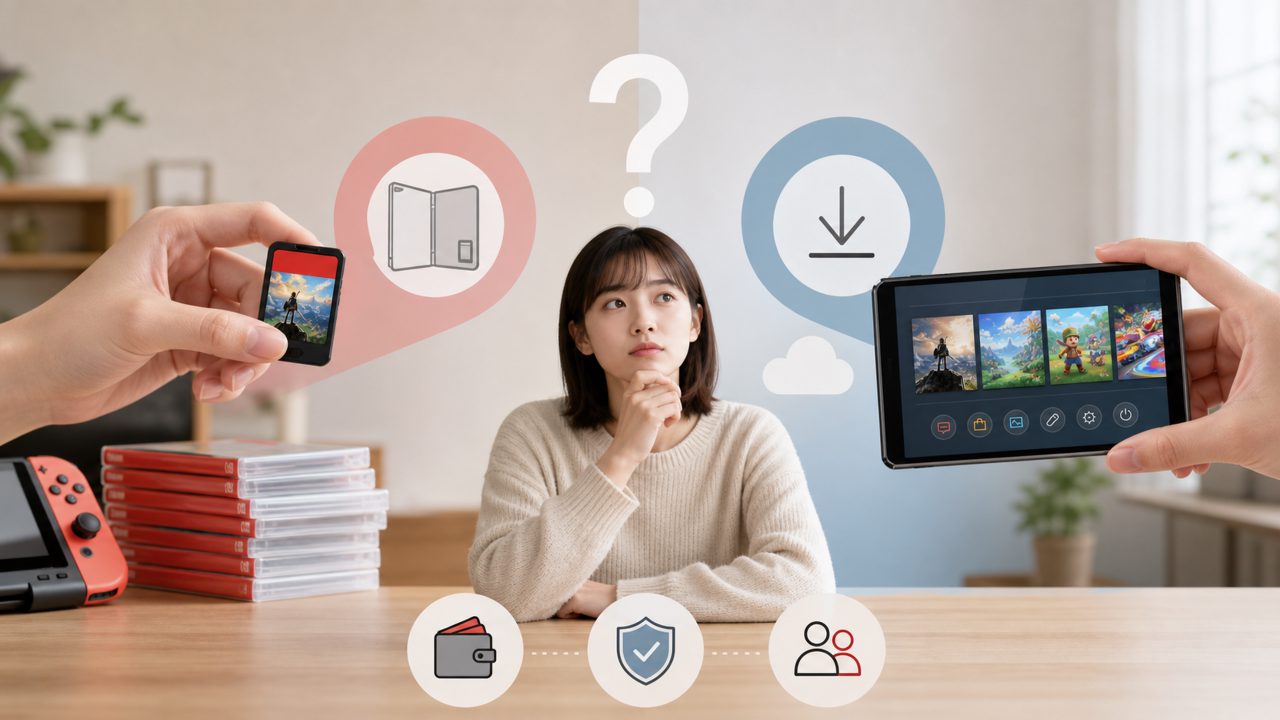
When buying a Switch, many people struggle with one question: should I get a physical cartridge or a digital version? There's no standard answer, but if you have a strong attachment to owning a physical item or plan to resell it after finishing, then cartridges are indeed the better choice. Below, we'll directly address the most frequently asked questions without beating around the bush.
What exactly is a Game Card? How is it different from the digital version?
A Game Card is the physical game cartridge for the Switch—insert it into the console and play. The digital version is downloaded from the eShop to your console and doesn't require a card.
The core differences are three:
- Cartridges can be sold or lent to friends; digital versions cannot (unless you give away your entire account).
- Cartridges don't take up console storage space (save data still does), while digital downloads often eat up space.
- Cartridges require swapping to change games; digital versions make switching games more convenient.
If you enjoy collecting physical boxes and cartridges, or aren't sure if you'll play a game long-term, cartridges are the safer way to start.
Are cartridges fragile? Will they stop reading after long use?
Under normal use, Switch cartridges are more durable than you think. As long as you don't frequently touch the gold contacts (the row of metal pins on the back), keep them away from humidity, and avoid direct sunlight, they should be fine for years.
However, there is a real issue: some people insert and remove cartridges too often, or force them in without proper alignment. Over time, the spring pins in the slot can loosen, causing poor contact. This isn't the cartridge's fault—it's about usage habits. When inserting a card, first check the orientation, gently push it in until you hear a click.
Additionally, if you get a used cartridge, you can wipe the gold contacts with a soft cloth. Sometimes a failure to read is just dirt on the contacts.
Why do some cartridges prompt for a download update when inserted? Isn't it the full version?
This is a common 'pitfall' many encounter. The cartridge does contain the game's base data, but many games release update patches after launch (fixing bugs, adding content, balancing). These patches are not on the cartridge and must be downloaded online. Also, some games (especially larger third-party titles) don't have the full game on the cartridge—only part of the data, with the rest requiring a download.
So if you plan to play offline for a long time, check whether the game is 'complete on cartridge' before buying. Most first-party Nintendo games (like The Legend of Zelda or Mario series) are largely complete on the cartridge, but some online multiplayer games may have stripped-down single-player modes.
If you're looking for reliable 'Nintendo game recommendations' or specific 'Switch game recommendations', check player feedback in gaming communities to confirm what's on the cartridge before ordering.
Which is more cost-effective: cartridge or digital? Let's do the math
In the short term, digital versions often go on sale (e.g., Nintendo's own vouchers, bigger discounts on third-party games), while cartridge launch prices remain relatively firm. But if you consider 'selling after finishing', the actual cost of owning a cartridge is often lower.
For example: buy a cartridge at launch for 350 yuan, finish it, sell it second-hand for 200–250 yuan, so you effectively spent 100–150 yuan. Even if the digital version is on sale for 250 yuan, you can't resell it, so you spend 250 yuan. Long-term, unless you never plan to sell your games, cartridges save you money.
However, digital versions have their value—for instance, if you often play online with friends, hate swapping cartridges, or play long-update games like Animal Crossing where jumping in anytime is convenient. Also, many 'two-player Switch games' that are motion-controlled or party games can be a hassle to swap cartridges frequently; digital versions are better for such scenarios.
Where are cartridge save files stored? Will saves be lost when swapping cartridges?
Save data is stored in the console's internal memory (or on the SD card you insert), not on the cartridge. So when you remove a cartridge and insert another, the previous game's save remains on the console. Reinserting the same cartridge later will let you continue from that save.
But one thing to note: if you use someone else's cartridge (borrowed or second-hand), the game will load your own save, not the original owner's. This is because saves are tied to the console and account, not the cartridge.
Also, if you switch consoles (e.g., from an old Switch to an OLED or Lite), you need to transfer saves via cloud save or the official system transfer tool. Don't expect to just insert the cartridge and have your saves move with it.
Can third-party docks or portable docks damage cartridges?
This question is more about whether the dock itself can harm the Switch console, rather than directly damaging the cartridge. Some low-quality third-party docks (or docks) have unstable power delivery, which could brick the console or damage the USB-C port—and then the cartridge inserted would be affected too. But if you use the official dock or a certified reliable third-party dock, there's no extra risk to the cartridge.
Speaking of Joy‑Con and Controllers: if your Joy‑Con drifts and the camera spins wildly while you're playing with a cartridge inserted, that's not the cartridge's problem—it's a controller issue. Many people confuse this.
What should I watch out for when buying used cartridges?
Mainly three things:
- Are the gold contacts noticeably scratched or oxidized? (Light marks are normal; dark oxidation spots are a concern.)
- Is the cartridge case original? (Some sellers use aftermarket cases for original cartridges; the build quality differs a lot.)
- Does the game include download codes or bonuses? Codes that came with the cartridge may have been used—ask before buying.
Also, some games (like Ring Fit Adventure or the Labo series) sell accessories and cartridges separately. When buying second-hand, confirm whether accessories are included—don't end up with just a cartridge that you can't play.
If you're unsure which games are safe to buy used, check 'indie game recommendations' or 'game rankings'. Many indie game cartridges are cheap and content-rich, so the price difference between new and used is small. For a more complete list, browse 'game encyclopedia' platforms and filter by type.
Summary: When should you buy cartridges?
Good for cartridges: You want to resell after finishing, enjoy collecting physical items, have poor internet (slow downloads), aren't sure you'll stick with the game, or plan to swap games with friends.
Not suitable: You frequently switch games and find swapping annoying, have multiple Switches and want to sync saves easily, or really love a game and want to jump in anytime (like Splatoon where you play one round daily).
There's no absolute right or wrong—only what works best for you. Think about your own gaming habits before buying, rather than blindly following reviews. One final note: don't be tempted by extremely cheap cartridges that can't be verified—getting a defective or fake card is a real loss.
Comments
Leave a Comment