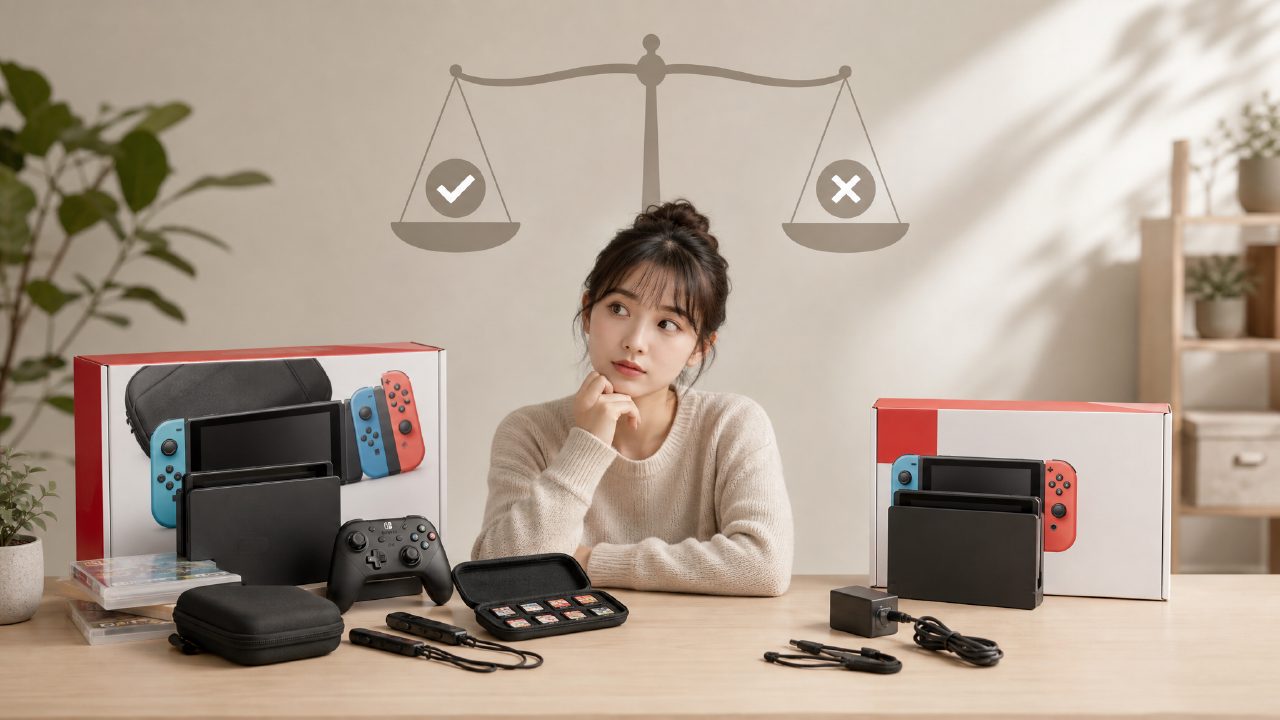
Every time I see the word "Bundle," my heart skips a beat. Not because I'm not tempted — I'm genuinely afraid of getting a bad deal. Switch bundles come in so many varieties that it's dizzying: ones with games, ones with accessories, ones with memberships. They all seem like a steal at first glance, but when you think about it, half the stuff might be things you never use.
If you're struggling with whether to buy a certain Bundle, or just want to understand which type of bundle is worth your money, this article should help. My principle is simple: every penny you spend has to go toward something you'll actually use.
What types of bundles are there? Don't be fooled by the box
Let's start with a simple classification. Nintendo and third-party bundles come in all shapes and sizes, but they generally fall into these categories:
- Console + Game: The most common type, like the Mario limited edition or Animal Crossing limited edition. The console has a different color scheme, and the box includes a game card or a download code.
- Console + Accessories: For example, bundling a Pro Controller, a carrying case, or an extra pair of Joy-Cons — yes, that's the much-criticized "rip-off Bundle".
- Digital Game Collections: Often available on the eShop, these indie game bundles let you buy a collection for a fraction of the price of buying separately.
- Game + Peripheral: For example, Ring Fit Adventure, where the Ring-Con and game are sold together — almost everyone has one.
Let's go through each one to see which are worth it and which to avoid.
1. Console + Game Limited Edition: Great for newcomers, but not for everyone
If you're a new Switch player, this kind of Bundle is actually the most hassle-free option. A console plus a popular game costs a few hundred less than buying them separately, and many limited edition consoles have really nice color schemes — like the Splatoon 3 one, which has a very striking color.
But there's a hidden issue: the game might not be the one you want. If the game in the Bundle isn't what you're after, the money you saved becomes meaningless. Many bundles come with Mario Kart 8 Deluxe, a staple on Nintendo's recommendation lists, but if you're only interested in indie game recommendations, that game card might just sit on the shelf.
So before buying, ask yourself: Will I actually play this game? If the answer is "not sure," then buying the console separately gives you more flexibility.
2. Console + Two-Player Accessories: Looks like a deal, but has hidden catches
The most ridiculous Bundle I've seen is one that includes a Pro Controller and costs only 200 more. A Pro Controller alone costs several hundred on the official store, so it seems like a bargain. But — did you actually need a Pro Controller?
For example, if you're buying a Switch to play two-player Switch games, you'd probably need an extra pair of Joy-Cons, not a Pro Controller. And many bundles deliberately don't give you what you need most.
Common tricks:
- Bundling a multiplayer game without an extra controller — you'll have to buy one later to play.
- Including a third-party dock case that feels mediocre, but you have no choice.
- Bundling an outdated game with a stubbornly high price.
In short: Accessories and games only save you money if you actually use them; otherwise, they're a waste.
3. Indie Game Bundles on the eShop: The most underrated
Many new players don't know this — the eShop often has "Build Your Own Bundle" or themed collections. For example, pixel-art, roguelike, or puzzle games sold together, where three games cost as much as one full-priced game.
This is a treasure trove for indie game recommendation enthusiasts. Games like Hades, Celeste, and Stardew Valley frequently appear in various collections. But the catch is that there can be a noticeable quality gap between the games you want and the "filler" games in the bundle. Before buying, it's best to check the ratings on a game ranking chart and read the gameplay descriptions in a game guide to see if it's your cup of tea.
By the way, many players in the Xingba community have scored great deals this way. If a bundle has two games you already want and one that's "acceptable," then it's probably worth buying.
4. Game + Peripheral Bundles: Ring Fit is the classic, but it's the only one
This one doesn't need much explanation. Ring Fit Adventure is the standard game + peripheral bundle — the Ring-Con, leg strap, and game card all in one box, ready to play. There's really no alternative; they have to be bought together, and the price is transparent.
But if you see other non-official peripherals bundled with a game — like a random controller plus a game — be cautious. Third-party controller quality varies widely, and many just slap a brand name on it and charge a high price. In the end, these bundles are more about clearing inventory than looking out for you.
So, how do you choose a bundle without losing out?
I've set up a simple decision process for myself:
- Is the game or accessory you want already included in the bundle? If yes, it might be a good deal.
- Were you planning to buy the bonus items in the bundle anyway? If yes, then you're saving money.
- Do you already own a physical copy of any digital content in the bundle? If yes, don't buy.
Also, in the Xingba community, people often share which Bundle is worth getting now and where the discounts are — much more efficient than browsing the eShop yourself. Especially for those niche indie game recommendations and two-player Switch game combos, following community discussions can help you avoid many pitfalls.
Final Word
Bundles aren't charity; they're business. The logic behind them is that sellers want to move a less popular item by attaching it to a popular one. As long as you can tell which is the "popular" item and which is the "add-on," you won't get ripped off.
Save where you should, and don't force a bundle just to get a discount when buying separate items is better — once you find that balance, you'll always come out ahead, not the manufacturer.
Comments
Leave a Comment