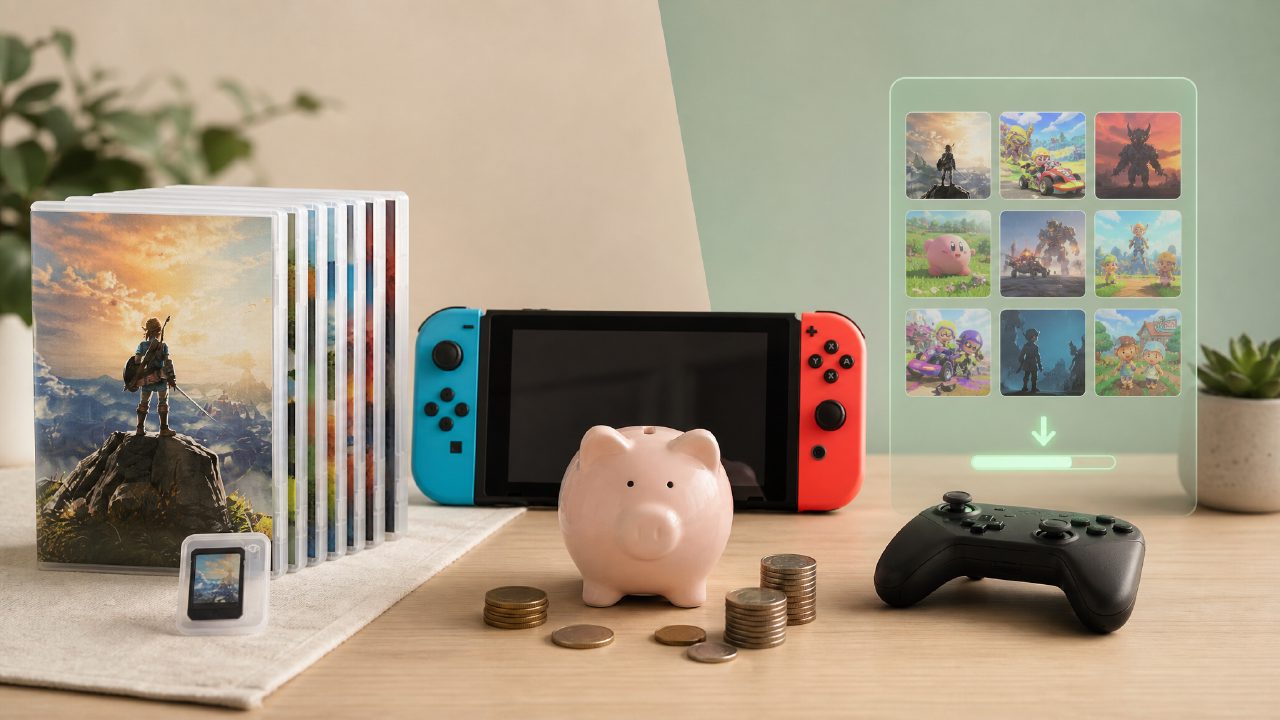
Before buying a Switch, many people thought 'finally I can play those Nintendo masterpieces.' But when the console arrived and they opened eShop to browse, they found it wasn't that simple — there are too many games, and they have no idea which to download; a more realistic problem is that the cost of 'buying games' is much larger than expected.
This is not your problem. Game prices on the Switch platform have always been high, especially first-party exclusives, which may not even get a 30% discount two years after release. Plus, many people find after buying the console that they don't have much time to finish every game. The result is: cartridges collecting dust, or several 'impulse purchases' sitting in the eShop account with only half an hour of playtime.
To buy games, should you go physical or digital?
There is no standard answer to this question, but if you compare the actual costs of the two options, the conclusion becomes much clearer.
The advantage of physical cartridges is the ability to recoup costs. After finishing, you can sell them second-hand; with luck, you only lose the shipping fee. The downside is you have to constantly swap cartridges, especially when playing two-player Switch games or at multiplayer parties — not having the right cartridge on hand is a downer. Also, physical cartridges go on sale much less frequently than digital versions, and popular titles remain pricey year-round.
What about digital? eShop has discounts every now and then, especially on the US and European servers, with deals so good you'll wonder if you overpaid before. The downside is that accounts are tied to the console, making things troublesome when switching devices or if account issues arise. More importantly, once purchased, there are no refunds or exchanges, so the sunk cost of 'buying the wrong game' is high.
The 'invisible' costs in eShop
Many people overlook one thing: the total number of games on eShop has long exceeded 10,000. Finding truly worthwhile games in such a vast pool is itself a daunting task. You scroll through the rankings for an hour, look at covers and descriptions, and in the end, you still might not dare to make a purchase.
That's why more and more people are now turning to Switch game recommendations and Nintendo game recommendations from player communities. It's not necessarily about ratings, but about real player feedback — which game has a reasonable completion time, which game has stable online play, which game is suitable for gathering with friends on weekends. This information is much more reliable than official promotional images.
Another thing is 'buying a family membership.' Many people get a family membership on their own, costing over a hundred yuan a year, just for online play and cloud saves. But in reality, if you share the cost with a few acquaintances, the per-person cost can drop to twenty or thirty yuan. This is essentially an invisible money-saving strategy — your actual need is the online functionality, not 'exclusive membership slots.'
Digital sharing and pooling — is it worth it?
Now many players choose the 'pooling' model: several people jointly buy a digital game, or share the console privileges of one account. This approach seems cost-effective to some, but others worry about the risks.
First, the worthwhile aspects. If you only play on weekends, or your interest in a game lasts only two or three weekends, then pooling is indeed much cheaper than buying alone. Especially for some niche gems in the indie game recommendations category, buying individually isn't cheap, but after pooling, the per-person cost is just a dozen yuan, making the trial cost almost zero.
But the problem is: account sharing comes with uncertainty. For example, if the main account changes its password, or if Nintendo suddenly tightens its policies, you might lose access in an instant. So my advice is — pooling is suitable for games you 'play and discard,' such as story-driven games you finish and move on. But for games you plan to play long-term, like 'Splatoon 3' or 'Mario Kart 8 Deluxe,' it's safer to buy your own copy.
With so many games, how to choose without stepping on a landmine?
Many people open eShop and see a screen full of '90% OFF' and easily think they've found a bargain. But in reality, the games with the steepest discounts are often 'filler games' that no one buys. They look cheap, but when you buy them, you can't even play them.
A more reliable method is to look at two things: one is the game ranking list, but not the overall list — instead, look at category lists, such as 'local multiplayer,' 'casual puzzle,' 'co-op campaign' — these segmented dimensions. The other is a game encyclopedia-style summary, which lets you quickly understand the actual genre, platform compatibility, and approximate completion time of a game, rather than being led by the cover art and trailers.
In the end, the biggest pitfall in buying Switch games is never 'expensive,' but 'buying the wrong one.' Digital sharing, family membership pooling, physical resale, waiting for eShop discounts — each method has its applicable scenarios. There is no absolutely correct solution, only the choice that fits your current gaming habits.
Comments
Leave a Comment