To be honest, every time someone asks me "What fun adventure games are on the Switch?" I have to pause for a moment. Because the term is used so broadly—some people want an open world like Breath of the Wild where you traverse mountains, while others just want to solve puzzles and run around before bed. After I inserted this cartridge into the console, I realized the same game can be two entirely different experiences in different people's hands.
At first, I was almost put off
In the first five minutes of opening the game, the visuals didn't impress me. The lighting was flat, distant details were mediocre, and the textures weren't refined either. But what really kept me going was the control feel—the split design of the Joy-Con actually works better for small-scale adventures than the Pro Controller. When adjusting the view with the right stick, your left index finger naturally rests on L/ZL, making the whole operation very intuitive. Switching to handheld mode felt a bit lacking—details are hard to see on the smaller screen, and during puzzle sections, you can easily miss hints.
However, this advantage in feel only holds during exploration. In continuous combat situations, the unstable feeling of the Joy-Con as a "palm treasure" emerges—during intense maneuvers, you're always worried it might slip out of your hands. Switching to a third-party controller with grips feels much more stable, but the trade-off is that the vibration feedback becomes muddled—the original HD Rumble really has its place in adventure games.
A specific fork in the road that made me hesitate
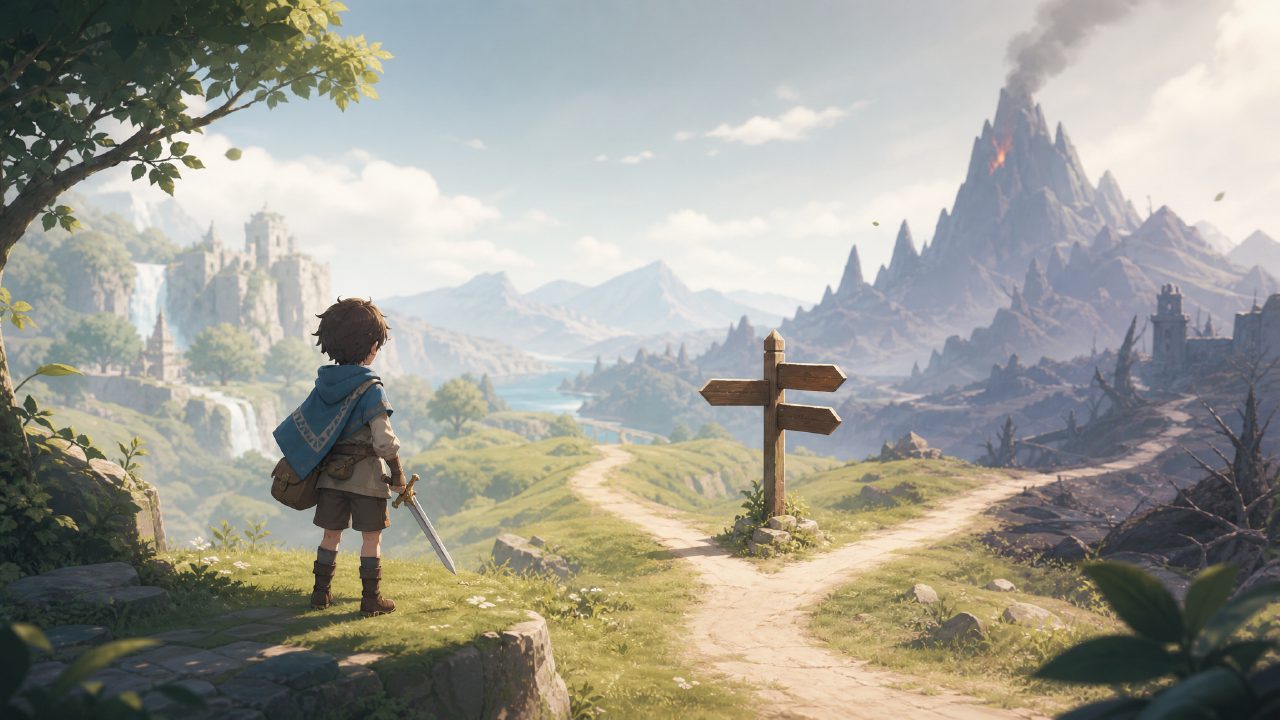
Midway through the game, there's a three-way fork: the jungle on the left, the desert on the right, and ruins straight ahead. I checked the equipment already unlocked in my guide and realized I didn't have enough fireproof potion strips—forcing my way through the jungle would likely drain my health from the heat. Going through the desert had a mission from an NPC commonly found in lists of Nintendo game recommendations, but the reward was a sword I already had. In the end, I chose the ruins, only to find cramped elevator battles inside. In these confined scenes, the Joy-Con's small sticks actually felt more responsive than larger ones—an unexpected gain.
This trade-off made me realize something: in adventure games, the branching choices are often not about "right or wrong," but about "what you're lacking right now." If you're just starting out, I recommend checking player notes in the Switch game recommendations community—it can save you hours of wasted effort.
In two-player mode, it's a completely different logic
I tried multiplayer split-screen. This is one of the few experiences truly worth defining as a two-player Switch game—not the kind where one person fights while the other waits, but one where both players must operate mechanisms simultaneously to progress. However, the trade-off is that with the screen split in half, the single Joy-Con's already narrow field of view becomes even tighter. If both players use Pro Controllers, the experience improves significantly, but that requires having two of them.
Also, this split-screen mode isn't suitable for a small bedroom TV—even anything under 55 inches feels cramped. Only a large living room screen can do it justice.
The balance between navigation and side quests—my biggest struggle
As someone who grew up playing linear adventures from lists of indie game recommendations, I found myself conflicted when faced with this design that scatters numerous side quests in every corner. On one hand, exploration does pay off—some hidden chests contain weapons with stats far exceeding the current chapter. On the other hand, wandering completely randomly can easily lead you to a level-overpowered area, where you end up chipping away at enemies for ten minutes. The method I eventually adopted was: every time I entered a new area, I first checked the main quest order recommended by players on the game rankings, then explored according to that rhythm to avoid being discouraged by numerical difficulty.
It should be noted that this game's map guidance is deliberately subtle. If you're used to the "big marker pointing you forward" style of guidance, you'll find yourself frequently flipping through the game guide for clues in the first dozen hours. This isn't a flaw, but it does cater to a specific type of player. Those willing to spend time reading maps, memorizing terrain, and paying attention to NPC dialogue details will love it; those who just want to open the game and casually roam after work might find it annoying.
The final compromise on controller choice
To this day, I still haven't fully decided which controller setup to use. The Joy-Con is indeed comfortable during puzzle sections—the split grip lets your hands hang naturally. But during long exploration treks and close-quarters combat, the stable grip and heavier trigger buttons of the Controllers are clearly more advantageous. In the end, I compromised: I use the Joy-Con for exploring new areas, then switch to a larger controller before entering a dungeon. It's not a perfect solution, but at least neither side feels too uncomfortable.
If you're also on the fence about whether to dive in, my advice is: first determine whether you enjoy "exploration and discovery" or "combat satisfaction" more. For the former, Joy-Con is enough; for the latter, prepare a controller budget before starting. As for whether to bring a friend along, the prerequisite is that both of you have the patience to get through the first two hours of adjustment.
Comments
Leave a Comment