If you want to experience simulation games on the Switch, it's easy to fall into a trap: games that look similar on the surface can have vastly different actual experiences. They're all called "simulation," but some feel like playing a digital version of house, while others suck you in and won't let you go. So, instead of a general introduction, this time we'll directly compare several groups of similar simulation games to help you save some trial and error costs.
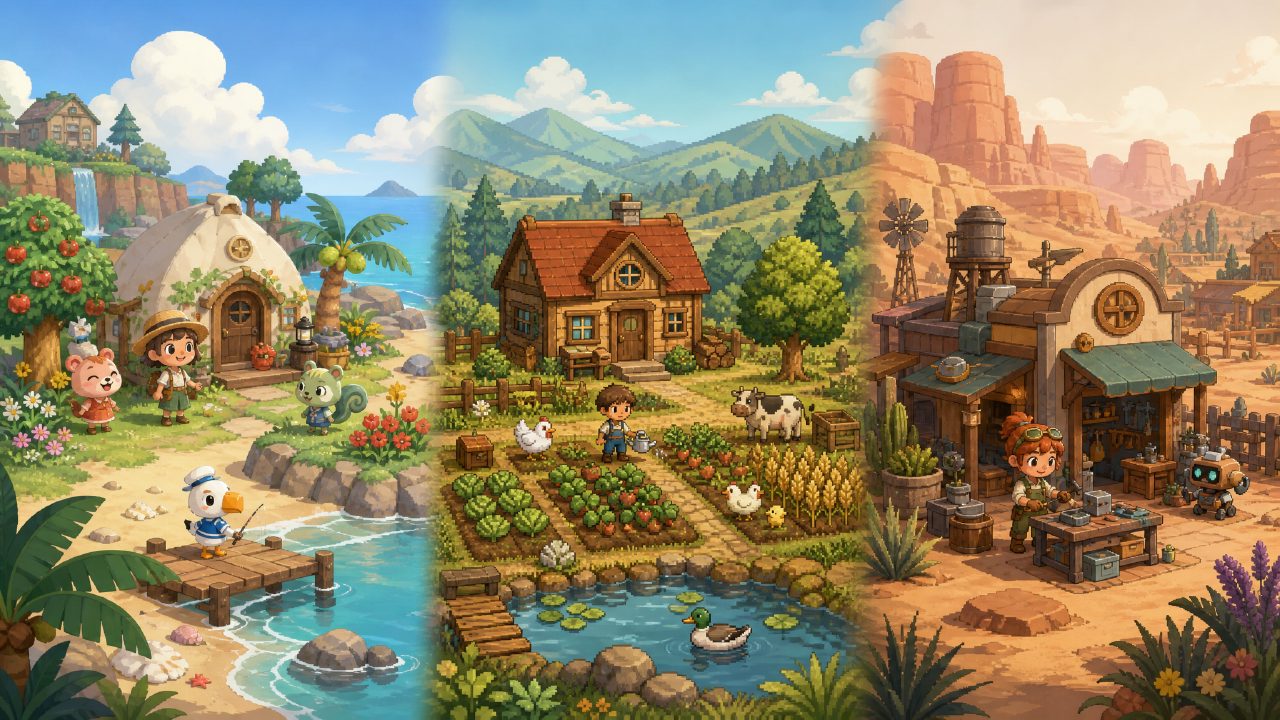
Life Simulation: Animal Crossing vs Stardew Valley vs My Time at Sandrock
These three are the most talked-about life simulation games on the Switch right now, but the gameplay is completely different. The core of Animal Crossing is decoration and socializing. There are almost no rigid goals on the island—you can just lie around if you want, making it perfect for fragmented playtime. But if you're expecting deep character development or a compelling story, you'll likely be disappointed—its "everyday feel" can actually create a fatigue of feeling like you have to log in to collect things even when you don't want to.
Stardew Valley, on the other hand, blends farming, mining, romance, and combat into a tighter package, with clear tasks to do every day. However, its pixel art style and relatively simple combat system can be a barrier for some players. If you want a smoother, more modern visual experience, My Time at Sandrock excels in building and quest volume, though the Switch version's loading times and frame rate optimization aren't perfect—especially noticeable stuttering in mid-to-late game when more scenes appear.
If you're looking for a life simulation you can play long-term, prioritize your own patience level: choose Animal Crossing for light socializing, Stardew Valley for faster, more immediate system feedback, and give Sandrock a try if you don't mind frame rate issues and want deeper content.
Management Simulation: Two Point Hospital vs Two Point Campus vs Parkitect
The common problem with this type of game is that they're fun at first but become repetitive later. Two Point Hospital wraps management in humor—details like patients queuing and doctors slacking off make you smile—but as you progress through levels, it mostly becomes about repeated expansion and number stacking, and the novelty wears off quickly.
Two Point Campus differentiates itself thematically by swapping "hospital" for "campus" and adding course scheduling and club systems, but the underlying operations haven't fundamentally changed. If you've already played the hospital version, the campus version feels more like a reskin than a new gameplay experience.
In comparison, indie game recommendation Parkitect may have simpler graphics, but its complexity in logistics management and visitor behavior simulation far exceeds the other two. It's better suited for players who enjoy "number crunching" rather than "watching a show."
Simulation Racing: Grid Autosport vs MotoGP 23 vs Motorsport Manager
Racing simulation choices on the Switch are limited, and each comes with noticeable compromises. Grid Autosport, often mentioned in game rankings, offers the smoothest racing simulation experience in handheld mode, with handling that sits between arcade and sim, and decent controller feedback. However, its graphics are clearly last-gen and don't look great on a big screen.
MotoGP 23 is a motorcycle simulation with a higher skill floor—players need to get used to braking and lean angles, which can easily turn off beginners. But for those in the know, its physics simulation is more detailed than Grid—crashes, tire wear, and track temperature all affect performance. The downside is inconsistent frame rates, especially noticeable lag when multiple bikes start together.
Motorsport Manager is a "team management" simulation with nothing to do with driving. It's more like a track version of Football Manager, suitable for strategy-oriented players. If you just want to drive, don't buy the wrong one.
Advice on Controllers
No matter which simulation game you choose, the Switch's Joy-Cons struggle to provide a stable experience. Especially in racing or management games that require frequent fine adjustments, the Joy-Con's stick precision and button feel fall short. For two-player Switch games in local co-op, it's recommended to have at least a pair of Pro Controllers or more compatible third-party controllers. When playing racing simulations, the difference between a controller with adjustable dead zones and response curves and the Joy-Con is almost the line between "playable" and "enjoyable."
Choosing a Simulation Game: Eliminate Those That "Look Fun" First
Many indie simulation games look rich in game catalogs but only offer a few hours of actual content. It's best to check two things before buying: player reviews on Steam or the Switch eShop (especially the negative ones), and mid-to-late-game playthrough videos from content creators. Because the core driving force of simulation games is the "loop"—whether the daily tasks give you a sense of satisfaction, not just the novelty of the start. In this regard, Nintendo's own titles are often the most polished, but there are also many cost-effective options among third-party games.
If you're at the stage of "wanting to play a simulation game but not sure which one to buy," first clarify whether you value socializing, management depth, or control feel more, and then narrow down from Nintendo game recommendations. Blindly following trends to buy popular titles will likely lead to pitfalls.
Comments
Leave a Comment