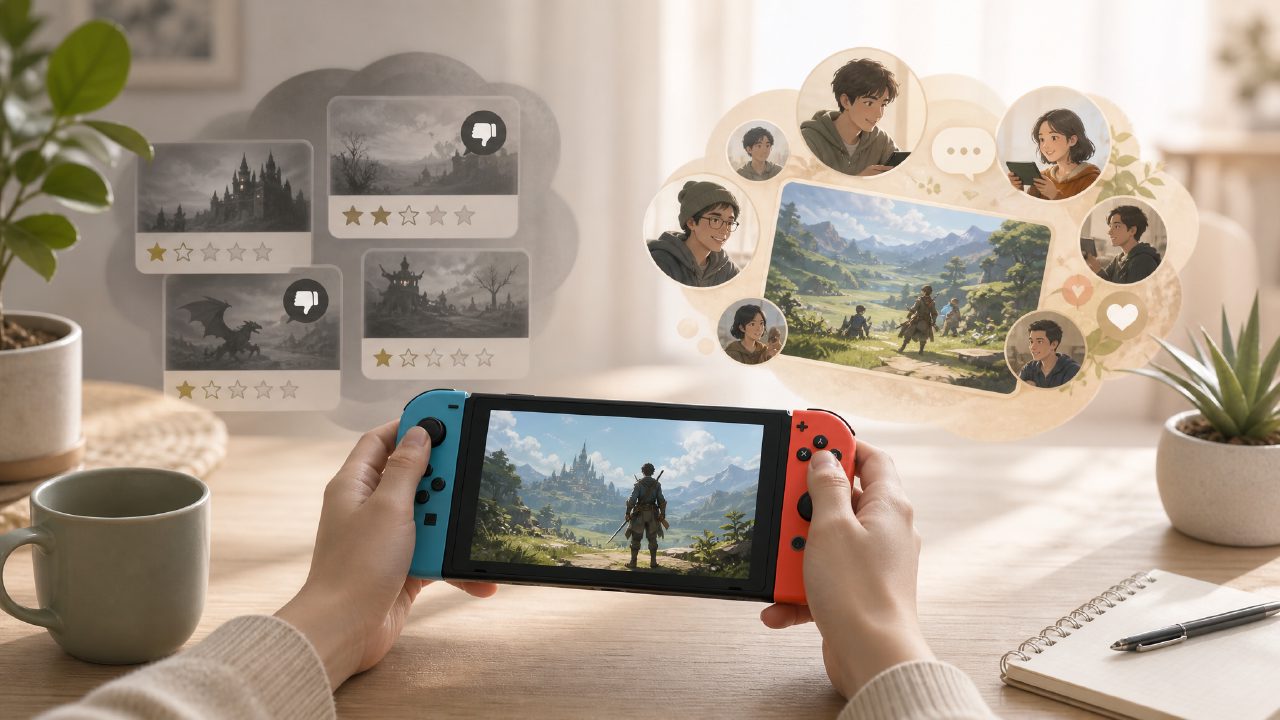
Open your Switch wanting to play an RPG, but after scrolling through the eShop for a while, staring at the “overwhelmingly positive” pixel art, JRPGs, Souls-likes, turn-based games… you end up even more unsure which one to pick. The number of RPGs on this console has long been excessive, but the proportion of those that truly leave you with “no regrets after buying” is not high.
The problem lies in the source of information. The reviews you come across are either passionate takes written before finishing the game, or media-style lists of pros and cons. But ask players in the community who have actually put in 80 hours, and their recommendations are often more direct and blunt — like “don’t buy that one, the story falls apart in the late game” or “the start is off-putting, but stick with it for 10 hours and it becomes a masterpiece.”
That’s why I think player communities like Xingba are more valuable than traditional review sites when it comes to choosing RPGs. You don’t need to go through all the reviews yourself; the community has real discussions about Nintendo game recommendations and Switch game recommendations, and the discussion atmosphere is practical—no hype, no hate.
For example: if you’re looking for an RPG to play with a friend, just search for the topic two-player Switch games. You’ll find that the games repeatedly mentioned aren’t the big blockbusters, but titles like Divinity: Original Sin 2—which has a slightly higher skill ceiling but offers excellent cooperative gameplay—or Ni no Kuni, a JRPG with charming art and a pace that makes it suitable for two players taking turns. You’d never see this information in the store page’s tag system.
Another common scenario: you have a limited budget and no obsession with AAA titles—just want a deep RPG to pass the time. In that case, focus on the indie game recommendations section. The quality of indie RPGs on Switch has risen in recent years, from pseudo-RPGs like Stardew Valley to short narrative works in the style of Yoko Taro. They cost only a third of major titles, but their unique art and storytelling are more worth savoring. Compared to those big titles that easily cost over 300, indie RPGs offer significantly better value for money—provided you know which ones are worth buying.
This brings up a practical selection method. My own habit is to first look at game rankings, but only the player-voted charts from the past month, not the all-time leaderboard. Old games are classics, but outdated graphics and controls can be a major turn-off for newcomers. In the rankings, you can also quickly spot currently updated online RPGs, like Monster Hunter Rise—which, strictly speaking, isn’t a traditional RPG, but the experience of farming gear, leveling skills, and teaming up to hunt monsters is core RPG gameplay.
More detailed than rankings is the game encyclopedia. This feature is especially crucial for RPGs, because the genre tags are too vague—under the label “role-playing” lurks dozens of gameplay types. A good encyclopedia categorizes by gameplay: turn-based, action, strategy, roguelike… and includes sub-tags like “multiplayer co-op,” “story-driven,” and “open world.” When searching, you can filter directly, which is much faster than reading ten reviews yourself.
Another easily overlooked point: before buying an RPG, it’s best to confirm its language support and DLC situation. Some Japanese RPGs only have Chinese in the Hong Kong region, or the base game is cheap but the DLC costs a fortune. These pitfalls are often mentioned in community posts, more detailed than the official FAQ.
To sum up my personal advice: if you’re an RPG player, instead of screening from scratch, make good use of the player communities around you. Use game rankings to narrow down the candidate pool, use the game encyclopedia for category filtering, and finally check Switch game recommendations or Nintendo game recommendations threads to see what veteran players say. This way, the chance of stepping on a landmine is much lower, saving both money and time. If you’re looking for two-player Switch games or cost-effective indie game recommendations, just search the keywords directly—the answers are often more straightforward than you think.
Comments
Leave a Comment