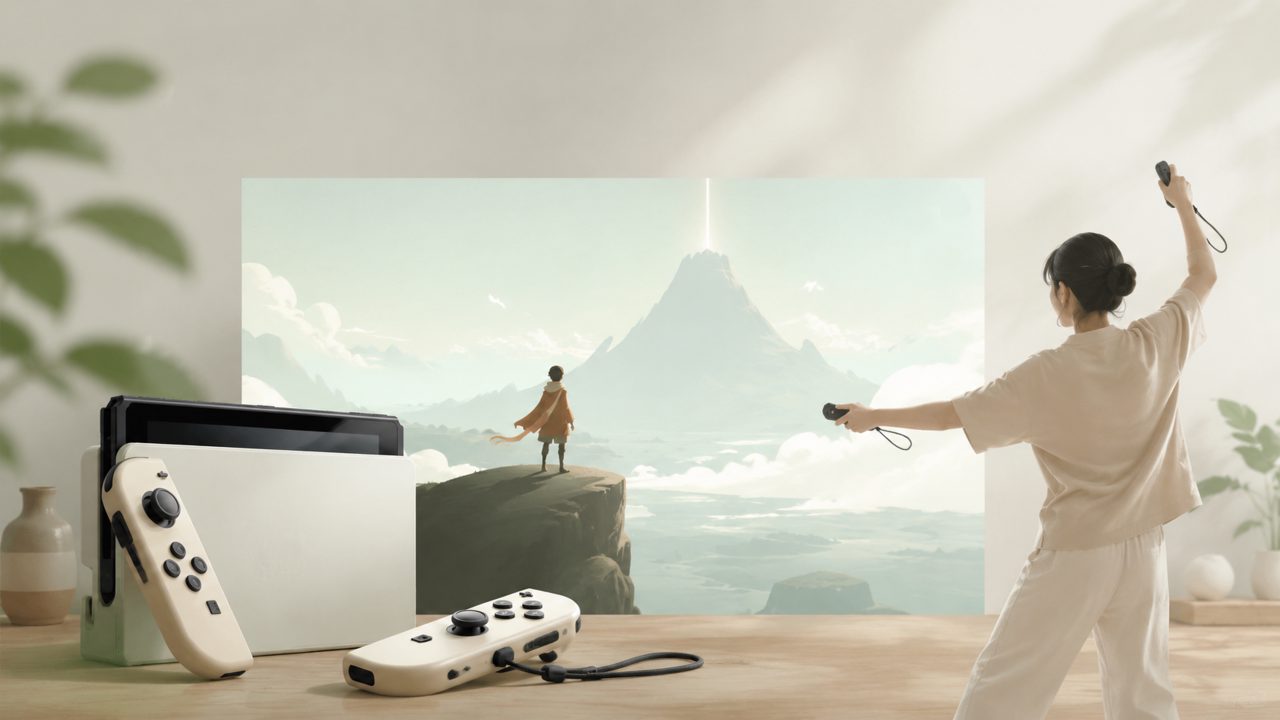
To be honest, the name Adventure isn't a hot topic on Switch. It's not like Zelda or Mario, where everyone nods when you mention the name. I originally looked it up because while searching for 'indie game recommendations,' I saw several foreign forums mentioning this kind of minimalist adventure game, so I picked it up on a whim.
After a week of playing, my feelings are mixed. Not all praise, but not a dud either. This thing depends on the angle you look at it.
First Impressions: What's More Old-Fashioned Than the Graphics Is Its Control Logic
I started playing in handheld mode. I detached the Joy-Cons and held one in each hand. The first time I entered the game, there was almost no tutorial. You stand in a pixel-art open scene with a few directions in front of you and a suspicious-looking hole nearby. Out of habit, I pressed the A button to interact—nothing. Pressed B—no response either. After fumbling for about two minutes, I realized this game doesn't rely on conventional buttons to progress.
Its core controls rely entirely on the motion sensing of your Joy-Con or any pair of Controllers. You need to hold the controller up in front of you as if actually holding something, tilt left and right to adjust the view, and wave up and down to perform interaction checks. For example, at that hole, you have to raise the controller to the screen and make a 'poke downward' motion to jump in.
This isn't a new design; similar things existed in the Wii era. But on the 2024 Switch, the motion controls aren't that sensitive. Especially in Console mode on the TV screen, the lag is noticeably one or two frames worse than in handheld mode. Playing in handheld mode is actually more responsive—strange, isn't it?
Two Scenes That Changed My Mind
One time was late at night, with all the lights off, relying only on the Switch screen's glow. There was a purely puzzle-based maze in the game where walls would flip as your gaze moved. You had to rotate your wrist very slowly and steadily to find the correct path. That sense of focus actually suppressed the hardware lag issue, because the 'sluggishness' of the motion controls in this scene turned into 'a need for patience.'
Another time was when a friend came over, and we tried two-player co-op in TV mode. This game surprisingly supports two people each holding one Joy-Con to explore together. Both players make motion judgments on the same screen, causing quite a bit of chaos, but it was genuinely funny. You can't help but wave wildly in the air, and then your character inexplicably falls into a pit on screen. If you're looking for an obscure 'two-player Switch game' suitable for couples or friends to mess around with, this one is worth adding to your consideration list.
There Are Plenty of Dealbreakers Too
I have to say, this game isn't for everyone. If you're looking for satisfying combat or a clear progression system, you can skip it outright.
The pace is really slow. Most of the time, you're observing, experimenting, waving the Joy-Con, and observing feedback. Some puzzle solutions have almost no logical clues and rely entirely on you accidentally trying a motion action. You might be stuck for twenty minutes only to find that you just need to flip the controller horizontally 180 degrees and place it on the table. With experiences like that, if you lack patience, you'll just quit the game.
Also, the visual style is very polarizing. Pixel art with minimalist colors—not the kind of refined artistry, but more like the level of a college indie game project. It definitely won't rank high on any 'game leaderboard.' If you care about graphical polish, I suggest watching some videos first before deciding.
Who Is It For? Who Is It Not For?
If I had to give a verdict, I'd say:
For —
- Players who have exhausted mainstream blockbusters and want to switch to a motion-sensing puzzle game for a change of pace.
- Those who enjoy spending time studying an obscure title and don't mind being repeatedly humbled by puzzles.
- Having one or two friends willing to sit on the couch and wildly wave controllers with you (the two-player mode is the correct way to play).
Not for —
- Players who prioritize visual presentation and narrative immersion.
- People with low tolerance for motion controls and sensitivity to lag.
- Scenarios where you only have fragmented time and can't settle down to repeatedly trial-and-error.
One last thing: if you're looking for 'Nintendo game recommendations' of this kind of motion-interaction, you might compare it with "1-2-Switch" or "Just Dance". But "Adventure" is quieter and more experimental, more like a tribute to the early Wii motion era. I can hardly call it a must-play, but it did make me rethink: besides pressing buttons, what else can a controller be used for to 'play' a game? That uncertainty actually became my most genuine gaming memory this week.
Comments
Leave a Comment