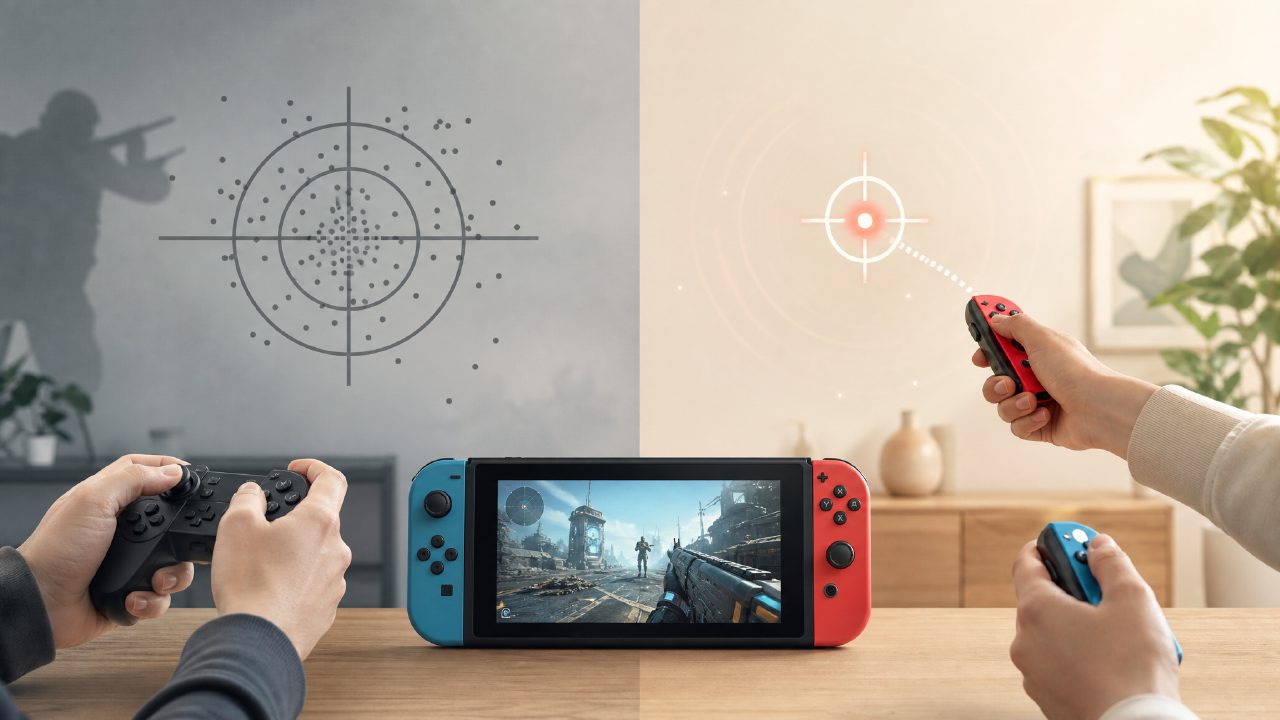
People who have actually played shooting games on the Switch have probably all experienced the same moment: holding the Pro controller, aiming at the screen, with the crosshair swaying like it's drunk, and then silently giving up on the idea. I used to think the same way, until I accidentally bought the wrong physical cartridge recommended by Nintendo, and was forced to seriously try out the games I had in hand. Not jumping to conclusions, let me first state the facts—the shooting game experience on the Switch is actually much richer than most people think.
Is Motion Aiming a Savior or a Gimmick?
Once the Joy-Con are detached, the gyroscopic motion aiming in the right controller is indeed the biggest variable in Switch shooting games. After trying three or four games, my personal take is: motion aiming is not a replacement for the right stick, but an aid. Setting the motion sensitivity to the lowest level and using it only for fine adjustments, while using the stick for large turns, this combination works quite smoothly for Splatoon 3.
But the trade-off is also obvious: holding the controller up for long periods really strains your shoulders and neck. Especially for games that require continuously holding up a weapon to aim, after half an hour, the fatigue in your arms is more noticeable than sitting at a desktop gaming for an entire night. And after getting used to Sony and Microsoft controllers, switching back to the Switch's motion controls leaves your palms sweating for the first ten minutes—the adaptation period is real.
What Shooting Games Can You Actually Play on This Platform?
Breaking down the types I know, you'll find that the Switch's shooting game lineup is actually quite layered:
Pure Shoot-'Em-Ups: The Doom series surprised me on the Switch. The resolution does drop in handheld mode, but the frame rate generally holds steady, and the portability of being able to pull it out and play a couple of levels anytime is something you just can't experience on a big screen. The downside is obvious—text is so small that it's nearly unreadable on handheld, so you have to rely on audio cues to fill in the gaps.
Online Competitive: Splatoon 3 truly understands Nintendo's game recommendation logic. The turf war mode suppresses the urge to "kill enemies," so beginners don't always get stomped, and advanced players have their own depth of gameplay. However, the matchmaking isn't perfect—sometimes you lose four matches in a row, clearly against a coordinated team farming points, and that can be frustrating.
Co-op Campaign: If you're looking for two-player Switch games, there are actually quite a few co-op shooting options. For example, some zombie-themed titles feature split-screen, which shrinks the screen significantly on the Switch, but the sense of teamwork in local co-op is something online play can't replicate.
Indie Shooters: There are plenty of gems hidden in indie game recommendations. For instance, some roguelike shooting games keep each run to about 20 minutes, perfect for a commute. The graphics are simple but the feedback is satisfying, and during eShop sales, you can grab them for under ten dollars—worth it depending on how many hours you put in.
A Few Unavoidable Trade-offs and Compromises
The Switch isn't a performance machine, so when playing shooting games, you need to consider three things:
First, frame rate. Most non-Nintendo first-party shooting games are locked at 30fps on the Switch. Switching from a high-refresh-rate monitor, the visible stutter for the first half hour is undeniable. It gets better after adapting, but if you're the type sensitive to frame rates, I suggest trying a demo first.
Second, network. The Switch's built-in Wi-Fi card is relatively weak. When playing online shooters, if you're far from the router, disconnections happen—I've experienced it more than once. A wired dock can solve the problem, but then you can't play while lying down—you have to choose between portability and stability.
Third, price. First-party shooters on the eShop rarely go on sale, while third-party titles often get steep discounts. I spent over three hundred on a major title, only to find the content comparable to a ten-dollar indie shooter. So before buying, it's much more useful to check game rankings and real user reviews than to watch trailers.
How to Tell If a Shooting Game Is Right for You
If you're about to open the eShop and search for "Shooter," ask yourself first: Do you value the portability of picking up and playing anytime, or do you care more about graphics and control precision? For the former, focus on first-party titles and well-optimized indie games; for the latter... honestly, the Switch might not be the best platform.
Also, keep an eye on the shooting category in game encyclopedias—many great games have names you've never heard of. There was one top-down shooter I played in handheld mode for a week, and only later realized the correct use of the invincibility frames during dodges. This kind of mid-budget surprise is actually the most interesting part of the Switch's shooting ecosystem.
Summary of Real Thoughts
Playing shooting games on the Switch isn't a mainstream choice, but it's definitely possible and can be enjoyable. Motion controls are worth adapting to, but you need to judge for yourself whether you can accept the shortcomings in network and frame rate. If you already own a Switch and don't want to invest in another device, or if you're looking for some fast-paced excitement during your commute, then pick one based on the directions above—chances are you won't run into major trouble. At least that's been my experience: from "Switch shooters aren't reliable" to "actually, it's okay"—it only took one concrete attempt.
Comments
Leave a Comment