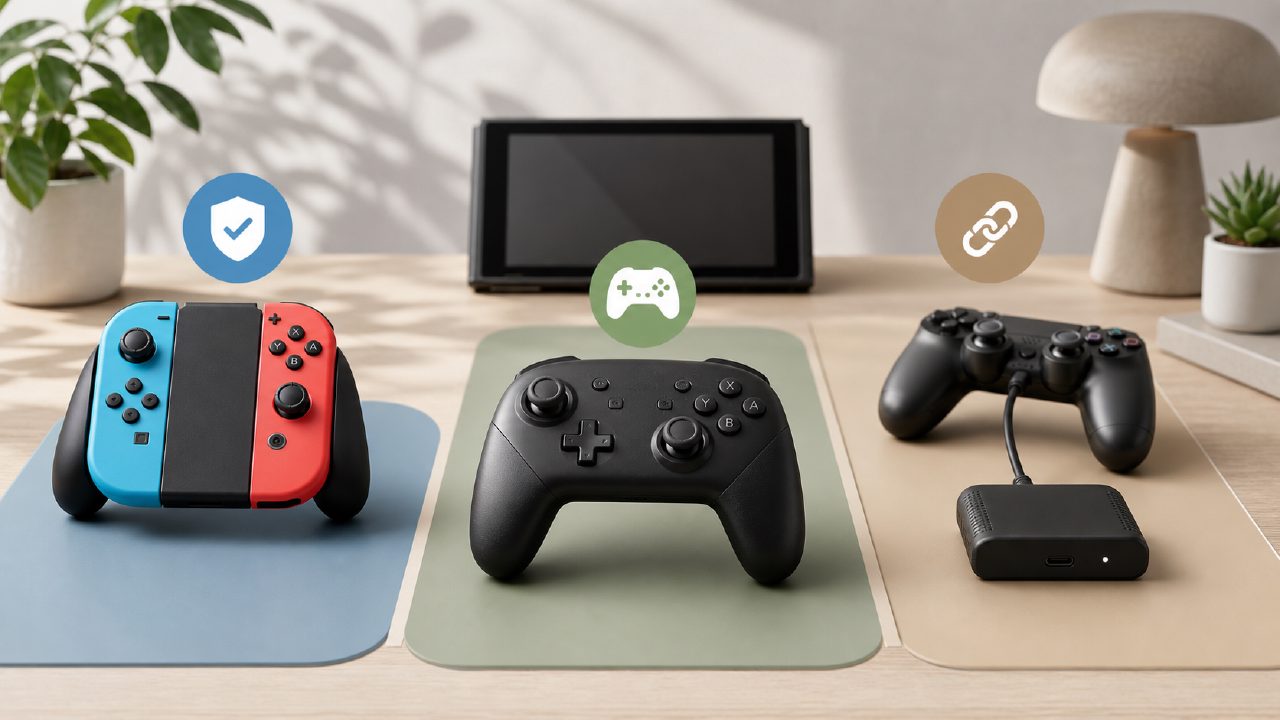
When it comes to choosing a controller, you'll face it sooner or later.
When you first buy a Switch, you might think the original Joy-Con is enough. That is, until you fail a dozen times at parrying in The Legend of Zelda's shrines, or get left in the dust by friends in Mario Kart 8 Deluxe, and start wondering: is the controller holding me back?
The key is that Switch controller choices aren't simple—Nintendo official, third-party manufacturers, retro styles, and even adapters that let you use controllers from other platforms. Each option comes with its own set of trade-offs.
Joy-Con vs Pro Controller: Internal Divisions in the Official Camp
The biggest selling point of the Joy-Con is its detachable design. Two people can split them and play, making them irreplaceable for party settings. If you often take your Switch out and play a lot of two-player Switch games, Joy-Con is a must. The downsides are obvious: joystick drift is an open secret, the grip feels small, and your fingers get sore after long sessions of action games.
The Pro Controller is a completely different direction. It has a solid grip, clear button feedback, and precise D-pad—for high-difficulty titles like Hollow Knight, one of the indie game recommendations, the Pro Controller experience is almost overwhelming. The official 40-hour battery life means you basically never worry about charging. The only barrier is the price—over four hundred yuan for a controller makes many people hesitate.
The biggest conflict between the two: you can't just pick one. If you enjoy parties and also want good hand feel, you'll have to buy both.
Third-Party Controllers: Unavoidable Compromises
Brands like IINE, HORI, 8BitDo, GuliKit have made significant progress in recent years. The most appealing is of course the price—you can get a controller close to Pro feel for just over a hundred yuan, and many brands directly include anti-drift Hall effect joysticks.
But in actual use, some detail issues emerge:
First is motion control accuracy. Playing Splatoon 3, which demands high motion sensitivity, the gap between third-party and official controllers is still noticeable. Second, some third-party controllers occasionally drop frames in wireless connection—though not frequent, it's annoying at critical moments. Then there's button feel—some brands' trigger buttons are too stiff, making it hard to control throttle depth in racing games.
If your main games are RPGs, simulation management, or story-driven titles from Nintendo game recommendations, third-party controllers are perfectly adequate. But if you mainly play competitive or hardcore action games, you might want to think twice.
Adapter Solutions: New Uses for Old Controllers
Using your existing PS5 or Xbox controller on the Switch is indeed a money-saving approach. A cheap adapter from brands like Brook or 8BitDo can do the job.
The advantage of this option is freedom of hand feel—you can migrate seamlessly if you like the Xbox controller's grip or are used to the PS5 controller's touchpad. The downsides are that some functions are limited on Switch: motion controls need separate mapping and may not be accurate; you can't wake up the console; some adapters have slight input lag.
It's clear who this suits: those who already have other platform controllers, don't want to spend extra, and can accept functional trade-offs. And who it doesn't suit: those who want simplicity, don't want to tinker with settings, and are sensitive to latency.
How to Choose Without Regret
First, look at the types of games you play. Mainly playing light-operation games like Pokémon or Animal Crossing: New Horizons? Joy-Con or cheap third-party controllers are enough. Often browsing game rankings for hardcore action games to challenge? Pro Controller or a third-party with Hall effect joysticks is worth the investment.
Then consider your usage scenarios. Most of the time playing solo masterpieces from Switch game recommendations? Prioritize Pro Controller. Always have guests over on holidays needing two-player? Keeping Joy-Con is wise. Paired with the cooperative games found in game library, one set of controllers can last a long time.
Finally, look at your budget. If money is no object, official Joy-Con + Pro Controller dual-wielding is the most worry-free. On a tight budget, focus on third-party Hall effect joystick controllers—domestic models for a few hundred yuan already cover most scenarios. Using the saved money to buy two more games actually gives a better experience.
Comments
Leave a Comment