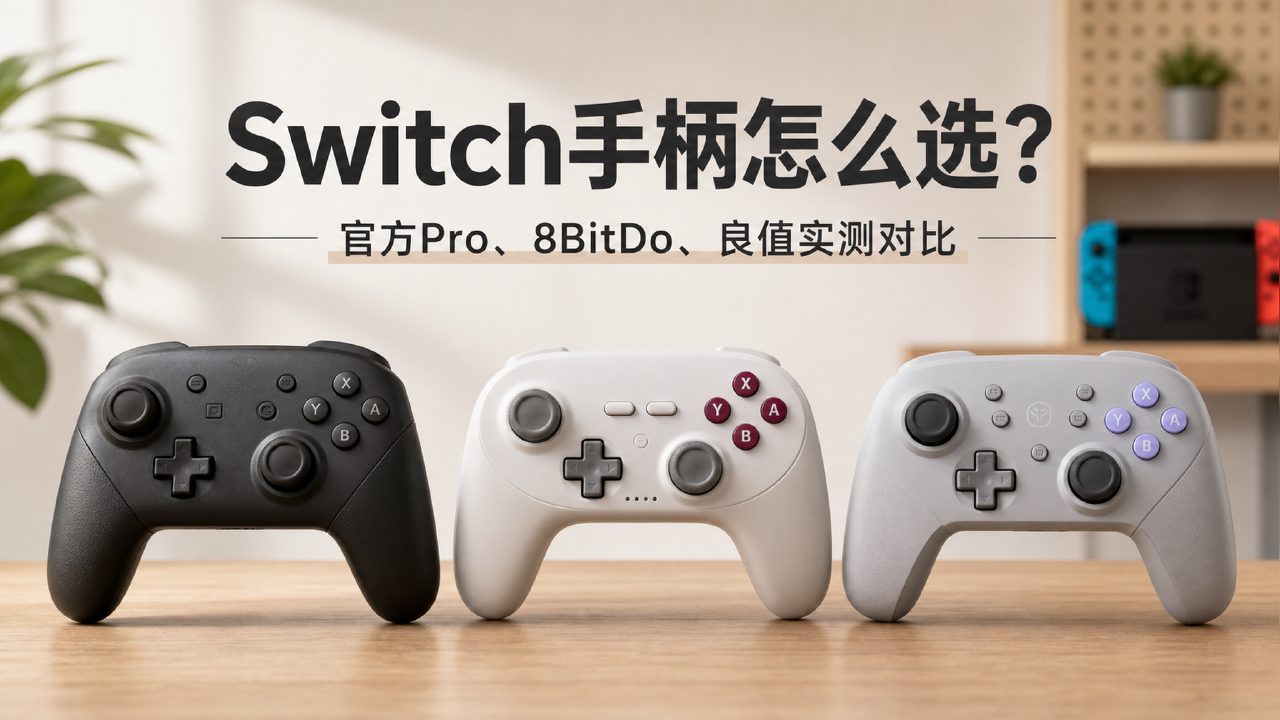
After buying a Switch, many people's first dilemma is: Are the original Joy-Con enough, or do I need to buy a dedicated controller? To be honest, the Joy-Con can be a bit awkward in some scenarios—the grip feels small, your hands get sore after playing action games for a long time, and the drift issue is a common topic. At this point, adding an extra controller becomes a practical necessity.
But there are many options on the market: the official Pro controller, 8BitDo, Liangzhi, PowerA... each with different price ranges and focuses. How to choose? We start from a few real-world usage scenarios and directly compare several mainstream options.
Official Pro Controller: Reliable but Expensive, Suitable for Most Heavyweight Games
The feel of the Nintendo Switch Pro controller is undoubtedly top-tier. The grips are full, the buttons have crisp feedback, and the HD rumble and motion controls are at the original level. Especially when playing heavy hitters like The Legend of Zelda or Diablo that require frequent inputs, the comfort is noticeably better than the Joy-Con.
But its price is also stable—usually over 400 RMB, occasionally dropping to 350 is considered a good deal. If you only play casual party games, this investment is not very cost-effective. Additionally, it lacks turbo and macro functions, so some action gamers might find it less "fun".
Situations where it's worth buying: 3A titles in the main Switch game recommendations, or for players who have high demands for rumble and motion controls. With a sufficient budget, the Pro controller is currently the choice that offers the most uncompromised overall experience.
8BitDo and Liangzhi: Cost-Effective Route, More Aggressive Features
Third-party manufacturers have made great progress in the past two years. The 8BitDo Pro 2 series takes a retro feel route, with D-pad accuracy even better than the official one. It's extremely comfortable for playing Street Fighter or pixel-action games in indie game recommendations. Its turbo function and customizable button mapping are very helpful in certain scenarios—for example, in RPGs that require repeated farming of materials, setting up turbo can save a lot of effort.
Liangzhi is closer to the official design, with a version that has back buttons and supports Turbo and adjustable turbo speed. The price is usually between 150-200 RMB. The downside is that the HD rumble is mostly simulated, feeling rougher than the official one, and when playing motion-control games (like Splatoon), the feedback may not be as refined.
The core advantage of this type of controller is that it's cheap and feature-rich. If you mainly play two-player Switch games and don't want to buy a second pair of Joy-Con (a pair can easily cost over a thousand), then spending two or three hundred on a third-party controller for a second player is a very practical solution.
PowerA's Wired Solution: Extreme Savings, But with Limitations
PowerA's Wired Controller has a high market share in Europe and America but is relatively niche in China. It follows an extreme low-price route, with entry-level models even under 100 RMB. The grip and button feedback are solid for the price range.
The trade-off is that it must be plugged in—fine for tabletop mode or docked players, but not convenient for lounging on the couch or taking on the go. Also, it lacks motion controls and HD rumble, so forget about playing Just Dance or Ring Fit Adventure from Nintendo game recommendations. The use case is very specific: playing in a fixed location while pursuing the lowest cost.
How to Choose? Here Are Some Specific Decision Points
- Primarily play single-player heavyweight games (Zelda, Hades, Odyssey) → Official Pro controller, the most comprehensive feel, no compromise on rumble and motion controls.
- Need to play two-player Switch games simultaneously, or occasionally farm materials → Third-party models with turbo (8BitDo Pro 2 or Liangzhi back-button version), the money saved can buy one or two indie game recommendations.
- Very tight budget, mainly play in docked mode → PowerA wired version, as long as it works normally, don't expect other features.
- Value D-pad and classic feel → 8BitDo series, compared to the official, they have an advantage in this detail.
Finally, I want to say: don't just look at the price, and don't just look at the brand. Browse through game encyclopedia or game rankings for the types of games you're interested in, and then work backwards to determine your controller needs—that will be more reasonable. After all, a controller is a tool, and whether it feels good to use ultimately depends on what that game in your hands needs it to do.
Comments
Leave a Comment