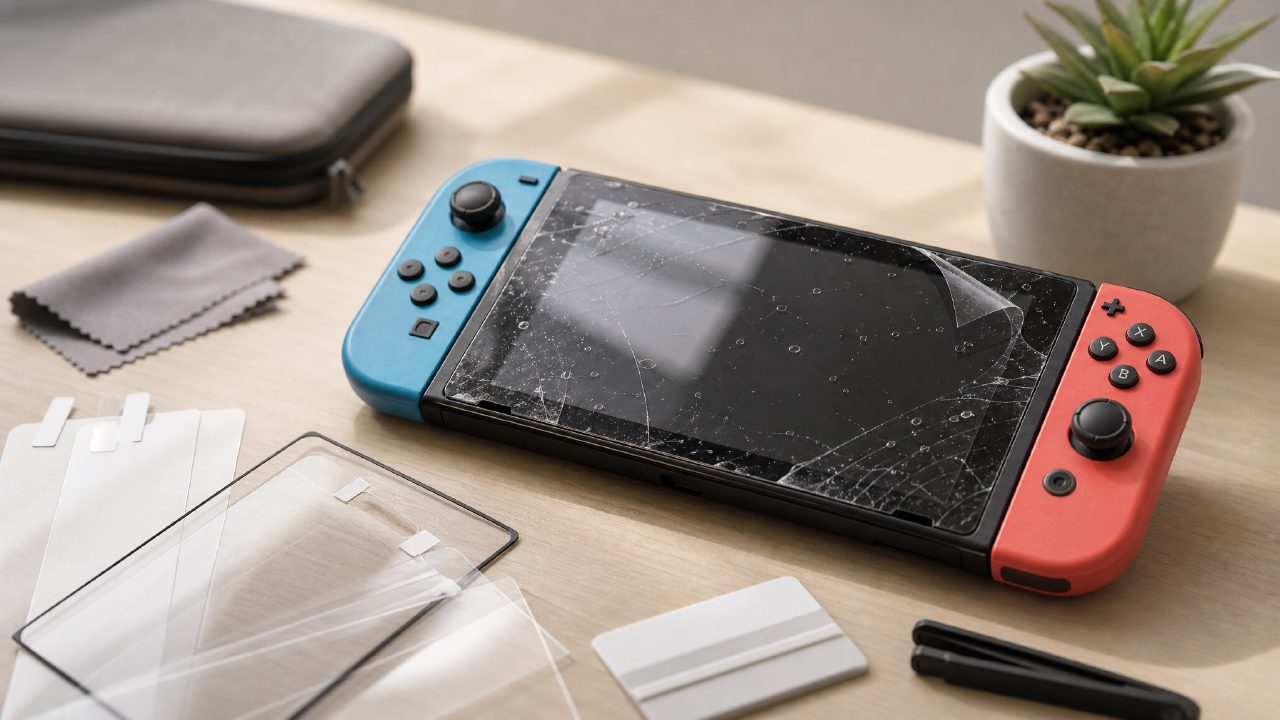
I hadn't even owned my Switch for a week before I started agonizing over whether to apply a screen protector. Some people online say it's unnecessary, that the original screen is durable enough; others insist you must use one, or the dock will teach you a lesson with scratches. I'm the kind of person who hesitates, so I decided to go without for now and use it bare for a while—only to regret it by the third day.
That day, I was playing a highly recommended action game from a Switch game list, and due to intense gameplay, the Joy-Con was swinging around, and the bottom right corner of the screen slammed directly into the edge of the table. When I picked it up, there was a 2-centimeter shallow scratch. Not deep, but when the screen was on, it happened to be right across the character's face, which was quite annoying to look at. So this isn't one of those "I used a protector for a few days and now I'll tell you" articles; it's a "I had no choice but to apply one" experience sharing.
Choosing: Material Matters More Than Thickness
When selecting a protector, I compared a few types. Hard glass protectors feel close to the original screen, but if you apply them crooked and peel them off, the edges easily chip. Soft protectors are easier to apply, but their anti-fingerprint capabilities vary. I ended up choosing a mid-priced tempered glass film, around 0.2mm thick, for this reason: the Switch itself isn't a phone, so it doesn't require frequent swiping, and a bit of extra thickness can better absorb bumps.
The application process wasn't smooth. On the first try, a speck of dust got in; I lifted it up and reapplied, but then bubbles appeared along the edge. I pushed them out with a card for a while before they barely disappeared. Later, I realized that before applying the film, you should let steam run in the bathroom for a bit to settle the dust in the air—this greatly increases the success rate.
Subjective Experience: Differences After Application
First is glare. The original screen's oleophobic coating gets oily over time, but after applying the film, it stayed cleaner. However, outdoors or under direct light, the reflection on the film surface is a bit more noticeable than on the bare screen. When playing those recommended indie games with dark tones, I need to adjust the angle slightly to see the details clearly.
Next is touch control. The capacitive touch latency after applying the film is almost imperceptible, but the resistance when sliding with a fingertip is slightly greater than on the bare screen. When playing Switch games for two players with high operation frequency, the finger feels a bit rough. It's not a big deal once you get used to it, but there is a brief adjustment period when first using it.
An unexpected improvement: the edges of the original screen are a bit sharp; applying the film actually wraps the corners, making the grip feel a bit gentler.
Trade-offs: Scenarios Where a Protector Isn't Ideal
A screen protector isn't a cure-all. If you primarily use the console in docked mode and the screen remains still for long periods, the protector is less meaningful, and it might even get its edges lifted by the frequent docking and undocking. One of my friends applied a film but found the dock was a bit too tight; every time he inserted or removed the console, the film would get squeezed, creating a gap, and he eventually just peeled it off.
Additionally, if you are very sensitive to screen clarity—such as when playing some beautifully detailed games from the recommended Nintendo game list and want to see the original colors and brightness—the protector will indeed slightly diminish the visual experience. This isn't due to a poor-quality film; it's a physical limitation of any covering.
As for drop protection? A film can shield against scratches and minor bumps, but if the drop is severe enough, even with a shattered film, the screen can still be damaged. So a screen protector is more like a "buffer consumable" and is less of a priority than a case.
To Apply or Not?
My advice: if you don't sweat much on your hands, primarily use the console at home, and rarely take it out, you might not need one. But if you, like many people, play during commutes, in queues, or at gatherings, then applying a protector is more worry-free. The cost of a film is far lower than the psychological cost of replacing a screen.
Since applying the film, I've continued browsing new titles on the game ranking list, occasionally flipping through the game gallery to pick my next target. The old scratch on the screen is almost invisible now that it's covered by the film. At least at this stage, I haven't regretted spending those extra few minutes putting it on.
Comments
Leave a Comment