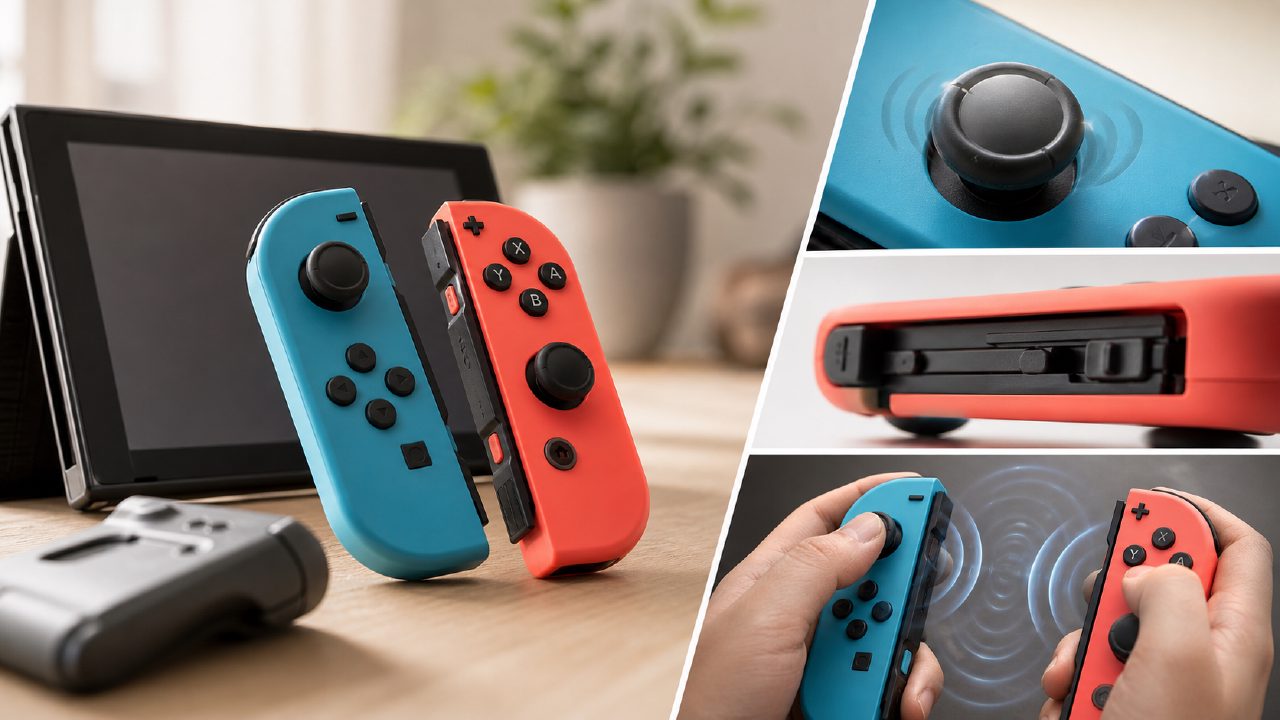
Joy-Con – every Switch player knows the name. But if you ask me for my honest feelings? This thing is a love-hate relationship, and my emotions are complicated.
Before you jump to praise or criticism, let me say this: I own three pairs of Joy-Con, used for over a year. Drift, looseness, the feel of attaching and detaching – I've experienced it all. This article isn't about "teardown reviews" or "lab data"; it's just the real, tangible feel of a regular player touching and using them daily.
The Contradiction in Your Hands
The best and most awkward thing about Joy-Con is how small they are. When you pop a pair off and hand one to someone else for a face-to-face round of a two-player Switch game, the liberating feeling of that compactness is immediate. No need to borrow another controller, no extra purchase required – just detach and hand over for picking fruit in Animal Crossing or drifting in Mario Kart.
But the problem is right there too – they're just too flat. If you have bigger hands like mine, playing something like The Legend of Zelda or Metroid Dread with a single Joy-Con will have your ring finger complaining after twenty minutes. And when set flat on a table as a makeshift grip, that little bump is more decorative than functional.
Also, I'm not sure if it's a batch issue. On one of my left Joy-Con, the rail has a slight wiggle when detached. Does it affect gameplay? Not really. But that subtle "click" feeling every time you attach or detach reminds you: this thing's ergonomics are the product of compromise.
I'm putting the downsides upfront because it deserves an objective look. Good is good, bad is bad – no need to force excuses for the sake of being fair.
HD Rumble and Motion Controls: Two Things Still Unmatched
HD Rumble deserves a separate mention. Playing minigames in 1-2-Switch – shaking a box to count pearls – or the fine tactile feedback in Kirby Star Allies – few third-party controllers have matched its precision. The Pro Controller's rumble is strong and heavy, but for that "delicate layering," Joy-Con remains the best.
And motion controls? Find a game like Ring Fit Adventure or Just Dance that relies entirely on Joy-Con's infrared and accelerometer for motion tracking, and that sensor tech is still not obsolete. Many third-party controllers, even with motion support, still have noticeable lag and accuracy gaps – especially when playing core motion-based titles from the Nintendo game recommendations list. Wrong controller, and the experience drops by 20%.
In this regard, Joy-Con holds an irreplaceable spot. As annoying as drift is, you have to admit that in certain scenarios, it's the only choice.
That Headache-Inducing Drift – Has It Been Fixed?
Drift – I'm guessing this is what most people searching for Joy-Con really care about.
My case: three pairs of Joy-Con. Two pairs started showing slight upward drift on the left stick after about four and seven months. If you often play games that require pushing the stick to the edge for running – like indie game recommendations (Hollow Knight, Hades, etc.) – drift will make your character walk into walls on their own, which is extremely frustrating.
But I'll be honest: Joy-Con produced after the second half of 2023 seem to have improved stick components. The pair that came with my Tears of the Kingdom limited edition console has held up for over a year without drift. So if you're new to the Switch, you don't need to panic yet. But I still think it's a bit of a gamble.
Should you take that gamble? To each their own. My solution: keep a can of WD-40 precision cleaner handy. When drift acts up, spray it, and it lasts a few months. If you want a permanent fix, swapping to Hall effect sticks is an option – but that requires soldering skills or paying a shop to do it.
Oh, and if you mostly play docked with a Pro Controller and only use Joy-Con for motion-controlled games or when on the go, the chance of drift is much lower. By the way, many of the top titles on the game rankings list that have long dominated actually offer a more stable experience with the Pro Controller.
What You Should Buy Depends on What You Play
If you're a pure handheld gamer and heavy single-player RPG player, Joy-Con are a necessity – but you might also want to invest in a grip shell or just go for a Pro Controller. Playing a 100+ hour game like Xenoblade Chronicles with bare Joy-Con? Your fingers will protest.
But if you often host parties, have kids at home, or frequently throw your Switch in a bag for commuting, the flexible splitting and portability of Joy-Con are unmatched by any other controller. Want four people to play Mario Party? Just split the controllers. However, note that if you only have one pair, you'll need another pair or have everyone hold a single Joy-Con sideways, which compromises the experience. Check the game encyclopedia for specific controller requirements on party games – some titles demand more controllers than you'd expect.
Overall, Joy-Con are more like a "compromised optimal solution" within the Switch ecosystem: imperfect, even flawed in some ways, but they achieve a balance between flexibility and motion controls that no other controller has yet reached. The question isn't "should I buy Joy-Con?" but rather "can my playstyle tolerate their shortcomings?"
After all, the entire concept of the Switch – seamlessly switching between console and portable – makes the incredibly small and flexible Joy-Con an irreplaceable component to this day.
Comments
Leave a Comment