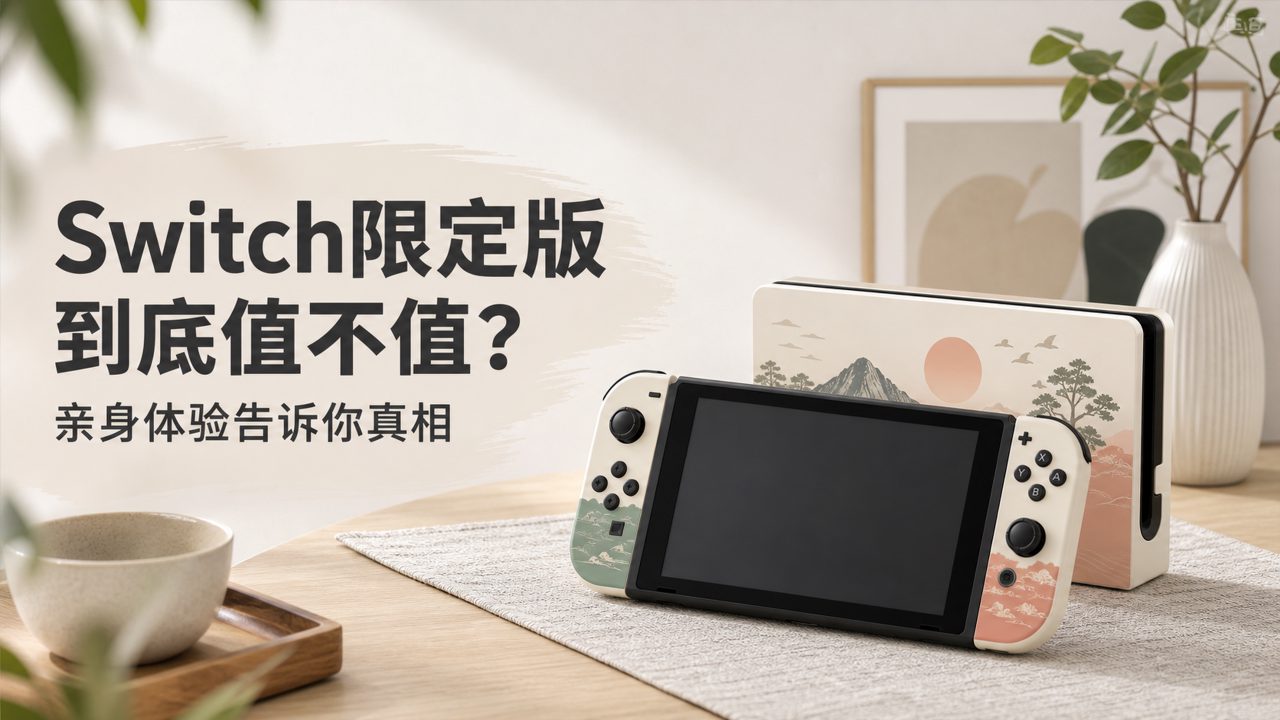
You're staring at that limited edition Switch from The Legend of Zelda or Pokémon in your shopping cart, your finger hovering between "Place Order" and "Go Back" for at least five minutes.
This is almost a soul-searching question every Switch player faces: Is it worth spending a few hundred or even a thousand extra on a console with special colors and some patterns? Or is a regular version plus a skin good enough?
I upgraded from a regular battery life model to the Splatoon 3 Limited Edition console last year, and I've been using it for nearly a year now. Breaking down my real feelings through this process might help save you some agonizing time.
Step 1: Don't Just Look at the Console Itself—First Calculate the Accessory Costs
The so-called Limited Edition often isn't just a color change for the console itself. If you buy the full set (including Dock and controllers), that's where the real premium comes from.
Let me give you the most practical example: the Tears of the Kingdom limited edition. The back of the console has golden Triforce patterns, the Dock has hot-stamped designs, and the left and right controllers are in white and green. You can hardly buy these items separately—third parties don't dare make them, and Nintendo officially doesn't sell them alone.
If you're someone who likes a "family bucket" approach, wanting every piece you receive to have a unified design language, then the limited edition bundle actually offers better value than buying a regular version plus accessories separately. A regular gray Dock and controllers really look ugly on a table, and many people end up spending hundreds on transparent shells or custom stickers anyway.
But there's a catch: the circuit structure of the limited edition Dock is exactly the same as the regular one. If you already have a Switch and are purely buying the limited edition bundle for the Dock, that money could top up your eShop balance and buy three popular titles from the Switch game recommendations.
Step 2: The "Feel Trap" of Controllers—You Need to Experience It Yourself
Many limited editions come with matching Controllers in the same color scheme. For example, the gradient controllers from Splatoon or the translucent controllers from Xenoblade Chronicles 3. They look great, but when you get them, you'll find the material is exactly the same as the regular ones—even the matte texture is indistinguishable.
Here's an issue many don't mention: the paint adhesion on limited Controllers. I've used the Super Smash Bros. limited Pro Controller, and the white areas started showing noticeable yellowing after about half a year. If you have sweaty hands, the special coating may fade faster than you think.
Of course, if you don't plan to treat it as a heirloom, it's perfectly fine for daily use. But seasoned players know that if you're really worried about scratches, the safest solution is to buy a bare console plus a transparent crystal case, and then pair it with a set of solid-color controllers. For nice color schemes, check out community posts on Nintendo game recommendations rather than official render images—they're more accurate.
Step 3: The Hidden Connection Between Digital Games and Limited Consoles
Many people who buy a limited edition console fall into a subtle mindset: the console looks so good, I can't bear to use it for games with ugly graphics.
This is no joke. A friend of mine bought the Animal Crossing: New Horizons limited edition, but 99% of his playtime was spent on independent game recommendations bought during eShop sales. He said, "Playing pixel art games on a pretty console feels like a waste." Sounds ridiculous, but this kind of sentiment is very common among limited edition console users.
If you're that type, I suggest you go to the eShop right after getting the console and download a few games that showcase the color advantages of the OLED screen. Vivid two-player Switch games or visually striking indie titles pair much better with a limited edition console. Open the game rankings, sort by rating, pick a few with strong art styles, and you'll quickly verify what I'm saying.
Final Verdict: Which Type of Player Are You?
I'll break it down into three categories for your reference:
· Newcomers who don't have a console yet: If your budget isn't too tight, go ahead and buy the Limited Edition version you like most. You might get tired of the regular version after half a year, but with the limited edition, at least the moment you turn it on feels fresh. Plus, if you ever want to sell it later, the second-hand price of limited editions holds up much better.
· Those who already have a console and want to upgrade or replace it: Be cautious. Unless your obsession with the color scheme reaches the point where you can't sleep without switching, a regular OLED plus a transparent case can already cover 95% of the limited edition's visual effect. The price difference saved can let you browse the entire game library and pick games truly worth your time.
· Those more into collecting than playing: Then don't hesitate—just buy it. If you open it, don't worry too much about condition; if you don't open it, don't buy it. Being stuck in the middle—half-opened and half-displayed—is the most awkward: neither preserving its collectible value nor enjoying it fully.
In the end, a Limited Edition is something that "won't feel like a loss if you buy it, and won't make you regret not buying it." It doesn't solve whether the game is fun or not; it solves that half-second of visual satisfaction before you turn on the console. This premium is for your mood, not performance. Once you've thought it through, just place the order decisively.
Comments
Leave a Comment