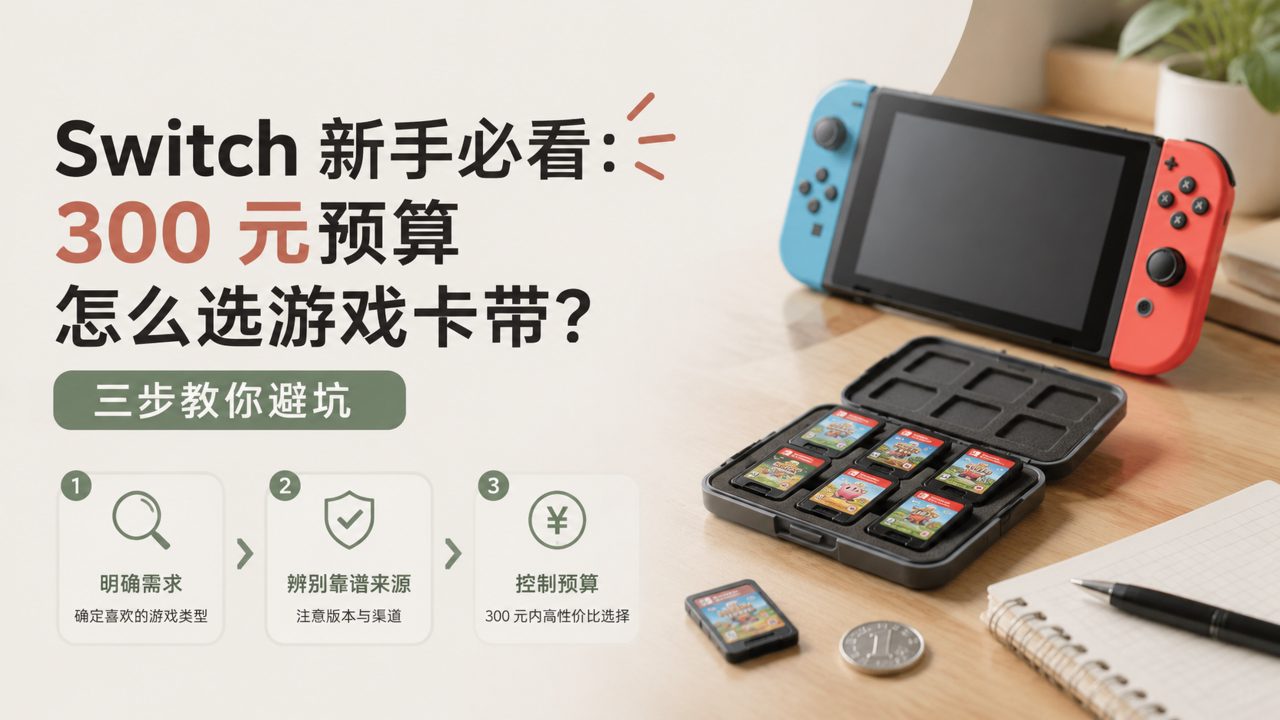
Just got a Switch and faced with a dazzling array of game cartridges, many people's first reaction is confusion. Should you buy Zelda or Mario? Digital version or physical version? Looking at a row of games in your shopping cart, which cartridge is truly worth your money?
Instead of reading a bunch of reviews and getting tangled, it's better to walk through a practical scenario. Suppose you are a newcomer who just got a Switch, with a budget of about 300 yuan, wanting to buy one or two games to start playing, while also hoping to play with friends or family later. I will demonstrate step by step how to select a game cartridge that suits you from scratch.
Step 1: Narrow down the scope with a game library
Don't rush to place an order. Open Xingba or the Nintendo eShop, and directly look for the game library feature. This is much more useful than reading scattered reviews. First, set three filters: Chinese language support, any genre, price under 300 yuan. You'll see a long list, but don't panic — this is just an initial screening.
My own approach is to pick three or four games from the library that have covers I like, and note them down. This step relies not on ratings but on first impressions. For example, the pixel art style of Stardew Valley or the graffiti style of Splatoon 3 — just looking at the cover decides whether you're willing to insert it into the Switch cartridge slot.
Step 2: Make decisions by referring to game rankings
Once you have a shortlist, go check the game rankings. Focus on two dimensions: sales charts and reputation charts. Sales charts indicate what everyone is buying, so the chance of hitting a dud is low; reputation charts show what core players recognize, with fewer major flaws.
For example, you might see Overcooked 2 in the library, think its art style is cute, but aren't sure if it suits you. Check the rankings, and you'll find it consistently ranks in the top five for multiplayer games. At that point, you can be pretty sure: it's not a niche flop, and buying this cartridge likely won't gather dust.
Step 3: Determine whether you need two-player Switch games
Your needs mention wanting to play with friends or family, so this step is crucial. Check your shortlisted games to see if they support local multiplayer. Simply look at the "supported players" section on the Xingba game detail page. If it says "1-4 players" or "2 players", that's a two-player Switch game.
I've stepped on this landmine: I bought Octopath Traveler — beautiful graphics, great story, but single-player only. While I enjoyed playing it alone, when friends came over, they could only stare blankly. Later, I got Mario Kart 8 to solve the problem of having no games for gatherings. If you often have people to play with, prioritize cartridges that support local two-player, even if their main focus isn't multiplayer mode.
Step 4: Make a trade-off between cartridge and digital version
Many guides are vague about this step, but the actual difference is huge. If the game you choose is something like The Legend of Zelda: Breath of the Wild, which can last dozens or hundreds of hours, a cartridge is actually the better choice — you can sell it after finishing to recoup some money, essentially renting it for a few dozen yuan for half a year. But if you're buying something like Tetris 99, which you want to pull out and play a quick round anytime, the digital version is more convenient — no need to swap cartridges.
Here's a practical suggestion: buy physical cartridges for major releases when they first come out; if you don't like them, you can sell them second-hand. During sale seasons, buy games from indie game recommendations (like Hollow Knight, Dead Cells) — these are usually low-priced, don't take up a cartridge slot, and are suitable for long-term digital ownership.
Step 5: Look for bargain opportunities on rare cartridges
Not all cartridges are worth buying at full price. Some games sell modestly at launch but become "hidden masterpieces" half a year later, with prices rising. For example, the physical cartridge of Xenoblade Chronicles 2 was initially undervalued after release, but later word-of-mouth spread, and its second-hand price went up instead of down.
If you want to find a bargain, you can follow the player trading sections in the Xingba community, or watch for digital version discounts on the eShop. But note: if you're a collector, buying Japanese or American region cartridges holds value better than Hong Kong region ones. Of course, this applies if you only play a few games and want to specialize in one or two; otherwise, it's easier to just buy discounted digital versions.
Finally, a summary of scenarios. If you live alone and have limited gaming time, buy a cartridge from the Nintendo game recommendations list, like Super Mario Odyssey, and it will last you a long time. If you have kids or roommates at home, go straight for a multiplayer cartridge like Mario Party — the entertainment value doubles. If you're on a tight budget and want to play several games, the second-hand market is your domain.
Ultimately, choosing a cartridge isn't about the more expensive the better, but about whether it matches your Switch usage scenario. Follow these steps, and you'll basically never buy the wrong one.
Comments
Leave a Comment