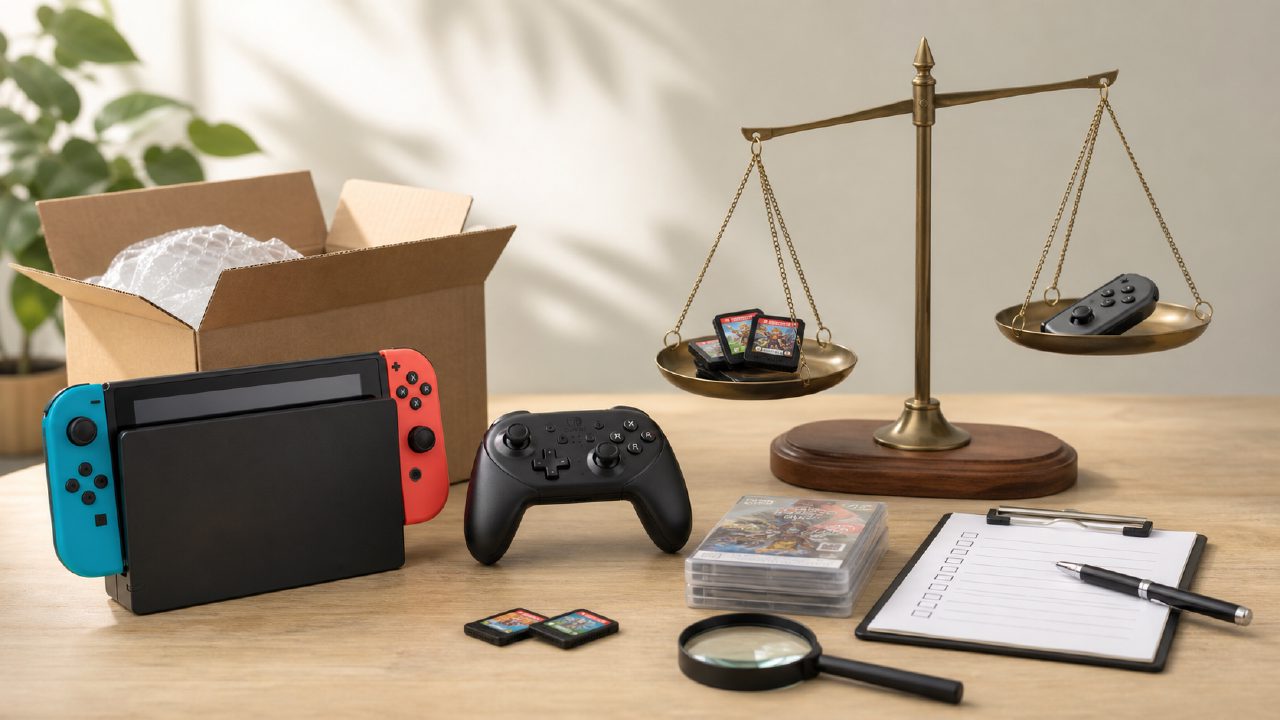
Thinking of trading in your Nintendo Switch console, Joy-Con controllers, or a drawer full of old game cards to upgrade to new gear? That's a good idea. But if you think you can just hand them over to a store and wait for the money to roll in, you're being too naive. The waters run deeper than you think, and there are plenty of pitfalls.
Let's start with the console. Many people think "trade-in means exchanging an old machine for a new one at a discounted price," but the actual valuation is completely different from what you'd consider "condition." The first thing a store looks at isn't whether your console powers on, but whether the screen has scratches, the joysticks have drift, or the backplate screws are stripped. Even if your OLED screen lights up flawlessly, if there's a faint scratch on the bezel you never noticed, the trade-in offer gets slashed by a tier. Many sellers lose out here, feeling they've been cheated. More critically, the price difference between Switch versions is huge—Japanese version, Hong Kong version, and China version can differ by a hundred or two hundred yuan in trade-in value. If you bring a China version battery-life model for trade-in, you might get a quote worse than if you just sold it on Xianyu.
Next up are the Joy-Cons. This is where it's easiest to mess up. Many people bought two-player Switch games, and after extended use, the joysticks have some play or even drift, but they think "it's still usable." When they take it for trade-in, the store tests for drift and either rejects it outright or gives a ridiculously low "drift machine" quote. If you're handy, replacing the joystick module before trading in can net you an extra few tens of yuan; if not, you'll have to take the loss. Another little-known fact: third-party or counterfeit controllers won't be accepted by stores—the unofficial Joy-Cons you bought to save money are worthless in a trade-in.
The game cards are an even deeper rabbit hole. Many people hoard a bunch of old games hoping to clear them out in one go, only to find that stores only accept major hits. Obscure or older titles get a straight wave-off. Your evergreen Switch game recommendations like Zelda and Mario Party can still fetch a decent price, but those motion-controlled games and unknown indie titles you bought on a whim? Stores won't take them—you call them hidden gems in Nintendo's game recommendations? Sorry, to them they're just waste cards. What's worse, some stores have extremely strict requirements for card condition: complete with case and manual, matching serial numbers, and no scratches on the card. Missing any one of these means a price cut. If you bought second-hand games online that came with only the card and no case, trading them in is basically giving them away for free.
Then there's the trap of digital games. You think having big digital titles on your account adds value? Don't even think about it—legitimate trade-ins don't recognize bound accounts because accounts aren't hardware and can't be resold. If you trade in your Switch without first unlinking your account and formatting the console, the store won't give you any bonus and may even reject it outright because they don't accept machines tied to someone else's account. This is an extremely easy pitfall to overlook.
So, is trade-in worth it? It depends. If you have a few physical copies of top-ranked games, along with a well-maintained console and original Joy-Cons, then trade-in is a convenient choice. But if you have many obscure indie games, worn accessories, or digital content on the console, the trade-in offer will disappoint you. I suggest you first look up the current second-hand market price of your games on a game database, compare it with the trade-in quote, and have a clear idea before deciding.
In the end, the truth about trade-ins is: stores profit from information asymmetry and your aversion to hassle. If you can spend half an hour listing items on Xianyu, taking photos, chatting, and shipping, you'll often get several hundred yuan more than a trade-in. But if you value convenience and efficiency above all, just remember that "trade-in is essentially exchanging convenience for a lower price" and don't set your expectations too high. Manage your expectations, and you won't fall into the traps.
Comments
Leave a Comment