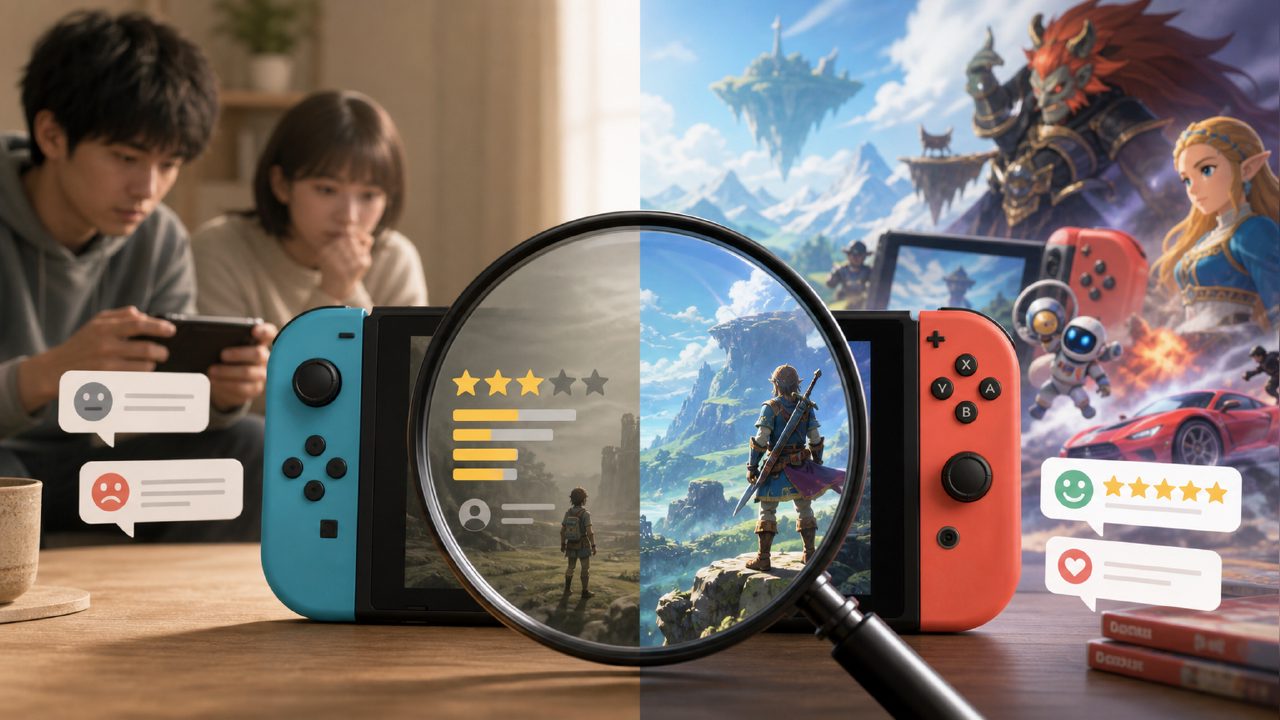
Seeing the word "High Score," Switch players might first think of the nostalgic arcade leaderboards, or stare at their own completion time in Zelda. But in the Xingba community, this term is more like the final checkpoint before tearing off a game's packaging—is this score reliable? Is it the real word-of-mouth from players, or a number carefully packaged by the marketing team?
I've always felt that Nintendo's eShop is the most counter-intuitive storefront among all console markets. It's deeply hidden, slow to load, and has so many games that it makes you question your life choices. That's where the rating comes in: it helps you filter out a viable list from thousands of games, but the prerequisite is—you need to know how to read this score.
1. Reading Reliable Scores from the "Metacritic Traffic Light"
The most intuitive standard is to look at Metacritic's color indicator. Green (75+ points) is generally safe, yellow (50-74) depends on the genre, and red (below 50) is only if you're really bored. But here's the problem: many excellent indie games aren't even listed on Metacritic, or only have a handful of critic scores.
That's when you need to turn to player scores from the Switch game recommendations community. There's an unwritten rule in Xingba: apply a 40% discount to "player scores" from the first two weeks of release, and wait for the second wave of real users to weigh in. For example, when Hades first launched on Switch, its player score started at 8.5, then jumped to 9.1 after two weeks—that truly reflected the controller feel and optimization.
2. The "Invisible Score" Beyond Ratings: Family Membership and Game Guides
Buying a game just by looking at a single score number is something only beginners do. True pros flip through the comment sections in game guides, especially those written by players who have reached Chapter 8 before reviewing. In Xingba's Nintendo game recommendations section, there's a classic case: Octopath Traveler had a difference of at least 1.5 points between critic and player scores. The reason is simple: critics reviewed it based on a 60-hour main story, but most players got tired of the map exploration after 20 hours.
Also, if you mainly play multiplayer, pay attention to the shared experience under a Family Membership. Some games' High Scores are achieved in single-player mode, but once you switch to two-player or four-player mode, the frame rate drops by half. This is especially common in two-player Switch games—in short, a rating can at most tell you "is this game worth it," but it can't tell you "will it lag when four of you play together."
3. How to Use High Score to Avoid the "eShop Pitfalls"
The eShop's "bestseller list" is not everything. Many $29 junk games climb to the top thanks to low prices and limited-time discounts, yet only have a 3.9 on Meta. That's when you need to cross-verify:
- Check Metacritic's critic score (at least 10+ outlets)
- Browse the comment section on the eShop's own page (watch out for those with just a few hours of play—don't trust 0.1-hour reviews)
- Use Xingba's game rankings to filter new releases from the past 30 days, avoiding those reheated old games with inflated scores
4. Indie Game Recommendations: The "Buffer Zone" of High Score
Indie games are the biggest blind spot in the rating system. Many masterpieces (like Celeste and Stardew Valley) had no scores at all when they first launched, and it took one or two months for ratings to stabilize. Xingba's indie game recommendations often jump the gun: they rely on the real-world feedback from a few core players before any scores come out. These people's criteria are very practical—they don't just look at graphics or frame rates, but at things like "do you need to save frequently" and "will getting lost make you want to throw the controller." You won't see these in score reports.
In the end, High Score is not the destination, but the starting point. It helps you narrow down your shortlist from hundreds to a dozen or so. The remaining filtering work—whether the game type is your thing, whether multiplayer runs smoothly, whether it's worth buying an extra Pro Controller—these rely on your own feel and the advice of those seasoned players from Xingba who have already put in 200 hours.
Next time you open eShop and spot a game labeled "4.5 stars," don't rush to swipe your card. First run it through the code above, and you'll find many "fake high scores" get unmasked by the third week.
Comments
Leave a Comment