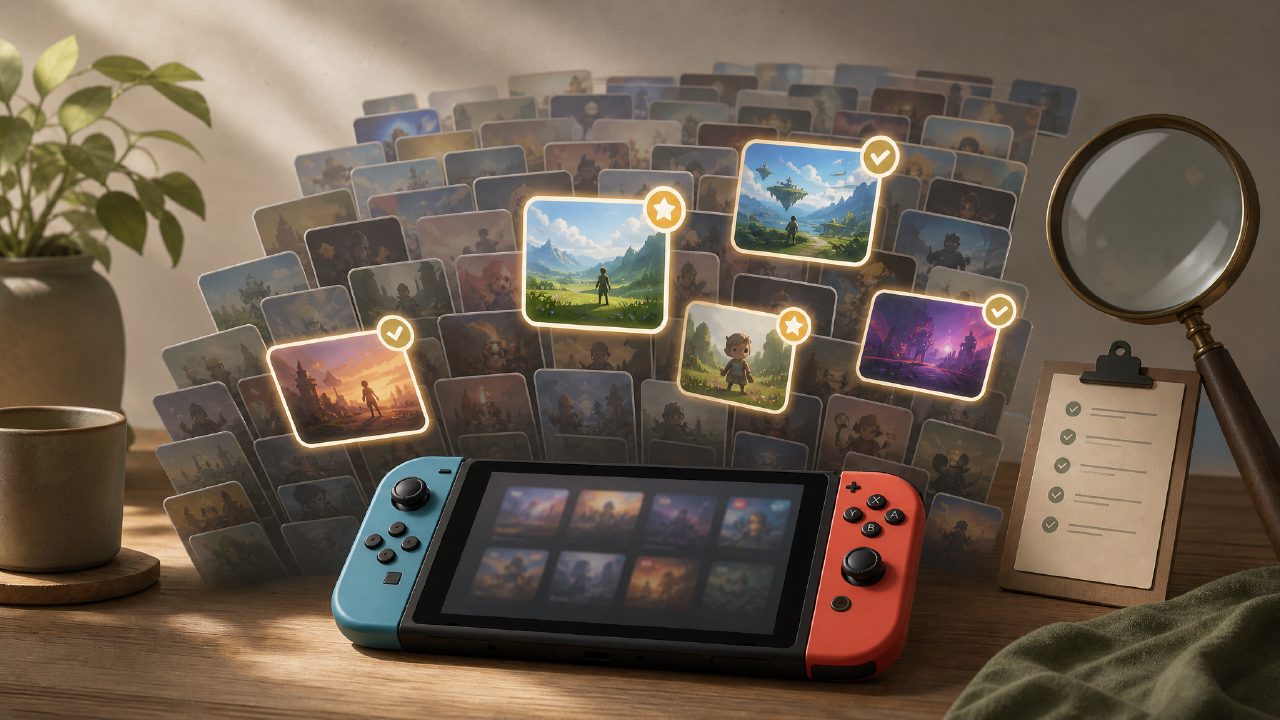
Most people who buy a Switch eventually get stuck with the same question: What to play next?
A few weeks after the console arrives, you've run Mario a few laps, explored most of the map in Zelda, and seen another Steam sale on games you already own. Then you open the eShop to check out new titles. And you find that the "Nintendo game library" looks huge, but when you actually try to pick something, you scroll endlessly without finding anything that suits your taste.
It's not because there are no games—it's because the information is too sparse. Dozens of pages of scrolling lists, cover images shrunk into thumbnails, indie games without English descriptions squeezed in between—buying a game feels like opening a blind box.
So today's article won't talk about reviews or list specs. It will only help you quickly figure out: How to filter through this pile of games?
The game library is really big, but categorization is key
Nintendo's own library has consistently stayed above 4000 titles. But for the average player, this number is almost meaningless. Because it's mixed with a large number of DLC, demos, retro emulator ROMs, and old games you'd never click on.
The practical approach is to first look at a few common coordinates:
- First-party exclusives — Nintendo's golden children, you can buy them with your eyes closed and hardly go wrong. Represented by titles like The Legend of Zelda: Tears of the Kingdom and Super Mario Bros. Wonder, these are basically the reason to buy cartridges themselves.
- Third-party big studio titles — such as Dragon Quest and The Witcher 3. These games can be played on other platforms, but for those without a PS5 or PC, the Switch version is the best option.
- Indie game camp — this is the most underestimated part of the Switch in recent years. Hollow Knight, Stardew Valley, and Hades all have extremely high completion rates and are very suitable for handheld mode.
Whether you're looking for Switch game recommendations or just want to refresh your Nintendo game recommendation list, first sort out these three buckets, and everything becomes much easier afterward.
Don't just look at the cover; check out others' game galleries
Many times, staring at a single cover image on the eShop, you can't guess the actual gameplay feel at all. At this point, the dumbest but most effective method is to open a game gallery that someone else has already organized.
On platforms like Star Bar, influencers and players share their collections and insights in the same space. Compared to the dry descriptions on the official store, a real screenshot plus a piece of actual experience can directly filter out at least 60% of unsuitable choices.
I once casually flipped through an influencer's game gallery on the subway and discovered that Blasphemous actually supports Chinese and has decent optimization—I had passed it at least five times before without clicking.
Who will you play with? This question is more important than you think
Many people only think about "Is it fun?" before buying a game, but overlook the most practical scenario—whether you're curled up on the sofa alone or have someone else fighting for your Pro controller.
The range of single-player modes is explosively wide, but once you plan to find a friend to play with, the options immediately shrink. At that point, two-player Switch games become a hard requirement.
To be honest, there aren't that many truly fun co-op two-player games on the Switch. Apart from obvious hits like Mario Kart 8 Deluxe and Overcooked, many cooperative indie games are actually better suited.
- Snipperclips — requires high coordination, perfect for couples or close friends with good synergy.
- Cuphead — retro art style but hardcore difficulty, suitable for competitive partners.
- It Takes Two — though not available on Switch, Luigi's Mansion 3 offers a similar puzzle-solving cooperative experience.
When searching for two-player Switch games, it's highly recommended to first watch others' actual gameplay videos. This is more intuitive than any rating—because you need to confirm that after the screen is split in half, you can still see where you are.
Indie game recommendations that suit everyone
If I had to pick the most valuable yet most overlooked segment of the Switch, it would be indie games. They're not expensive, moderate in size, don't take up much internal storage, and most are optimized for handheld mode.
Here are three that you won't regret buying:
- Stardew Valley — farm, raise chickens, date; time will disappear without you noticing.
- Dead Cells — the fluidity of action on the Switch is almost no different from PC.
- Celeste — a platformer with level design at the ceiling of the genre.
Of course, indie games also have a chance of being flops. Some ports have long loading times, and others have fonts too small to read without squinting. So before ordering any game from an indie game recommendation list, it's best to search for "Switch version + game name" to see if there are negative reviews about optimization.
Leaderboards are a shortcut, but they have blind spots
Many people's habit is to directly look at game leaderboards, which indeed saves time. But the eShop's ranking logic is too narrow—it only counts download numbers, not quality. A small game sold for $0.99 can boost its download count and climb to the top.
A more reliable method is to refer to leaderboards compiled spontaneously by player communities, such as the influencer rankings on Star Bar. These leaderboards often combine factors like actual playtime, completion experience, and value for money, making them more meaningful than pure sales numbers.
When you see names like Persona 5 Royal, Octopath Traveler II, and Metroid Dread frequently appearing in a ranking, you can basically confirm that this list isn't just randomly generated.
Moreover, different leaderboards have fine distinctions: there are "Handheld Mode Optimization Rankings," "Motion Control Rankings," and "Best Story Rankings"—you choose based on your preferences, which is much more efficient than digging through the huge library.
In the end, the Nintendo game library is a massive treasure trove. The entrance isn't hard to find, but the difficulty lies in quickly locating the game that belongs to you among tens of thousands of records. Using the right method is much more important than spending more time.
Comments
Leave a Comment