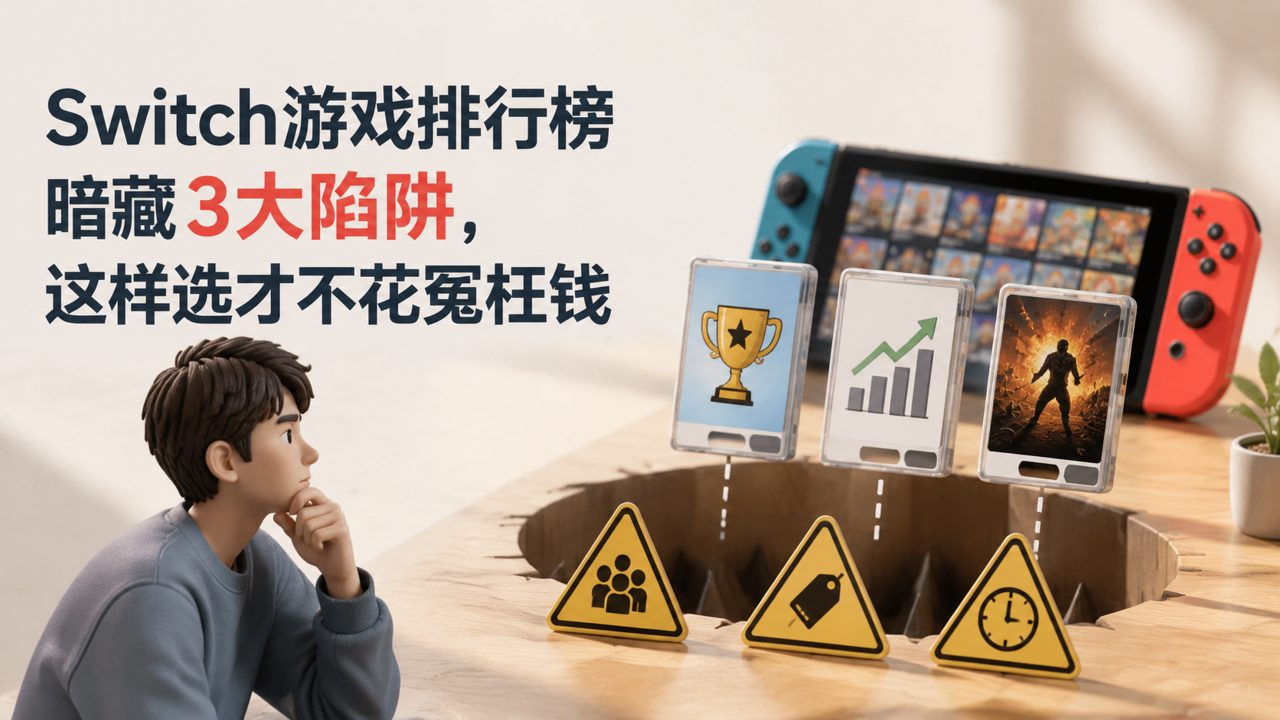
Ten out of eight people who go picking Switch games by “rankings” have stepped into pitfalls. It’s not that the rankings are fake—it’s that you don’t know what’s lurking behind them.
For example, a certain “must-buy masterpiece” that tops charts all year long—you buy it and find the Joy-Con controls are so complicated they drive you away, or it doesn’t even support two-player co-op. Then there are those overrated “nostalgia titles” with blurry graphics and frame drops that make you question your sanity. Today, let’s dig into the game rankings and the common traps behind them, so you can avoid wasting your money.
Timeliness Trap in Rankings: Don’t Buy This Year’s Games with Last Year’s List
Many players habitually click on the “All-Time” or “Historical” rankings, thinking high collection counts mean safety. But the list you’re looking at might not have been updated in six months. The Switch game market moves fast—an indie team suddenly releases a hit, or a big studio game gets a reputation turnaround thanks to a patch. These “live data” points are things that lagging rankings can’t reflect.
Even worse, some “Nintendo game recommendations” lists are littered with old titles that are already shut down or have dead online play. You order based on the ranking, only to find no one to match with online, and the single-player mode is boring to the point of agony. So before you check game rankings, first look at the time dimension: prioritize “Hot This Month” or “Recent Rising Reviews” and avoid those zombie lists living off old accomplishments.
No “Taste Filter” for Scores: High Scores Don’t Necessarily Suit You
A typical example: An open-world RPG scores 9.2 on a game encyclopedia, but you play it in handheld mode for half an hour and your eyes ache and hands tremble. Why? Because all its UI fonts are designed for TV mode—the text is too small to read in handheld. These details, rankings won’t tell you.
Similarly, hardcore action games get sky-high scores from the “core gamer” crowd, but for casual players, they can’t even get past the first level, and the Joy-Con almost wears out. The right approach: Find reviews from players with tastes similar to yours, not the “average score.” If you only play two-player Switch games, specifically search for rankings under that tag—don’t be misled by scores propped up by single-player stories.
“Value” Doesn’t Equal “Playability”: Hidden Inflation in Rankings
Some games rank high simply because of heavy discounts or bundled sales. For instance, a low-budget indie title pushes sales through frequent promotions, gets its score padded up, but when you pop in the cartridge, it’s hollow, repetitive, and can’t hold your interest for two hours. These “data-beautiful” indie game recommendation rankings are a minefield for newcomers.
Even more insidious: Some lists deliberately boost games that work well with their own peripherals. For example, a ranking sponsored by a third-party dock maker will always put its compatible games at the top, but your original Dock might not even run them at a stable frame rate. To spot this kind of commercial bias, you need to check the “editor’s note” or “sponsored” tag on the list.
Don’t Be Fooled by “Multi-Platform” Scores: Switch Experience Is Its Own Track
Many Switch game recommendation articles directly use PC or PS5 scores—this is highly irresponsible. For the same game, the Switch version can suffer from lower resolution, frame rate, and load times due to hardware limits. Especially for games that require frequent camera control, the precision of Joy-Con sticks in handheld mode creates a huge gap in experience.
The deepest pitfall I’ve stepped into: A universally acclaimed “masterpiece narrative” that stuttered like a slideshow during cutscenes on Switch, and dropped frames in combat that affected input judgment. I later found out the review media used the PC version’s high score, and the game encyclopedia scores didn’t differentiate platforms at all. So only look at “Switch-exclusive scores”—don’t be dazzled by high cross-platform ratings.
Practical Tips to Avoid Pitfalls: How to Use Rankings Without Getting Duped
First, narrow down your scope. Decide what you’re looking for: single-player/two-player/online? Action/puzzle/casual? Then search only the game rankings under that category—don’t blindly open the “All-Time” list. Second, cross-verify. Check reviews for the same game on at least two different communities (e.g., Reddit subreddits and Chinese forums). If one list says masterpiece and another says flop, it’s probably extreme fans padding scores. Third, reading “negative reviews” is more useful than reading positive ones. Scroll to the lowest-score comments on a game encyclopedia and see if the complaints are things you can tolerate—like “great story but awful controls”—if you’re a story person, you can go for it.
One last reminder: Two-player Switch game rankings are the easiest to inflate, because many publishers package “two people can play” as “suitable for two,” when in reality the second player’s experience is terrible. It’s best to look for vertical lists specifically about “family-friendly” or “party games”—they’re much more trustworthy.
Rankings are a good tool, but don’t treat them as gospel. Being able to read Nintendo game recommendations clearly, deeply, and spot the inflation is the real basic skill of picking Switch games.
Comments
Leave a Comment