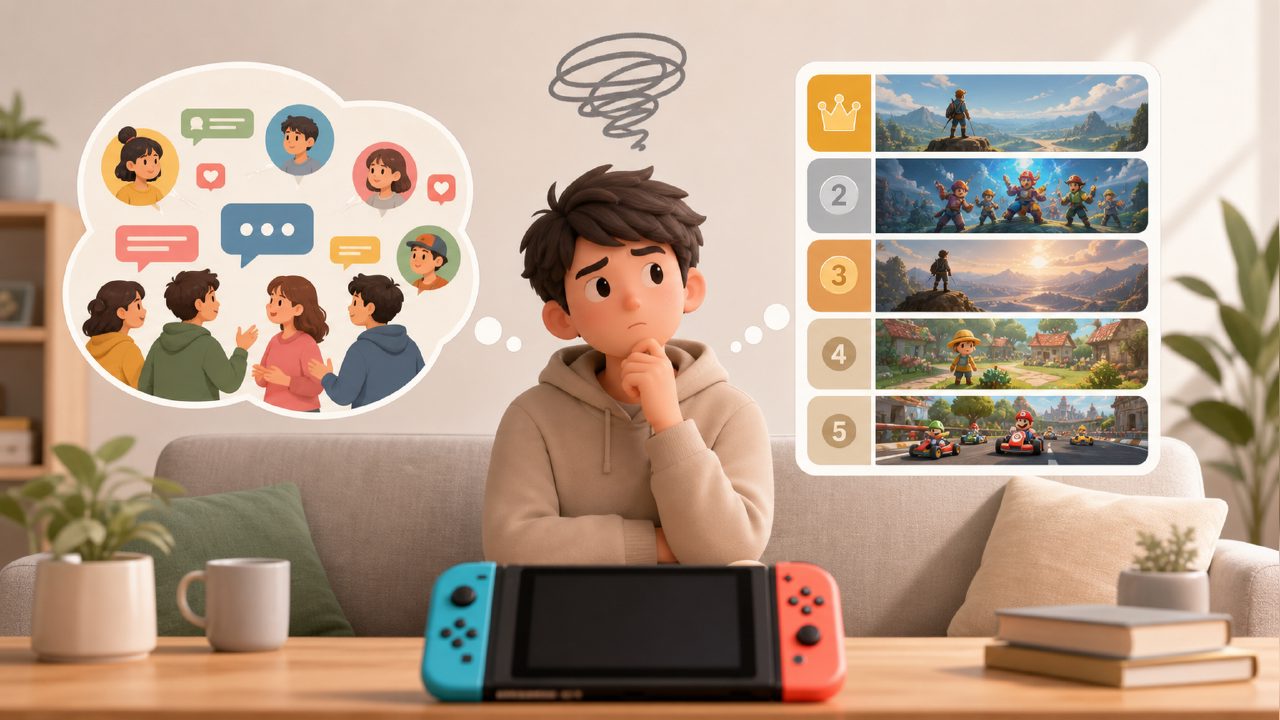
Every time you open the eShop and face thousands of games, scrolling until your fingers ache without being able to make a decision—this is something many Switch players have experienced. I often find myself jumping from one shooter to another, and eventually just turn off the console.
Finding games, in fact, has no so-called "best solution." Different channels and platforms address different levels of need. Today, from a comparative perspective, let's talk about several mainstream ways to discover games, helping you quickly lock in your target.
Community Recommendations vs Official Lists: One Helps You Filter, The Other Makes You Lost
The biggest problem with the official eShop is that it's "too honest." It lays everything out in front of you, and the hot list is always dominated by evergreens like Fortnite. Truly interesting indie games are often buried elsewhere. If you want a reliable Nintendo game recommendation, relying on its built-in categories is hardly efficient.
In contrast, communities like Xingba have a core value not in showing everything, but in filtering and categorizing. The Switch game recommendations in the community are no longer cold "98% positive rating," but real players sharing their actual experiences—like "this game is really fun with two players, but easy to get stuck alone." This granularity of information is something algorithms cannot provide.
My own take: if you know exactly what series you want to play, just search directly; but if you're just "looking for something fun," community recommendations have a much higher hit rate than mass browsing on your own.
Game Encyclopedia vs Ranking Lists: A Clash of Two Information Organization Logics
Many players' habit for finding games is to first look at game rankings. The benefit of hot lists is saving time and avoiding pitfalls, but they are heavily influenced by the "Matthew effect" of sales and reputation. Most games on the rankings are ones you've already heard of.
In contrast, a game encyclopedia offers a different perspective. It acts more like a "filter" where you can search by genre, whether it supports Chinese, or whether it's suitable for multiplayer. In this regard, Xingba's encyclopedia feature is more practical than pure rating sites, because rating sites only have numbers, while the encyclopedia notes "what scenarios this game is suitable for."
Take a real scenario: your friend comes over on the weekend, and you want to find a two-player game. If you only look at rankings, you'd have to click into each game to check if it supports two players. With a specialized filter for two-player Switch games, you can lock in a choice in just a few minutes.
Indie Game Recommendations: The Biggest Information Gap Between Official and Community Channels
Honestly, the most headache-inducing section of the eShop is indie games. Big studio titles have ads everywhere; no matter how good an indie game is, its exposure relies entirely on luck. At this point, the value of indie game recommendations fully shines. Many players in the community are "voluntary miners"—when they find a niche but great indie game, they write about their experience on Xingba, while the official store would never give you such a recommendation.
Several gems I've bought, like Stardew Valley and Hollow Knight, were actually purchased because community players repeatedly mentioned them. If I only looked at the store screenshots and descriptions, I might have missed these masterpieces.
Comparative Summary: How to Choose to Minimize Waste of Time and Money?
If you have a limited budget and can only buy one or two games, prioritize checking Switch game recommendations and Nintendo game recommendations posts in the community. Because behind every recommendation is a conclusion drawn from dozens of hours of gameplay by real players.
If you need to quickly understand the detailed content, screenshots, and supported modes of a specific game, using the game encyclopedia is more direct than reading review articles. Reviews have subjective bias, while the encyclopedia is an objective data set, suitable for elimination.
Finally, a special note on two-player Switch games. Many players buy games to play with friends, but although some games are labeled as two-player, the actual experience may be poor. Player feedback in community recommendations is often more honest than official descriptions, such as: "the two-player mode is basically just a filler." In this regard, spending five extra minutes reading a single player's comment may be more useful than reading ten pages of reviews.
Comments
Leave a Comment