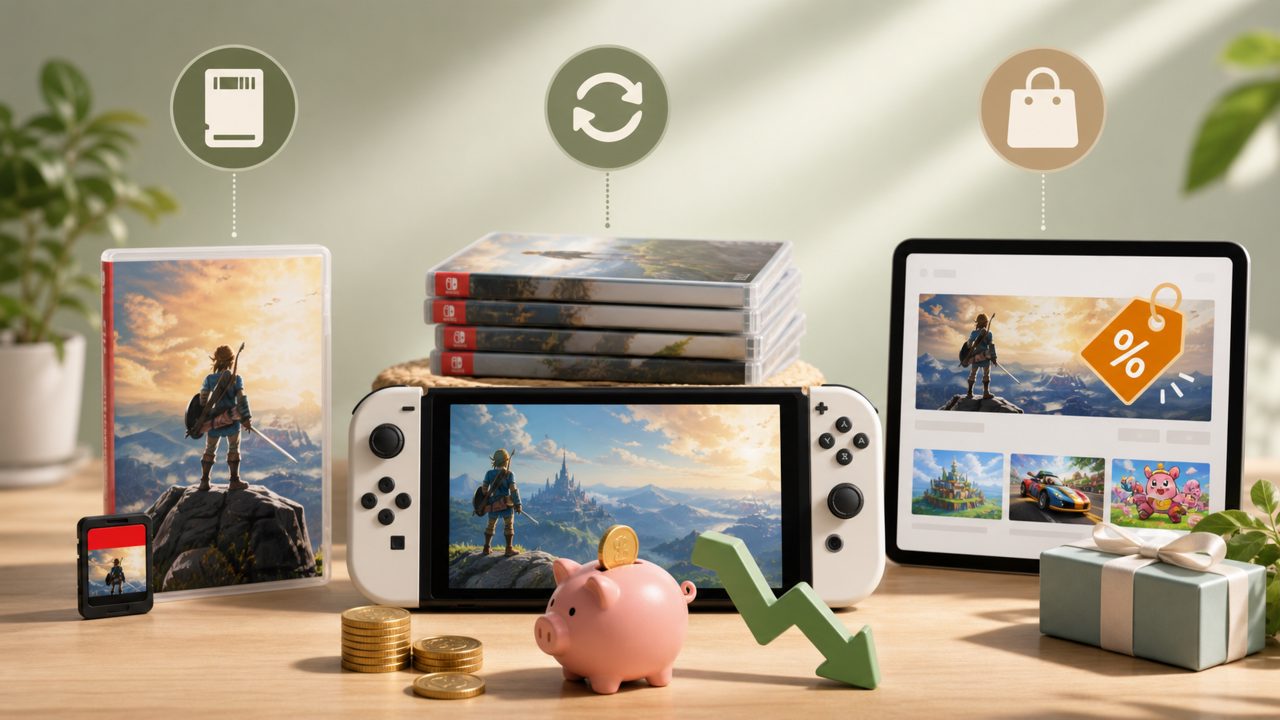
Buying Switch games can actually be quite a headache. Cartridges are expensive, and digital versions aren't cheap either—browsing and picking can easily lead to buyer's remorse. Especially for newcomers, seeing the long list of prices in the store makes you want to try something but fear it might not be a good fit.
So various money-saving strategies have emerged—buying secondhand cartridges, waiting for eShop discounts, sharing family memberships, or pooling money to buy digital games. Each path has its own tricks, but when it comes down to it, the truly cost-effective and hassle-free options are actually just a handful.
Can Cartridges and Secondhand Games Really Save Money?
Let's start with the most traditional option: physical cartridges. The advantage of physical cartridges is that they can be resold—sell them after playing, and you might only end up paying a small price difference. But the issues are clear: popular games ship slowly, and if you want to play on a whim, you can't wait; less popular games are hard to sell secondhand, and they might sit on Xianyu for weeks without inquiries.
Moreover, for many Switch games, digital versions are actually better. For example, "Overcooked" or "Monster Hunter"—you want to start a round anytime, and the constant swapping of cartridges becomes really annoying. Not to mention those cheap indie games where buying the cartridge isn't even worth it.
So secondhand cartridges are suitable for one type of player: those who aren't in a hurry to play and don't mind dealing with logistics and transaction processes. If you're after instant play and reducing trial costs, this path isn't really smooth.
Are eShop Discounts for Digital Games Reliable?
Many people wait for eShop all-time low discounts, and you can indeed snag a bargain. But think about this scenario: you want to play a certain game, but waiting for a discount might take two or three months, and by then your enthusiasm might have cooled. Also, eShop prices vary by region, and switching regions is cumbersome—getting burned by the zero-balance trap once is a lesson you won't forget.
A more realistic issue is that many discounted games are ones you don't recognize. Just looking at the cover and description, it's hard to tell if they're fun. That's when you need a reliable Switch game recommendation or Nintendo game recommendation for reference. Otherwise, even if it's on sale, you hesitate to buy, fearing it'll just gather dust.
Shared Memberships and Carpooling: Actually More Practical
Compared to traditional methods, the sharing model offered by communities like Xingba is a different approach. It integrates family memberships, digital game purchases, multiplayer collaboration, and carpooling, essentially addressing a few core pain points: how to try games at low cost, how to quickly find suitable games, and how to have others help share the cost.
For example, if you don't have a console or don't want to spend a lot on games, Xingba's carpooling service lets you get play rights at a price far below the original. This is a completely different path from cartridge resale—cartridges rely on secondhand price differences, while carpooling relies on multiple people sharing the cost.
A very real scenario: on the weekend, you want to play online with friends, but none of you own the game. A service like Xingba can directly help you find someone with a spot in a car and jump in to play. It eliminates the hassle of buying a cartridge, waiting for delivery, and scheduling. At that point, your perspective on two-player Switch games or multiplayer co-op games shifts completely—not "which one is cheaper," but "which one lets us start playing together the fastest."
The Key to Choosing: Do You Value "Ownership" or "Experience"?
Ultimately, whether a plan is worth it depends on what you truly want.
If you love collecting boxes and filling shelves, physical cartridges are irreplaceable. If you're after playing more games at the lowest possible cost, shared digital versions are definitely more cost-effective. The carpooling and sharing offered by Xingba essentially lower the entry barrier, preventing you from wasting money on a game you're not sure you'll enjoy.
This also extends to something very valuable: indie game recommendations. Many great indie games are buried in the eShop, but in communities like Xingba, player-generated game rankings and game guides help you quickly filter. You no longer need to scroll through reviews one by one—just look at everyone's play records and recommendation lists.
In the end, tools are just means. What truly saves you money, time, and indecision is a platform that makes information transparent and costs shared. Xingba does this quite practically, without too many fancy concepts—it just lets every player spend less and play more.
Comments
Leave a Comment