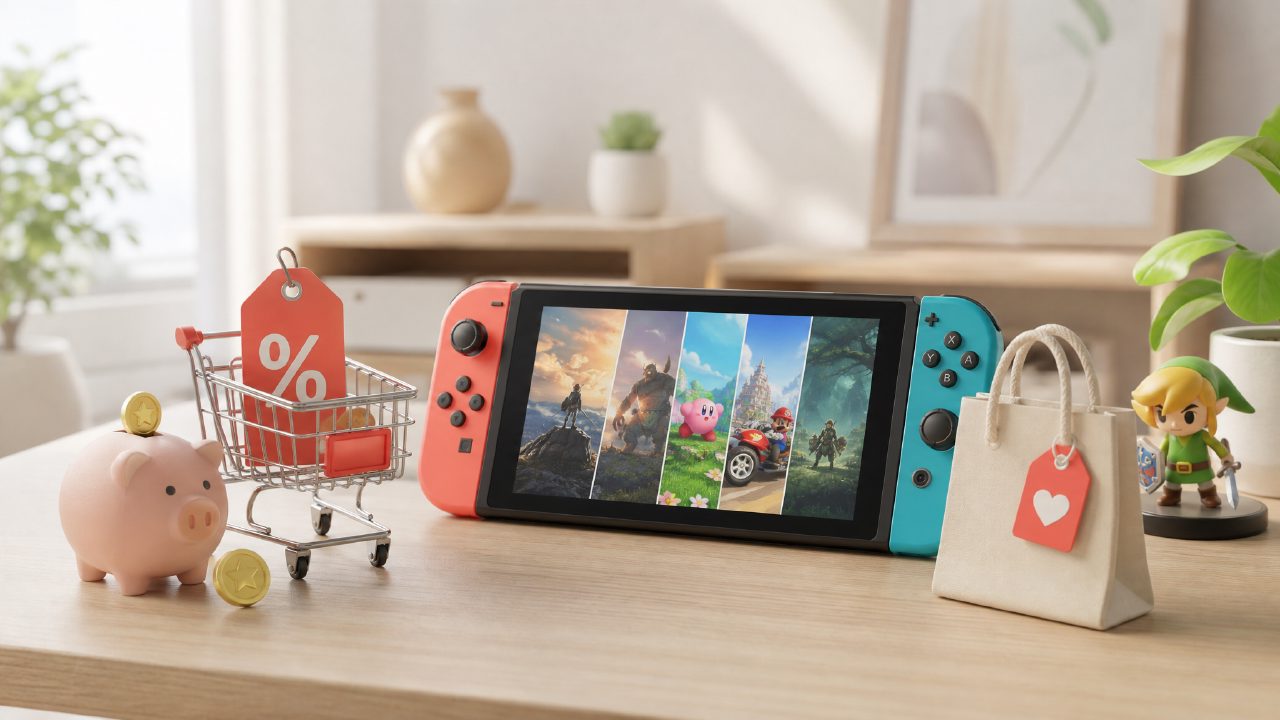
Many Switch players struggle with buying games, not because they aren't fun, but because they worry about missing a better deal.
Game prices on the eShop fluctuate wildly and discounts are frequent. Buying Hades at full price last week only to see it half off this week—everyone hates that feeling. But waiting for the lowest price every time means risking missing the multiplayer peak when everyone is still playing.
So the question becomes: how can you know about a Discount the moment it appears and make a quick decision?
In this regard, different people have very different approaches. Some only keep an eye on official discounts in the US and Japan eShop, manually browsing through each sale season. The problem is that the eShop interface is clunky—slow loading, messy categories. A game might look cheap, but clicking in reveals it's only for Nintendo Switch Online members, or the discount applies to DLC, not the base game.
Other players turn to third-party price comparison tools, like some redirect sites that show all-region price history curves and remaining sale days. These tools offer comprehensive data, but many people find themselves stuck at the payment step. Either WeChat Pay or Alipay isn't supported, or they need to switch regions, buy gift cards, pay fees—the whole process costs more in time than the game's price difference.
That's why many are now seeking player community services to "copy the homework." For example, places like Xingba directly list prices that already account for region switching, group purchases, and exchange rates. If you want to play a two-player Switch game like It Takes Two, you don't need to fuss with online setup and account switching—just jump in. The price is often significantly cheaper than buying directly on the eShop because the team uses long-term fixed cheap-region channels.
For players, this is really a trade-off between "absolute low price" and "hassle-free low price."
If you care deeply about the absolute lowest price for every purchase—for example, you insist on getting a recommended indie game like Stardew Valley for under 60 yuan—then you can't avoid the process of tracking low prices, switching regions, and buying gift cards. But if your monthly game budget is only around 200-300 yuan, checking a game ranking to see what others are playing, then directly ordering from a reliable discount channel, saves you time and trouble that are actually more valuable.
There's another easily overlooked point: some discounts come with "hidden costs." For instance, the Japanese eShop often runs a "Nintendo Switch Game Voucher" promotion—calculating out to about 200+ yuan per first-party game, which seems like a great deal. But it requires buying two vouchers at once, and they must be used on the same account. If you only want to play one flagship exclusive and have no second game to redeem, the voucher becomes a burden. Some community-provided Nintendo game recommendations for purchasing or group buying allow you to buy just one game slot without hoarding vouchers, offering more flexibility.
Additionally, game encyclopedia features serve as an invisible useful tool. Many people don't lack knowledge of what games they want, but they don't know if a currently discounted game is worth it. Looking only at the discount percentage is useless—a game originally priced at 500 yuan at 30% off is indeed cheap, but if you don't play that genre, the money saved is actually spent elsewhere. First, check the game's genre, playtime, and local multiplayer support via an encyclopedia, then look at the discount—that's how you save effectively.
Finally, here's direct advice:
If you prefer playing alone and don't mind fiddling with accounts, use the eShop to add wishlist items, wait for discount email alerts, and combine with gift card channels to get the lowest price. If you often play multiplayer, need fellow players for Switch game recommendations, or don't want to waste time on payments and region switching, find a player service that maintains low-price regions—the overall experience will be much smoother. Neither approach is absolutely right or wrong, but figuring out in advance whether you're more short on money or time makes the choice much easier.
Comments
Leave a Comment