Staring at the discount list on eShop for ages, the game you want isn't on sale, and the ones on sale are unfamiliar. This scenario is all too familiar for every Switch player. Digital games have no second-hand recovery value; buying at the wrong price means a permanent loss. So "when to buy, where to buy, and how to buy cheapest" has become a frequently asked question in the Switch community.
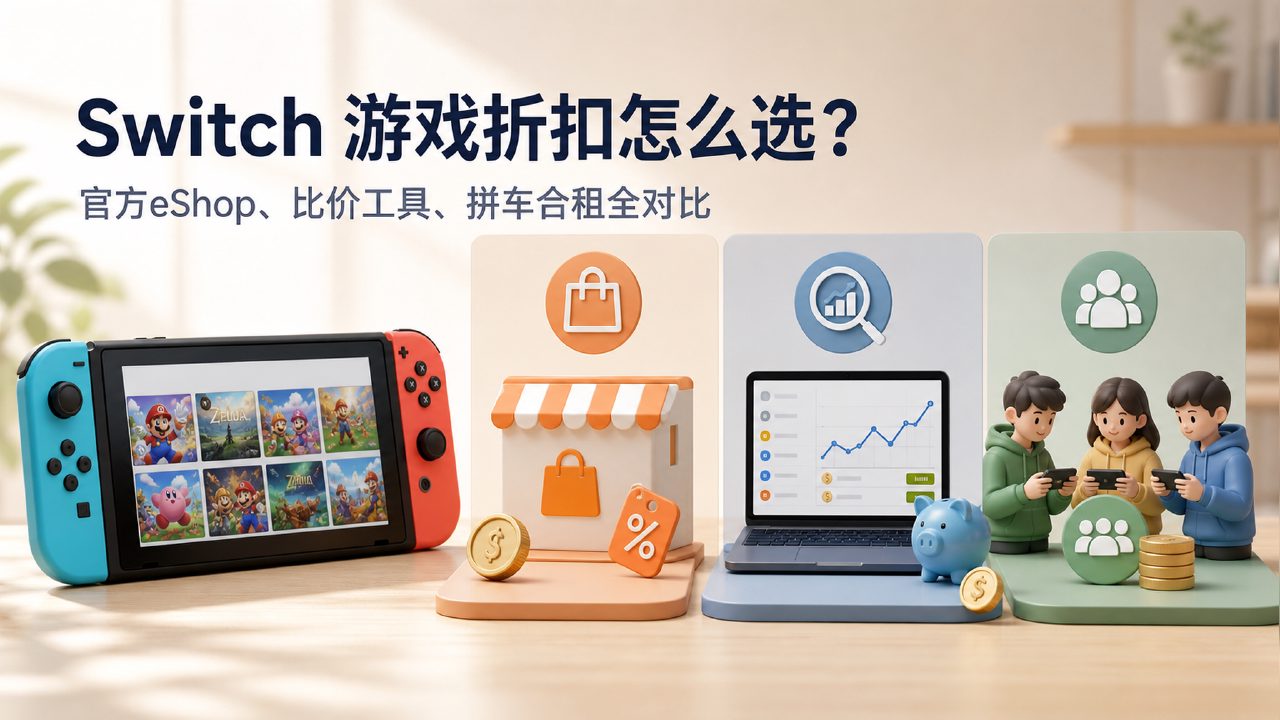
Currently, there are three main approaches to getting discounted games: lurking on the official eShop, using third-party price comparison tools, and community-based carpooling or sharing. It's meaningless to simply say which is best; it depends on what kind of player you are.
Official eShop Discounts: Stable but Not Smart Enough
Nintendo's own eShop updates frequently, with several rounds of new discounts almost every month. But the experience is far from user-friendly—slow loading,混乱分类, and having to switch accounts for Japan, US, and Hong Kong servers. The worst part is that it only tells you "this game is cheaper now," but not "this game's historical lowest price."
Often you see a 30% off and think it's a good deal, only to find out later the historical low was 50%. This information gap is something eShop itself cannot solve. If you only stick to official channels, at least learn to use Dock mode to connect your Switch to a large screen, then browse the web version of eShop for comparison—it's a bit smoother. But for beginners unfamiliar with historical low prices, relying solely on watching discounts can easily miss truly worthwhile opportunities, especially those Switch game recommendations hidden in the discount list, which might be overlooked due to complex pricing logic.
Third-Party Price Comparison Tools: Comprehensive Data but No Choice Advice
For more experienced players, using third-party websites or apps to check discounts has become a habit. These tools can directly list the historical low across regions, the current lowest price, and price trends. They are efficient, but have a clear drawback: they only care about price, not whether the game suits you. That is, you might find a very cheap "XX Adventure," but then realize it's a single-player narrative game you don't enjoy at all, making the discount meaningless.
This brings up a key issue: Discount itself cannot be the sole basis for decision-making. Cheap is one thing; worth playing is another. What you really need is someone to combine discount information with the game's quality, genre, and suitable scenarios. Pure price comparison tools cannot do this; instead, some community-based platforms do it better.
For example, Xingba is doing something that adds a layer of filtering on top of discounts. It not only tells you which games are on sale but also combines community-based Nintendo game recommendations, two-player Switch game recommendations, indie game recommendations, etc., as cross-references to help you judge whether the discounted game is worth your time. For instance, you see "Overcooked" is on sale again. If you have a regular co-op partner, this kind of two-player Switch game is a masterpiece; if you're always solo, no matter how cheap, don't touch it.
Additionally, it has game encyclopedias and game rankings features, allowing you to check data and reviews on the same interface without switching apps. For games you're somewhat interested in but not sure about, a quick look at player ratings and short reviews in the encyclopedia gives you a good idea.
Community Carpooling and Sharing: Extreme Savings but with Trust Costs
Another hidden cost-saving path for digital games is "carpooling"—several people sharing one account or a family membership. This method can significantly reduce the cost per person, especially for full-price AAA games costing $60. But the problem is practical: who manages the account? What if someone changes the password? Who is responsible if online services are interrupted?
The price of cheapness is trust cost. Carpooling with complete strangers carries a high risk of things going wrong. In contrast, a community with management mechanisms, user rating systems, and a certain player reputation can reduce this risk to an acceptable level. Using a platform like Xingba, at least each member of a carpool team has basic credit records, and there are channels to communicate if issues arise—unlike on forums or second-hand trading groups where it's all luck.
Also, issues related to the Dock interface are easy to stumble upon in carpooling scenarios—for example, some games require online verification. If your Switch is always in Dock mode connected to the TV, it auto-connects to the internet on startup, which can conflict with the verification mechanism of shared accounts. Many carpool users only discover this after the fact.
So Which One to Choose?
There is no one-size-fits-all solution, but there are practical combinations that suit you:
If you only buy AAA games and don't mind waiting for discounts → Official eShop discounts + historical low queries are enough, plus at most an email alert tool. If you want to try everything, have a limited budget, and don't want to miss indie game gems → It is recommended to use community tools as the main entry point, because beyond discounts, they also provide reference value from game rankings and indie game recommendations. If you want to share costs with friends → Find a carpooling service with management mechanisms; don't form groups privately with strangers.
Discounts are not the goal; playing the games you want is. Don't buy a pile of digital games you never touch just because they're cheap—that's more wasteful than buying a game you finish at full price.
Comments
Leave a Comment