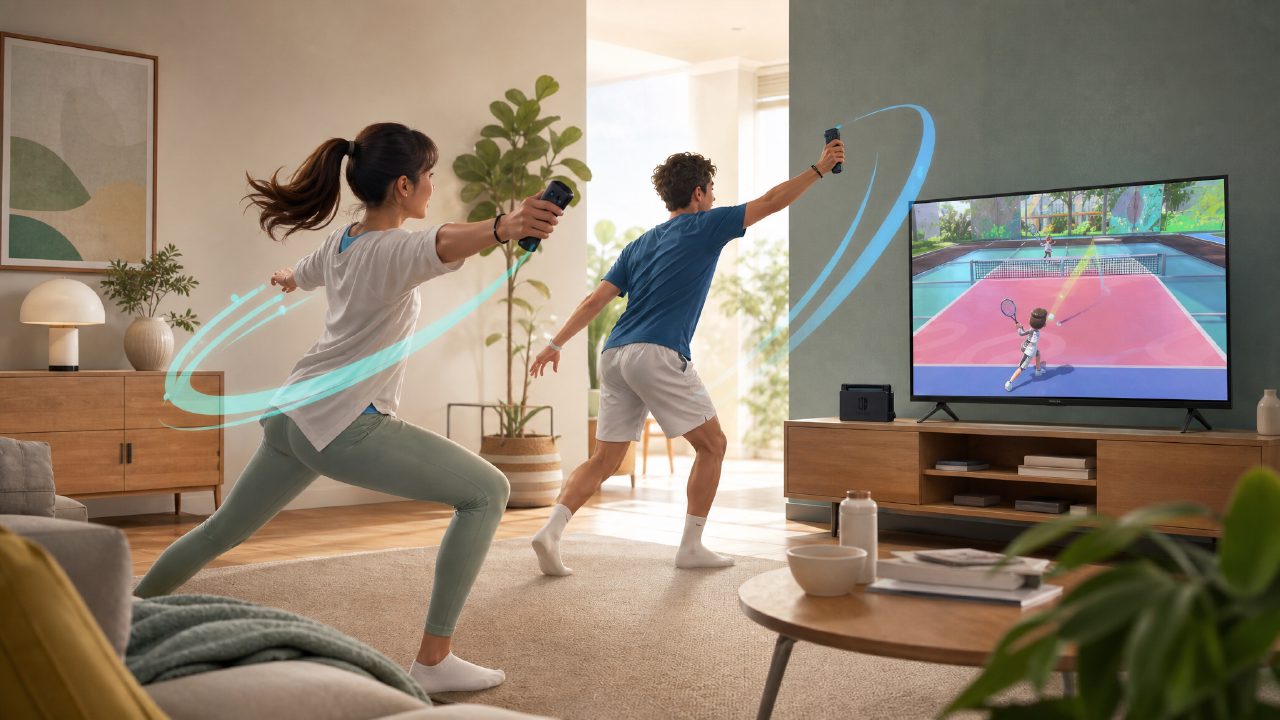
After a month of playing Switch Sports, I have to get some things off my chest
Before buying a Switch, I didn’t have high expectations for the console’s motion-controlled sports games. I tried Ring Fit Adventure at a friend’s place twice and couldn’t stick with it. Motion control always felt more like a gimmick than something truly practical. But this time, after moving to a new place and having an empty space in the living room, I figured I couldn’t just sit around playing Zelda every day, so I bought Nintendo Switch Sports. It’s been a full month now, and I usually play a match or two after work every day.
Let me start with the conclusion: It’s not a substitute for Ring Fit Adventure, nor is it a hardcore sports simulator. It’s more like a game that “makes you want to stand up and move,” and behind that “want” lies a very low barrier to entry and surprisingly good wrist feedback.
How accurate is the motion control? Tennis and bowling are the most convincing
The first time I played tennis, I instinctively swung my arm wide like in real life. The result: the character’s movement was a beat slow, and the ball often went out of bounds. Later I realized the key is the timing of your wrist movement—swinging your whole arm too much actually causes lag. You don’t need to actually run; by standing still and controlling the ball path with your wrist angle and swing rhythm, you’re good. Bowling feels even closer to real life—the spin direction the moment you release the ball depends on the tilt angle of the Joy‑Con when you let go. I tried curving the ball into the side pins, and it worked about 60% of the time, which was already impressive.
But badminton and fencing are less reliable. In badminton, smash attacks are often misread as flat drives, especially when both players are flailing in front of the screen—the Joy‑Con sometimes “doesn’t know which input to follow.” Fencing is even more luck-based: moving forward and backward uses the analog stick, attacking uses a swing, but when your opponent crouches and thrusts, you might not react in time—this isn’t about motion lag; it’s purely that the control logic isn’t intuitive enough.
Single-player and multiplayer are two different games
When playing alone, online matchmaking is the only fun part. The matching speed is decent—most of the time you find an opponent within 30 seconds. But there’s one issue: you never know if the opponent is a real player or someone idling for XP. I’ve encountered opponents who didn’t move the entire match, and winning felt meaningless. Also, when playing tennis solo, you control two characters by yourself, and the AI handles the positioning. Sometimes watching your AI teammate freeze and lose points is frustrating.
Multiplayer mode is completely different. Playing volleyball face-to-face with a friend is the most joyful experience. One person sets, the other spikes—mistakes in coordination make you laugh so hard you might drop the controller. I strongly recommend that if you’re thinking of buying it, make sure you have at least two people to play with. At its core, this is a two-player Switch game—its greatest value lies in living room socializing, not solo competition. If you often spend time alone, it’ll likely gather dust.
A note about Dock mode and Controller accessories
You might think using a Pro Controller would give a better experience? Absolutely not. The Pro Controller lacks motion sensing, so it won’t work. You have to use Joy‑Cons. I’d also recommend buying an extra pair of official wrist straps—Joy‑Cons can easily slip out of your hand when swinging, and I’ve nearly thrown one at the TV once. If you often play in the living room, consider getting a Controllers-specific wrist strap set; the official ones secure much better.
Also, if you play on a big screen using Dock mode, don’t stand too far away. Motion sensing is quite sensitive to distance—if you’re more than two meters from the TV, the Joy‑Con signal might drop out briefly, which is annoying when it happens during a crucial point. Handheld mode doesn’t have this issue, but the screen is too small—two people crowded together can’t see the ball clearly.
Is the game content worth it? Make sure you understand this before buying
Switch Sports launched with six sports: tennis, bowling, volleyball, badminton, fencing, and soccer. Soccer was added later and requires an extra leg strap (or you can stuff the Joy‑Con in your pocket as a workaround). The amount of content is indeed somewhat limited—if you play an hour a day, you’ll probably master all the sports in about two weeks. The post-launch rewards are mainly clothing and accessories, which don’t affect gameplay.
So is it worth it? My take: It depends on how long someone in your living room is willing to play with you. If you have a group of friends who come over for gatherings every now and then, this game will keep you laughing for half a year—it’s definitely a social staple in Nintendo game recommendations. If you’re alone looking for an excuse to move a bit, I’d suggest checking out indie game recommendations for more immersive solo experiences, or just go for Ring Fit Adventure.
In fact, if you check user reviews on game rankings, you’ll see that high scores mostly say “So fun playing with friends,” while low scores say “Boring alone.” That pretty much says it all.
A few practical tips from someone who learned the hard way
- Confirm you have space to stand and swing your arms before buying: You need at least 1.5 meters of clear space in front of the TV, or you’re bound to break something.
- Volleyball and tennis are the most replayable: Badminton and fencing lose their novelty quickly; soccer requires an extra accessory.
- Online mode requires a Nintendo Switch Online membership: If you don’t have one yet, consider a family membership sharing plan from Xingba, which is much cheaper than an individual plan. You can see the comparison of membership tiers in their game guide.
- Don’t expect it to help you lose weight: The motion control burns few calories—an intense hour of play is roughly equivalent to a walk. It’s more like an “activity to get sedentary people to stand up occasionally,” not a replacement for exercise.
Finally, if you’re buying a Switch and planning to use it as a sports machine, I’d suggest pairing it with one or two other game genres. The console’s real value lies in its diversity—today sports, tomorrow adventure, the next day multiplayer with friends. Sports is an indispensable piece of that puzzle, but it shouldn’t be everything.
Comments
Leave a Comment