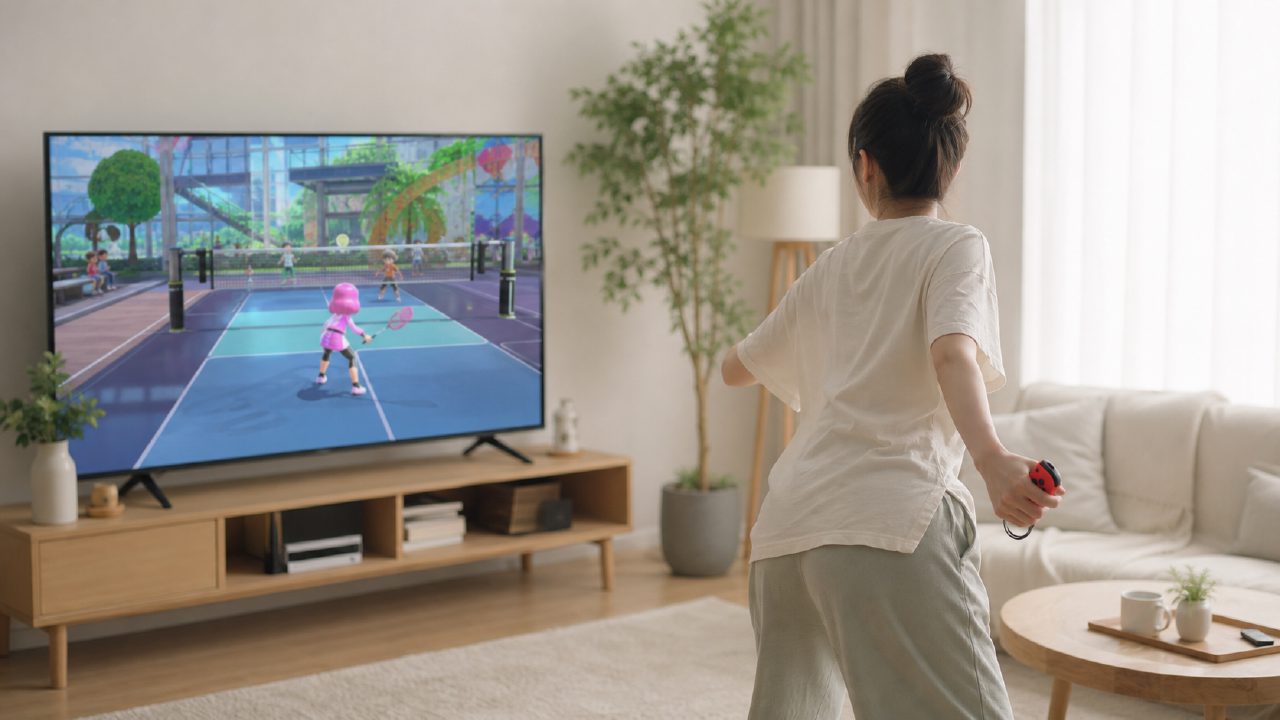
You might not believe it, but my motivation for buying "Nintendo Switch Sports" was very straightforward—I wanted to break a sweat at home without having to lay out a yoga mat and change into workout clothes every time like with Ring Fit Adventure. Simply put, I wanted to move a little in a lazy way.
I started with tennis. It's the easiest event to pick up, and the motion feedback is far ahead of the Wii era. You don't need a big swing; a slight flick of the wrist and your in-game character can hit sharply angled shots. But the problem is, it easily gives you the illusion that "I'm playing well." That is, until I matched against players who were clearly regulars on the Nintendo game recommendations list. Their topspin shots bounced fast and low after landing, and I couldn't return a single one. That's when I realized Sports actually has considerable depth—you can't just fling the controller around and win.
Speaking of the wrist strap, I initially found it annoying and didn't use it. Then after three games of bowling, the right Joy-Con nearly flew out of my hand and hit the TV. No joke—I strongly recommend checking it every time you start up. Bowling is the event in Sports that feels closest to the real thing. The aiming and spin mechanics are finely tuned, but the problem lies there: if you brush the edge just a tiny bit too hard, the ball slides straight into the gutter. That "so close" frustration hurts more than completely missing.
The soccer mode was added in a later update and requires the leg strap. Honestly, I played three matches with the leg strap and haven't touched it since—not because it's no fun, but because running around the living room kicking at nothing is just too awkward. Plus, if your living room isn't wide enough, you'll easily kick the couch or a corner of the wall. The game itself is fine—it's the space limitation that's to blame. If you have limited room, this mode will likely collect dust.
What surprised me the most was volleyball. It's fast-paced and requires two players to coordinate on blocking, spiking, and receiving—hesitate for a moment and you're giving away points. This is probably the best event among all the current ones to recommend as a two-player Switch game to friends. Playing locally with two people is much more fun than online matching. However, the serve in volleyball is a bit confusing—you have to toss the ball first, then swing, and if the timing is slightly off, the ball won't make it over the net. It took me about two or three games to figure out the coordination between toss height and swing rhythm; the guidance isn't very intuitive.
Speaking of online matching, that brings up network stability. If you're using Wi-Fi, you'll occasionally encounter lag. You can see your character swing, but the sound of the hit comes half a second later. By then, your opponent has already scored. I later switched to a wired connection (or used the Dock's Ethernet port), and it improved a lot. If you care about your win rate, I recommend prioritizing a wired connection.
There's another trade-off worth mentioning: if you play alone, most events rely on online mode to keep things fresh. Local single-player just means grinding against CPUs, and after a dozen hours, the CPU opponents' patterns start to repeat. So if you're mainly playing solo, there are actually plenty of Switch game recommendations for single-player indie game recommendations that might be a better choice than Sports. The real value of this game is when friends come over on weekends, or if you're willing to join online communities for matches.
If you want to see what tricks players have come up with for each event, check out the game leaderboards. High-score players in bowling and tennis are already pulling off moves so fast that you'd wonder if they're cheating. Of course, that's from practice, not something built into the game. If you want to study the technical details of each character, the game encyclopedia has some data-like info, but honestly, the game itself doesn't tell you much—you have to find it in the community.
Finally, a practical issue: the durability of the Joy-Con. Sports relies heavily on motion controls, meaning you swing the controller frequently. After about two months of use, the left Joy-Con's joystick started drifting. If you play often, I'd suggest having a spare pair of Joy-Con ready, or buy the digital version during an eShop sale and save the money for replacement controllers.
Overall, Sports is a game with "a low entry threshold but a high ceiling." It can make you sweat, but it won't make you question your life choices. It has social value, but the single-player content is thin. The motion controls are much better than the previous generation, but it makes demands on both the controller and your environment. If you can accept all that, then it's a game worth keeping in the cartridge slot.
Comments
Leave a Comment