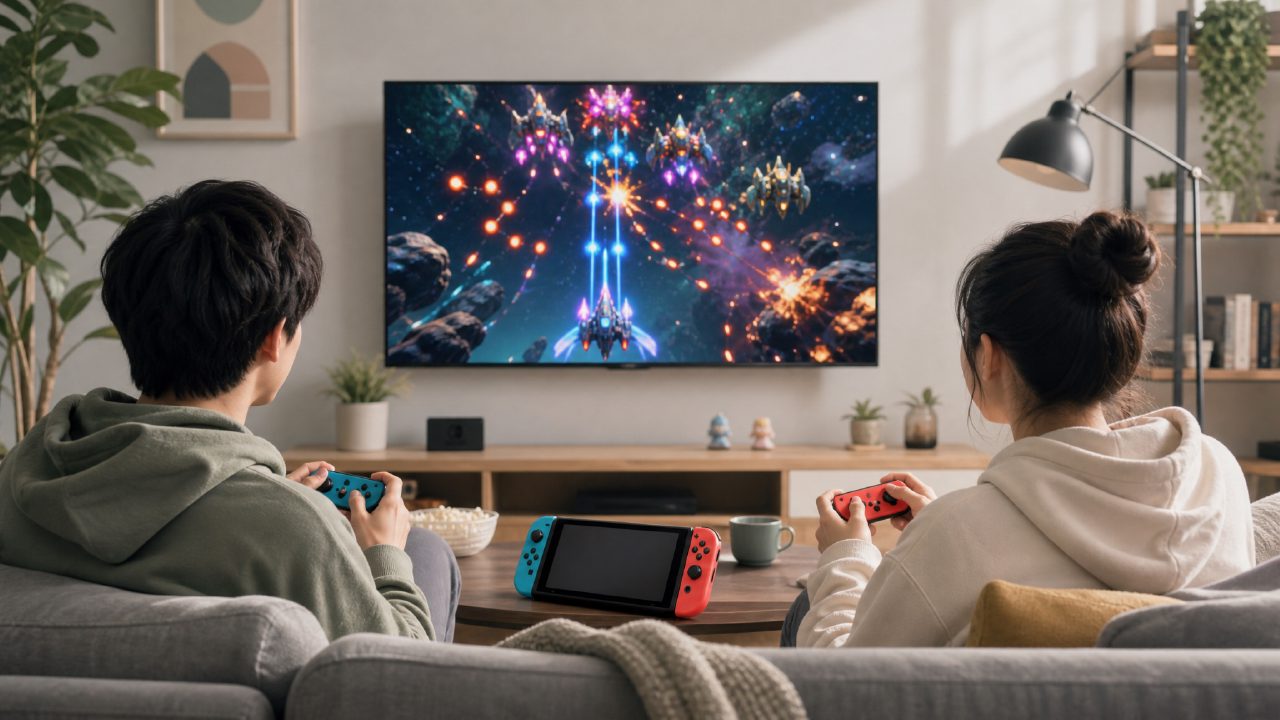
Pursuing High Score on Switch: 5 Directions Worth Paying Attention To
After playing Switch for a long time, many people gradually shift from "just clear the game" to "play one more time, get a higher score." High Score is not just a nostalgic symbol of the arcade era; it still has very real appeal in today's eShop and physical cartridges. But the question is: There are many fun games on Switch, but which ones are truly worth replaying for scores? Which ones are just surface-level excitement that you'll get bored of after a few rounds? I've compiled 5 directions to help you decide.
-
Classic high-score games, suitable for fragmented time
If you only have a dozen minutes for commuting or lunch break each day, the traditional high-score mechanism is actually the best solution. For example, rhythm games or shoot 'em ups take just two to three minutes per round, but getting into the top ten on the leaderboard may require dozens of hours of practice. There are many such indie games on eShop, but quality varies. My suggestion is to first check game rankings — community-filtered lists can directly filter out those filler games with stiff controls and weird hit detection. For example, games like Downwell are easy to pick up, but the rhythm of each jump and resource management determine your final score, making them very suitable for repeated challenges.
(Here naturally appears: game rankings) -
Co-op High Score is more fun than solo
High Score doesn't have to belong to just one person. Many two-player Switch games are designed with a combined score mechanic — your and your friend's individual scores add up to a total, or you take turns in a relay. In this mode, the score is no longer a cold number but a signal of coordination. For example, the Overcooked series doesn't have a traditional scoreboard, but the rating after each level is essentially a high-score driver. Other arcade port games are more direct: two players share one console, taking turns, and it's immediately clear who is holding back, but that actually provides more motivation than solo grinding. The downside is that once you find a regular partner, you might end up arguing over coordination mistakes — and I mean really arguing, not joking.
(Here naturally appears: two-player Switch games) -
High-score gameplay in indie games is often underestimated
Big companies' high-score modes are often packaged in "all achievements" or "platinum trophies," but indie game recommendations often retain purer high-score designs. No complex upgrade systems, no plot interference — you start with a gun (or a mouth), and everything else relies on skill and judgment. For example, the Spelunky series: each round is a randomly generated dungeon, and your goal is to survive, grab as much treasure as possible, and escape. Its charm lies in the fact that you never know what the next level will be, but your experience value (yes, your own, not the character's) slowly grows. The problem with such games is that they are not beginner-friendly; you might not even see the second level in the first few dozen hours. But if you enjoy the feedback of "gradually getting better," it's more substantial than any fragmented gacha system.
(Here naturally appears: indie game recommendations) -
Use Switch game recommendations and game encyclopedia to find the high-score type that suits you
Not all High Score games are right for you. Some people like memorizing patterns — learning the spawn points of monsters and item drop rules for each level, like the high-score mode in Tetris Effect; others prefer adapting on the fly, like battle royale or auto-chess high-score rankings. How to decide? You can browse Switch game recommendations sections for posts marked "for high-score enthusiasts," or use a game encyclopedia to filter by "scoring method" — with tags like "combo bonus," "time reward," "no-damage bonus," etc. A friend of mine used this method to find Puyo Puyo Tetris 2 that suited him, and now he's in the top 200 of the Southeast Asian server. Of course, the downside is his girlfriend says he might as well marry his console.
(Here naturally appears: Switch game recommendations, game encyclopedia) -
High-score classics in Nintendo game recommendations, why they're worth replaying
When it comes to High Score, you can't avoid Nintendo's own IPs. From the limited-time coin challenges in the Super Mario series to the Trial of the Sword speedruns in The Legend of Zelda: Breath of the Wild — these aren't traditional scores, but they are essentially about getting the highest rating in the shortest time. Looking at Nintendo game recommendations lists, you'll find that many old games' high-score modes still haven't had their optimal paths cracked. For example, in Mario Kart 8 Deluxe's time trials, the best route for each track has been optimized tens of thousands of times by players worldwide; even being 0.1 seconds faster can put you near the top. The downside of such games is a steep learning curve, but the positive feedback is strong — every time you beat your personal best, the satisfaction is incomparable to buying a new game.
(Here naturally appears: Nintendo game recommendations)
Let's be practical
Pursuing High Score is a lonely but addictive path. If you're just casually playing, there's no need to torture yourself grinding the leaderboards. But if you enjoy the sense of control from "getting a little better each time," then pick a game on eShop that has good rhythm, solid controls, and an active leaderboard, and let time do the rest. Remember to occasionally check game rankings to see community trends, and Switch game recommendations for player insights — sometimes a single technique can save you dozens of hours of trial and error.
Comments
Leave a Comment