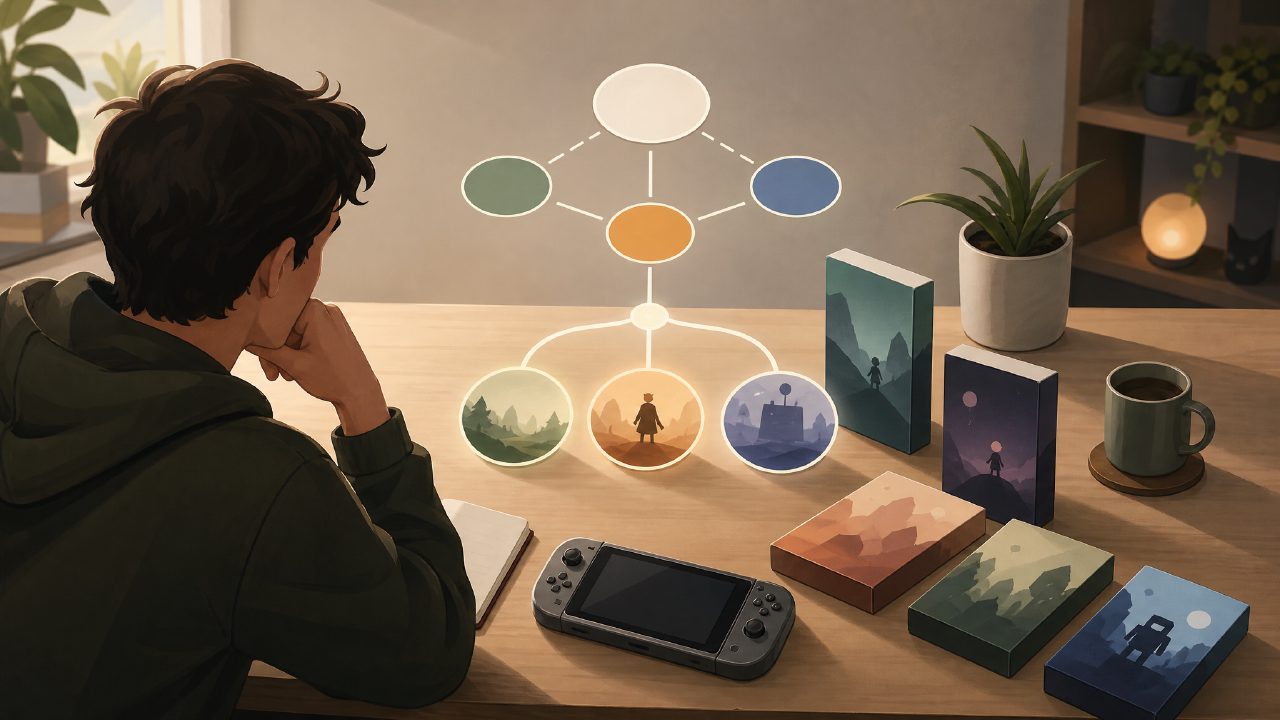
Can't find a good game? Confirm these things first
Most people get stuck for a simple reason: they haven't clearly figured out what type they want, or their filtering method is too random. You browse the store, read reviews, ask friends, and after all that, you still don't know what to play. You're not alone in this.
When you want to find a game to play, the first step isn't opening a platform—it's asking yourself three questions: How much time do you have right now? Are you playing alone or with friends? What exactly was it about the games you've recently enjoyed that hooked you? Once you lock down these three answers, you can eliminate at least 60% of the unsuitable options.
Q: Where is the most reliable place to find games?
Simply browsing "hot" or "recommended" sections in the store can lead to pitfalls, because algorithms tend to push titles with high marketing weight. A more reliable path is: first check game rankings for historically well-reviewed lists to filter out inflated launch scores; then cross-reference with game catalogs sorted by specific genres—like "JRPG," "Roguelike," or "Strategy Turn-Based"—tags that actually matter to you. Combining both gives you a much higher hit rate.
Q: What's really worth playing on Switch right now?
If you have a Switch, don't just focus on newly released blockbusters. Many classics that repeatedly appear on Switch game recommendation lists, like The Legend of Zelda: Breath of the Wild and Animal Crossing: New Horizons, are still excellent. If you're playing with friends, two-player Switch games are a great direction—Overcooked, Luigi's Mansion 3, and Super Mario Party are proven combos. Don't think "they're too old." Games aren't clothes; how fun they are has nothing to do with release date.
If you're a Nintendo fan, Nintendo game recommendations essentially come with an entry threshold—if you accept their style and pricing system, you won't be too disappointed. But if you're indifferent to cartoon aesthetics or lighthearted gameplay, forcing yourself to buy will only waste your money.
Q: Are indie games worth spending time on?
Yes, but only if you know what you're picking. The advantage of indie games is that their creativity and gameplay feel are often sharper than mass-produced blockbusters, but the downside is inconsistent content volume and varying visual quality. I suggest starting with classic titles that frequently appear on indie game recommendation lists, such as Hollow Knight, Slay the Spire, and Stardew Valley. One common misconception: don't lower your expectations for completeness just because it's "indie." A good indie game should feel complete when played, not "creative but unfinished."
Q: How do I judge whether a game is right for me?
Looking at store screenshots and descriptions is mostly useless. You need to do two things: first, find a walkthrough video of at least 15 minutes (not a highlight reel) to see the actual pacing and feel; second, go to game catalogs or review sites and read the neutral and negative reviews. The complaints from those low ratings are often what you should really care about. For example, someone saying "the story is too slow," "too little guidance," or "the difficulty curve is broken" is far more valuable than a five-star review praising "beautiful graphics."
Q: If my budget is limited, how do I get the best value?
Prioritize cross-platform games and genres that support long play sessions. Roguelikes, survival-crafting, and simulation-management have the highest fault tolerance because single sessions are short or content is replayable. Many titles on indie game recommendation lists cost only one-third or even one-fourth of a big-budget title, yet easily provide over 50 hours of gameplay. In contrast, linear narrative blockbusters offer great experiences but usually gather dust after finishing. If you only buy two or three games a year, the latter are worth it; if you play every week, the former are more cost-effective.
Ultimately, finding a game to play has no universal formula. By changing your filtering path from "blind guessing" to "first use game rankings to subtract, then use game catalogs for precise matching," you're already ahead of most people. As for which specific game to choose, it depends on how much trial-and-error cost you're willing to invest for your next weekend.
Comments
Leave a Comment